Parking Lot Bollard Installation Calculator
Calculate bollard count, material cost, and installed price for parking lot perimeter protection, storefront vehicle barriers, and drive-through lane dividers. Includes surface mount, core-drilled embedment, and concrete-filled steel pipe bollards.
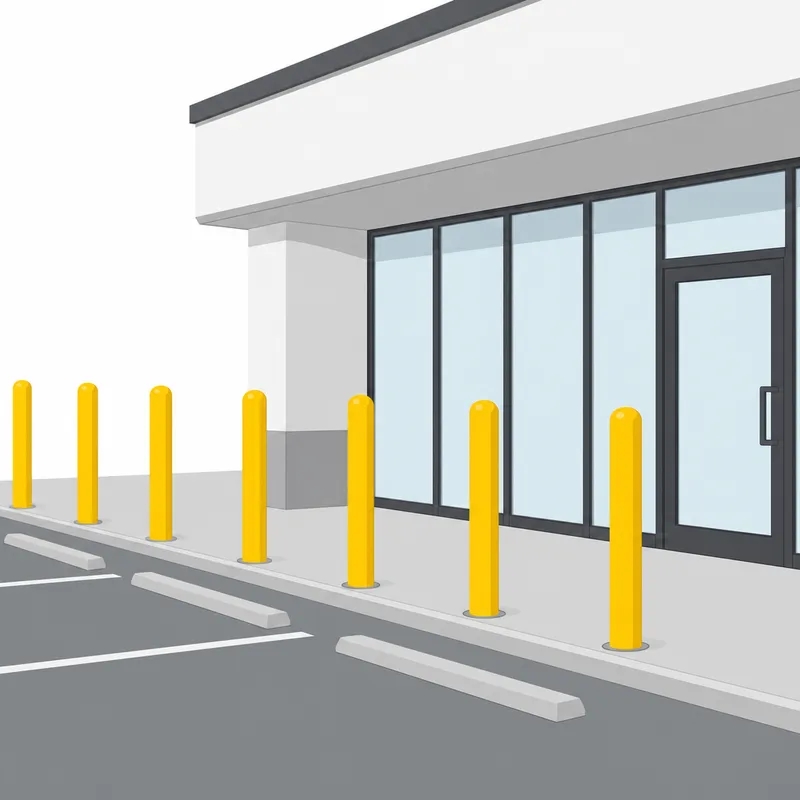
Bollards protect storefronts, pedestrian zones, and utility equipment from vehicle impact — but installation cost varies sharply by mount type, bollard material, and whether concrete work is required. The EstiCube bollard calculator breaks down what commercial site contractors include: bollard supply, core drilling or anchor plate mounting, concrete fill, rebar cages, and finish paint.
Enter bollard count, choose installation method and bollard type, and add optional items like removable sleeves, reflective tape, or crash-rated foundations. Results show per-unit and total installed cost based on 2026 US commercial averages.
Bollard installation cost per unit
Bollards are quoted per unit installed. Labor below assumes core-drilled installation into existing pavement, the most common method on finished lots.
| Bollard type | Material | Labor | Installed cost each |
|---|---|---|---|
| Flexible poly bollard | $95 | $85 | $180 |
| Steel pipe, concrete filled | $185 | $225 | $410 |
| Precast concrete bollard | $220 | $195 | $415 |
| Removable sleeve bollard | $320 | $275 | $595 |
Surface mounting saves about $35 per bollard; a deep-set concrete footing adds about $55. Painting or a decorative sleeve adds $35 each, mobilization is $275, and the minimum job charge is $400.
How much does bollard installation cost?
Commercial bollard installation in the United States typically costs $350–$950 per bollard installed, depending on mount type and bollard specification. Surface-mounted steel bollards on anchor plates run $350–$550 each. Core-drilled embedment bollards with concrete fill cost $550–$850 each. Crash-rated (K4/K12) bollards with engineered foundations start at $1,200–$3,500 per unit.
Material costs: standard 4-inch schedule 40 steel pipe bollards (42–48 inches above grade) cost $80–$180 each before installation. Concrete fill adds $25–$45 per bollard. Removable bollard sleeves with internal locking posts add $200–$400 per location. Decorative architectural bollards (stainless, powder-coated, or cast iron) run $300–$800 per unit before install labor.
Mobilization for bollard projects under 6 units often triggers minimum charges of $450–$750 for core drill rig, concrete truck, and crew travel. Bulk storefront installations of 10–20 bollards drop per-unit cost by 15–25% through shared mobilization.
Bollard types and installation methods
Surface mount: steel base plate anchored into existing concrete with epoxy-set anchors or wedge anchors — fastest and least invasive, suitable for light protection where no vehicle overhang occurs. Requires minimum 6-inch concrete slab; not rated for high-speed impact.
Core drill embedment: 8–12 inch diameter hole cored through pavement or sidewalk, bollard set in non-shrink grout or concrete with rebar tie-in — standard for storefront protection and parking lot perimeter. Depth typically 24–36 inches below grade with 36–42 inches exposed.
Concrete-filled steel pipe is the most common commercial spec: 4–6 inch diameter pipe filled with 4,000 PSI concrete for rigidity, capped and painted safety yellow or property-matched color. Removable versions use an internal sleeve with padlock or key access for delivery vehicle access.
Our calculator covers standard fixed steel bollards — the workhorse for retail pad protection, gas pump islands, and loading dock corners. Crash-rated bollards require engineered drawings and are priced separately.
Bollard spacing and code requirements
Storefront protection bollards are typically spaced 4–5 feet on center along building faces vulnerable to vehicle overhang — enough to stop a car bumper but not so close that pedestrians cannot pass. Corner locations always get a bollard; spacing tightens near ADA ramps and main entries.
Parking lot bollards protect light poles, fire hydrants, electrical cabinets, and HVAC equipment. Place bollards 3–4 feet from the protected asset on the traffic side. Drive-through lane dividers use linked bollard chains or continuous curb instead of individual posts.
Local fire codes may restrict bollard placement near fire lanes and hydrant access — maintain required clearances per IFC and AHJ. Reflective tape or bollard covers improve night visibility and reduce liability from pedestrian impact with unmarked posts.
How to use the bollard calculator
- Count bollard locations needed — walk the site or mark storefront faces, equipment pads, and lane dividers.
- Select installation method: surface mount on existing slab or core-drill embedment into pavement.
- Choose bollard type: standard steel pipe, removable sleeve, or decorative architectural.
- Set bollard height and diameter — 4-inch pipe at 42 inches above grade is the commercial default.
- Add optional items: concrete fill, safety yellow paint, reflective tape, or bollard covers.
- Review per-unit cost, mobilization, total material, labor, and project price for your bollard count.
Bollard installation calculator FAQ
How much does it cost to install one bollard?
A single standard steel bollard costs $350–$950 installed in 2026. Surface mount on anchor plates runs $350–$550. Core-drilled embedment with concrete fill costs $550–$850. Removable bollard systems add $200–$400 per location. One-off installs often hit $750–$1,000 minimum due to mobilization for core drill and concrete.
Surface mount vs core drill — which bollard installation is better?
Core-drilled embedment provides stronger impact resistance — the bollard is set 24–36 inches into pavement or footings with concrete grout. Surface mount is faster and cheaper on thick existing slabs where full penetration is impractical. Storefront protection specs almost always require core-drilled, concrete-filled bollards. Surface mount suits interior warehouse column protection and low-speed areas.
How far apart should parking lot bollards be spaced?
Space storefront protection bollards 4–5 feet on center along vulnerable building faces. Standard passenger vehicles cannot pass between bollards spaced under 4 feet. Wider spacing (5–6 feet) works where only bumper overhang is a concern. Always place bollards at building corners and within 3 feet of protected assets like gas pumps and electrical cabinets.
What size bollard pipe is standard for commercial use?
4-inch schedule 40 steel pipe (4.5 inch OD) is the most common commercial bollard — 42–48 inches above grade, concrete filled. Heavy-duty storefront protection may specify 6-inch pipe. Decorative architectural bollards come in cast iron, stainless, and polymer composites in equivalent impact ratings. Match diameter to expected vehicle type and speed.
Do bollards need to be concrete filled?
Yes for impact-rated protection. Empty pipe bollards bend or shear at the base on vehicle contact. Concrete fill (4,000 PSI) adds rigidity and weight so the post transfers impact force to the foundation rather than folding. Surface-mounted decorative bollards may omit fill when specified as visual guides only — not impact protection.
How much do removable bollards cost?
Removable bollard systems with internal locking sleeves cost $550–$1,200 installed per location — $200–$400 more than fixed bollards for the sleeve hardware and precision core drilling. Padlock, key, or internal lift mechanisms allow temporary removal for delivery truck access. Popular at loading docks and event venue entrances.
Can bollards be installed in asphalt?
Yes — core drill through asphalt and compacted base into stable subgrade, then set bollard in concrete grout. Asphalt-only mounting without penetrating to concrete or gravel base fails under impact. For asphalt parking lots, specify full-depth core drilling with non-shrink grout. Surface mount anchor plates work only on concrete pads and sidewalks, not flexible asphalt surfaces.
What are crash-rated bollards and when are they required?
Crash-rated bollards (ASTM F2656/K-rating) stop vehicles at defined speeds and impact angles — required at federal buildings, airports, and some retail pad corners per local ordinance. K4 bollards stop a 15,000 lb vehicle at 30 mph; K12 at 50 mph. Engineered foundations with rebar cages cost $1,200–$3,500+ per bollard. Standard steel pipe bollards are not crash rated.
Sources
- F3016/F3016M Standard Test Method for Surrogate Testing of Vehicle Impact Protective Devices at Low Speeds — ASTM International
- F2656/F2656M Standard Test Method for Crash Testing of Vehicle Security Barriers — ASTM International
- NFPA 1: Clearance Around Fire Hydrants — National Fire Protection Association
Related calculators
Projects often planned together — jump to a related estimator for the next line item.
Striping
Estimate pavement marking linear feet, traffic paint gallons, and striping cost. Includes stalls, ADA symbols, fire lanes, arrows, and mobilization.
Wheel Stop
Calculate rubber and concrete parking wheel stop supply and installation cost. Includes rebar pins, reflective stripes, and mobilization.
Signs
Estimate regulatory, ADA, stop, and wayfinding sign counts with posts, footings, and installation cost for commercial parking lots.
Epoxy
Calculate epoxy floor coating cost for warehouses and commercial spaces. Self-leveling, quartz, and metallic systems with grind prep and mobilization.
More commercial calculators
Striping, sealcoating, potholes, signs, sweeping & curbing
Explore all 4 categories
Browse every free EstiCube tool by project type — home builds, outdoor hardscape, landscape, and commercial pavement.
View full calculator directory