Drywall Calculator
Estimate drywall sheets, joint compound, tape, and screws for any room. Deducts doors and windows, supports 4×8 and 4×12 panels, optional ceiling, and finishing labor.
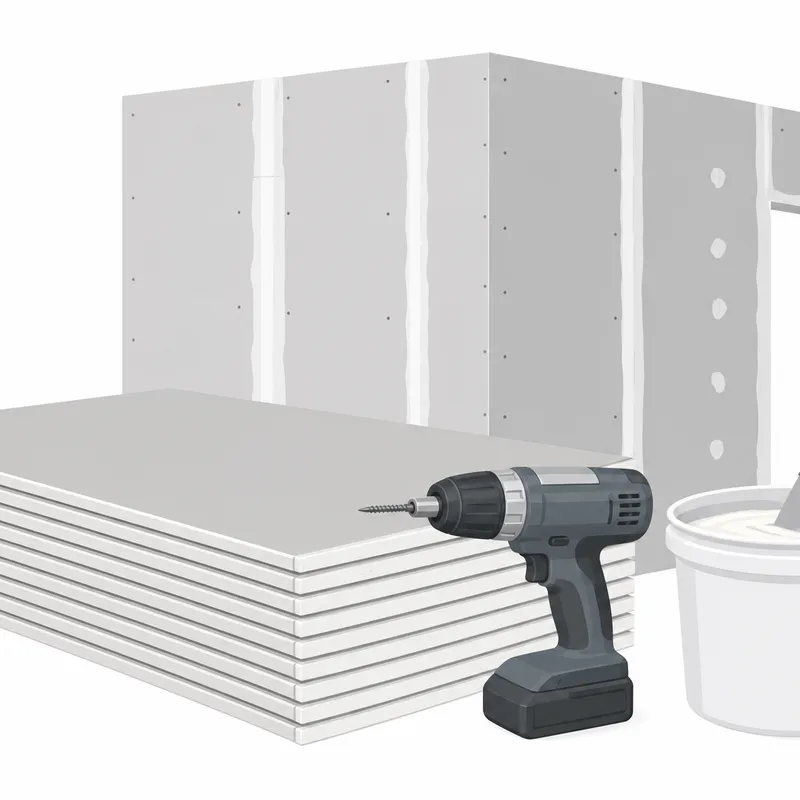
Ordering too few drywall sheets stalls your project mid-hang; ordering too many leaves bulky panels stacked in the garage. The EstiCube drywall calculator converts room dimensions into sheet count, mud, tape, screws, and a realistic budget using 2026 US material and labor averages.
Enter room length, width, and ceiling height, count doors and windows, choose sheet size and thickness, and get your full materials list before you visit the lumber yard or hire a finisher.
How much does drywall cost in the US?
Standard 1/2-inch 4×8 drywall sheets cost $12–$16 each at big-box stores in 2026; 4×12 sheets run $16–$22 and reduce seams on long walls. Joint compound runs $14–$18 per 5-gallon bucket. Paper tape is $4–$7 per roll; drywall screws cost about $0.30–$0.40 per pound.
A typical 12×14 ft bedroom with 8-ft ceilings needs about 14 sheets of 4×8 drywall after deducting one door and two windows — roughly $200 in materials plus 4 buckets of mud, 1 roll of tape, and 9 lbs of screws. Professional hang and finish labor adds $40–$55 per sheet installed.
Fire-rated 5/8-inch board costs 20–30% more than 1/2-inch and is required on garage walls, shared walls, and some ceilings per local code. Moisture-resistant green board suits bathrooms but is not a tile backer — use cement board behind shower tile.
Drywall materials per square foot
Plan one bucket of joint compound per 100 sq ft of finished surface for a standard Level 4 finish. Tape needs run about one 250-ft roll per 500 sq ft. Screws: roughly 1 lb per 40 sq ft when spacing 12 inches on walls and 8 inches on ceilings.
Add 10% waste for simple rectangular rooms; 15% for rooms with many corners, soffits, or angled ceilings. 4×12 sheets cut labor time on long runs but require two people to lift and are harder to haul in a pickup.
Drywall hanging and finishing tips
Hang ceilings before walls. Stagger vertical seams between rows so joints do not line up on the same stud. Keep screw heads slightly recessed without breaking the paper face.
Apply three coats of mud for a paint-ready Level 4 finish: tape coat, fill coat, and skim coat. Sand between coats when dry. Prime before painting — bare mud and paper absorb paint unevenly without primer.
How to use the drywall calculator
- Measure room length, width, and ceiling height in feet.
- Count doors (21 sq ft each) and windows (15 sq ft each) to deduct openings.
- Enable ceiling if you are drywalling overhead — ceilings use more screws per sheet.
- Choose 4×8 or 4×12 sheets and 1/2-inch or 5/8-inch thickness.
- Set waste allowance — 10% is standard; use 15% for complex layouts.
- Enable finishing labor to compare DIY material cost vs professional hang and tape.
- Review sheets, mud buckets, tape rolls, screw weight, and total estimate.
Drywall calculator FAQ
How do I calculate how many drywall sheets I need?
Add wall area (perimeter × ceiling height) plus ceiling area (length × width), subtract doors and windows, divide by sheet size (32 sq ft for 4×8, 48 sq ft for 4×12), and round up. Add 10–15% waste. Example: 12×14 room, 8-ft ceilings, one door, two windows ≈ 365 sq ft ÷ 32 = 12 sheets + waste ≈ 14 sheets.
How much joint compound do I need per room?
Plan one 5-gallon bucket per 100 sq ft of finished drywall for a standard three-coat tape-and-mud job. A 12×14 bedroom with 365 sq ft needs about 4 buckets. Lightweight all-purpose compound is easiest for DIY; setting-type compound dries faster for experienced finishers.
How many screws per sheet of drywall?
Walls: one screw every 12 inches on studs — about 32 screws per 4×8 sheet. Ceilings: every 8 inches — about 48 screws per sheet. Our calculator estimates roughly 1 lb of screws per 40 sq ft, which matches typical 1-1/4-inch coarse-thread drywall screws.
4×8 vs 4×12 drywall — which should I use?
4×8 sheets are easier to handle solo and fit in most vehicles. 4×12 sheets cover 50% more area per panel with fewer seams — ideal for long, straight walls when you have help lifting. Both are standard 1/2-inch thickness for interior walls.
When do I need 5/8-inch drywall?
Use 5/8-inch Type X fire-rated board on garage walls and ceilings, shared townhouse walls, and some commercial assemblies per IRC code. It is also stiffer for ceiling spans over 16 inches on-center. Most interior room walls use 1/2-inch regular drywall.
How much does it cost to drywall a room?
DIY material cost for a 12×14 bedroom runs $180–$280 for sheets, mud, tape, and screws. Professional hang and finish costs $600–$900 for the same room. Our calculator uses 2026 averages of $14 per 4×8 sheet and $45 per sheet for finishing labor.
Should I include the ceiling in my drywall estimate?
Include the ceiling if you are hanging new board overhead — ceiling area equals length × width. Ceilings require more screws and are harder to finish. If you are only patching walls, leave the ceiling unchecked.
How long does drywall finishing take?
Hanging a standard bedroom takes 4–8 hours for an experienced crew. Taping and mudding needs three visits over 3–5 days to let coats dry. Total DIY timeline is often 1–2 weekends; pros finish a room in 2–3 days including drying time.
Sources
- Understanding the Differences Between Type X and Type C Gypsum Boards — Gypsum Association
- Fire-Resistant Gypsum Panels: Single Family Homes — Gypsum Association
- Frequently Asked Questions (FAQs) — Gypsum Association
- Occupational Exposure to Respirable Crystalline Silica — Construction — Occupational Safety and Health Administration (OSHA)
- Dwelling-Garage Fire Separation (IRC Table R302.6) — International Code Council (IRC)
Related calculators
Projects often planned together — jump to a related estimator for the next line item.
Paint
Calculate how much paint you need for walls and ceilings. Gallons, primer, and painting cost for interior and exterior rooms.
Tile
Calculate tile count, boxes, thinset, grout, and install cost for bathroom and kitchen floors. Ceramic, porcelain, and natural stone.
Insulation
Calculate blown insulation bags or batts for attic, walls, and floors. R-value depth estimates with material and install cost.
House
Full home construction estimator — foundation, basement, framing, roof, MEP & finishes. Cost ranges for every building phase.
Siding
Estimate vinyl, fiber cement, wood, and aluminum siding cost per square foot. Includes trim, waste allowance, and installation labor.
More home & structure calculators
Whole-home builds, drywall, siding, insulation & finishes
Explore all 4 categories
Browse every free EstiCube tool by project type — home builds, outdoor hardscape, landscape, and commercial pavement.
View full calculator directory