Slurry Seal Cost Calculator for Parking Lots
Price a parking lot slurry seal by the square foot for a Type I, II, III or polymer-modified mix, with crack seal, sweeping, restriping, mobilization and a minimum job, with a written comparison against a sealcoat at the same area. Copy the share link, or switch to contractor bid mode to build a proposal.
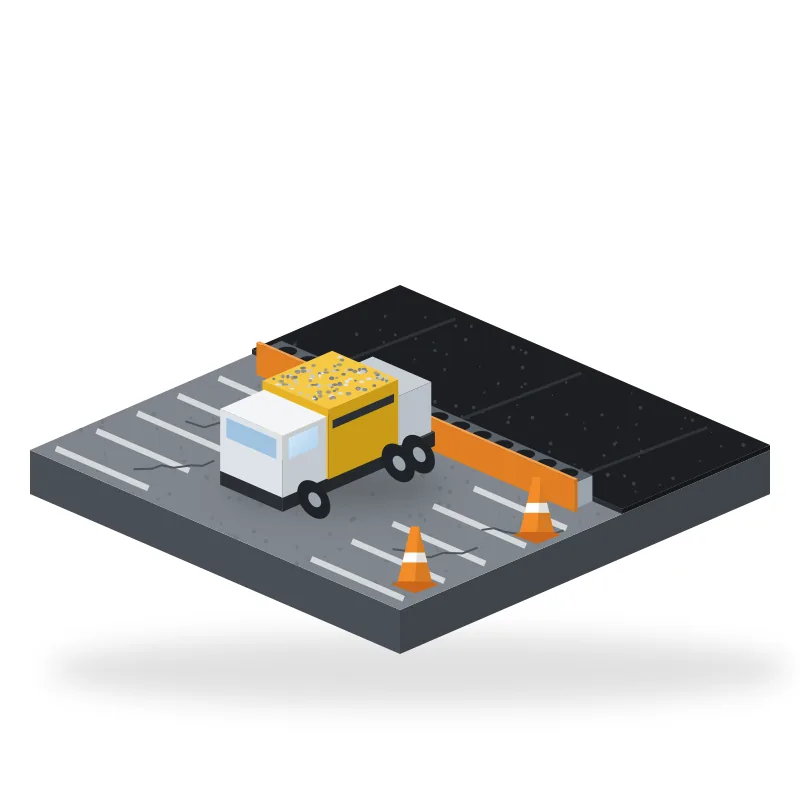
Slurry seal is a pavement preservation treatment that goes on an existing surface. The EstiCube slurry seal calculator prices the job as a short list of lines: sweeping, crack seal before the slurry, the slurry itself by the square foot for the mix you choose, and restriping by the stall afterwards. Mobilization is a charge on every job, and the $3,500 minimum is a floor that sets the price only when the job adds up to less.
Enter the lot area, pick a Type I, Type II, Type III or polymer-modified mix, and say how many linear feet of cracks to seal and how many stalls to restripe. The unit prices come from two public bid tabs, Sparks, Nevada (2025) and Peoria, Illinois (2023), and from the other EstiCube calculators; the Type I price is an estimate because no public Type I price was found. Public bids are municipal-volume prices, and a small private job usually prices higher, so the calculator carries that as the mobilization and the minimum job and, for Types II and III, by starting at the highest of the Sparks bids. This is an estimate, not a quote, and it does not decide whether your pavement is a candidate for slurry seal.
Comparing slurry seal with a standard sealcoat of the same lot? Use the sealcoating cost calculator. Restriping more than the stalls, with arrows, stop bars, crosswalks and accessible markings? Use the parking lot striping cost calculator. Deciding between the two treatments? Read the guide to slurry seal vs sealcoating.
Slurry seal cost: unit prices used
The slurry line is priced per square foot of lot, complete and in place, and the price depends on the mix. The examples use the default job: 40,000 sq ft (4,444.44 sq yd) of Type II, 800 LF of crack seal, sweeping, and 80 stalls restriped.
| Line item | Unit price | Notes |
|---|---|---|
| Type I (fine) slurry seal | $0.30 per sq ft | 40,000 sq ft, $12,000; an estimate, because no public Type I price was found |
| Type II (general) slurry seal | $0.38 per sq ft | 40,000 sq ft, $15,200; Sparks’s 2025 bids were $0.20, $0.22 and $0.38 per SF, engineer’s estimate $0.22 |
| Type III (coarse) slurry seal | $0.41 per sq ft | 40,000 sq ft, $16,400; Sparks’s 2025 bids for its Type III modified item were $0.28, $0.28 and $0.41 per SF, engineer’s estimate $0.26 |
| Polymer-modified slurry seal (microsurfacing) | $0.56 per sq ft | 40,000 sq ft, $22,400; Peoria’s 2023 tab lists one bid, $5.03 per SY ($0.5589 per SF), under a LABOR heading that does not say whether materials are included, so an all-in price could be higher |
| Crack seal (pre-treatment) | $1.50 per LF | 800 LF, $1,200; an estimate taken from the crack seal calculator’s hot rubberized, hairline-crack rate |
| Sweeping before application | $0.0035 per sq ft | 40,000 sq ft, $140; an estimate taken from the sweeping calculator’s one-time rate |
| Restriping | Striping calculator rates | 80 stalls, $1,169; a plain restripe of the same stall count (no arrows, stop bars, fire lane, crosswalks or accessible stalls) priced with the striping calculator’s rates, without its separate mobilization and minimum; 300 stalls is $4,221 and 10 stalls is $198 |
| Mobilization | $1,500 | Flat charge to bring the paver, trucks and crew, once per job; an estimate |
| Minimum job charge | $3,500 | Floor for a small job; the total is raised to it only if it would be lower; an estimate |
| Tack coat, traffic control, patching, weed and oil-spot treatment | Not priced | Add them as bid-mode extras, or as a contractor quote |
The default job comes to $19,209, which is $0.48 per sq ft: $140 sweeping, $1,200 crack seal, $15,200 Type II slurry, $1,169 restriping and $1,500 mobilization. With the same other lines, Type I comes to $16,009, Type III to $20,409 and the polymer-modified mix to $26,409. The Type I, crack seal, sweeping, restriping, mobilization and minimum prices are estimates, and the polymer-modified default rests on one Peoria bid whose scope is not clear. The Type II and Type III defaults are the highest of three Sparks bids, an estimate that carries a small lot; they are not Sparks’s prices for a 40,000 sq ft job.
How much does slurry seal cost for a parking lot?
With the defaults the job comes to $19,209, or $0.48 per sq ft. The Type II slurry is $15,200 of it (40,000 sq ft at $0.38), restriping 80 stalls is $1,169, crack seal is $1,200 (800 LF at $1.50), mobilization is $1,500 and sweeping is $140. The slurry is 79% of the total, so the mix and the area drive the price far more than the other lines. Restriping is priced with the striping calculator’s rates for a plain restripe of the same stall count (no arrows, stop bars, fire lane, crosswalks or accessible stalls), without the striping calculator’s separate mobilization and minimum, because this job has its own. It is $198 at 10 stalls and $4,221 at 300 stalls. It is not the striping calculator’s default job, which has arrows, stop bars, a fire lane and a crosswalk.
At the default prices and 40,000 sq ft, with every other line unchanged, the total rises with the mix: $16,009 for Type I, $19,209 for Type II, $20,409 for Type III and $26,409 for the polymer-modified mix. The Type I price is an estimate and the polymer-modified price comes from a tab that lists one bid, so treat the gap between the options as a planning figure. Turning off restriping takes the Type II default to $18,040, and turning off restriping, crack seal and sweeping takes it to $16,700, which is the slurry plus mobilization.
The $3,500 minimum is a floor that sets the price only when the job adds up to less. A 3,000 sq ft area of Type II with no other lines is $1,140 of slurry plus $1,500 mobilization, which adds up to $2,640, so the minimum sets the price at $3,500. With every quantity at zero the only line is the $1,500 mobilization and the total is the $3,500 minimum. Mobilization is a charge on every job.
Scale changes the cost per square foot. At the default scope, the same Type II job on 20,000 sq ft (with 800 LF of crack seal and 80 stalls unchanged) is $11,539, or $0.58 per sq ft, against $0.48 per sq ft at 40,000 sq ft, because the $1,500 mobilization, the crack seal and the restriping are spread over fewer square feet.
How the defaults compare with public slurry seal bids
The City of Sparks (Nevada) tabulated its 2025/2026 Preventive Maintenance Slurry Project with a bid opening on May 29, 2025: three bidders and an engineer’s estimate. For “Type II Rapid Setting Slurry Seal, complete and in place”, 3,528,277 SF, the bids were $0.20 per SF (Sierra Nevada Construction, Inc., the apparent low bidder), $0.22 (Intermountain Slurry Seal, Inc.) and $0.38 (VSS International, Inc.); the engineer’s estimate was $0.22. For its Type III modified rapid setting item, 1,173,627 SF, the bids were $0.28, $0.28 and $0.41, and the engineer’s estimate was $0.26. The tab names Sierra Nevada the apparent low bidder, with a project total of $1,784,007.00 against $1,902,361.00 and $2,720,435.00 for the other two, and it does not mark any bid as corrected or rejected.
At the same 40,000 sq ft and no other lines, those Type II prices come to $8,000 at $0.20, $8,800 at $0.22 and $15,200 at $0.38. The calculator’s default Type II price is the highest of the three, $0.38, which is 90% above the low bid; its default Type III price is the highest Sparks bid, $0.41, which is 46% above the $0.28 bids. That is an estimate, not a figure from the tab: Sparks’s Type II item is about 88 times the area of the default lot, and a small private job usually prices higher than a municipal one. Sparks priced crack seal per SF, not per LF ($0.08 to $0.31 per SF across the three bids and the engineer’s estimate, on 359,116 SF), so the calculator’s $1.50 per LF crack seal price is not taken from it, and its tack coat item ($0.03 to $0.08 per SF) is a line the calculator does not price.
The City of Peoria (Illinois) Slurry Seal Contract-2023 had a bid opening on June 1, 2023, and the tab lists one bid, from Microsurfacing Contractors, LLC. Its item is “high quality aggregate polymer modified slurry seal, single pass, Ty. 2, Mix ‘C’”, at $5.03 per SY on 70,952 SY and on an alternate of 17,589 SY, which is $0.5589 per SF. The calculator’s polymer-modified default is $0.56 per sq ft. Peoria’s tab has a “LABOR” heading above the item and does not say whether materials are included, so it may not cover the same scope as Sparks’s “complete and in place”, and the tab does not use the word microsurfacing for the item. With one bid it gives no range, and if the price is labor only, the calculator’s $0.56 understates an all-in price. At 40,000 sq ft, $5.03 per SY is $22,356 and the calculator’s $0.56 is $22,400.
Treat these as reference points, not as our prices. They are municipal-volume bids from 2023 and 2025 in two states, the quantities are far larger than a parking lot, and the scopes differ. The calculator carries the small-job premium as the $1,500 mobilization, the $3,500 minimum and the choice of the highest Sparks bid for Types II and III.
Slurry seal vs sealcoating at the same area
At the same 40,000 sq ft, the sealcoating calculator’s default job (asphalt emulsion, two coats, fair condition, crack prep, mobilization and traffic control on) comes to $12,900, or $0.32 per sq ft. That total is $10,400 of sealer material and labor, a $2,000 crack prep allowance (an area-based figure, not a count of linear feet of cracks), a $350 mobilization and $150 of traffic control.
The slurry seal calculator’s default is $19,209, or $0.48 per sq ft, $6,309 more than the sealcoat. The scopes differ, so compare the lines: the slurry application alone is $15,200 against $10,400 for the sealer, which is $4,800 more, or 1.46 times. The slurry total also includes $1,200 of crack seal (800 LF), $1,169 of restriping (80 stalls), $140 of sweeping and a $1,500 mobilization, and it has no traffic control line. The sealcoat total has no restriping and no sweeping line. Without the restriping, the slurry total is $18,040, against $12,900.
That is a price comparison at the default prices for a lot with 40,000 sq ft, nothing more. The calculators do not say how long either treatment lasts, and they do not decide which one your pavement needs. A sealcoat and a slurry seal are different treatments; use the sealcoating calculator for the standard sealcoat.
What the FHWA slurry seal checklist says
The Federal Highway Administration’s Pavement Preservation Checklist Series, 8 Slurry Seal (publication FHWA-HIF-19-036, July 2019), says it is a checklist “to guide State and local highway preservation/maintenance and inspection staff”. It is written for highway agencies, and its only mention of parking is the rolling step. Under Project Review it says: “Verify that the project is a good candidate for slurry seal by confirming the absence of any alligator cracking indicative of subgrade failure or inadequate subsurface drainage.” It then says: “Investigate whether any rutting exists on the pavement, and if so, is ¼ in. or less in depth.” and “Determine if crack treatment is needed. Cracks wider than ¼ in. must be sealed.”
For the aggregate type it says: “Type I (fine) aggregate mixtures are typically used for maximum crack penetration and sealing minor raveling within areas of low traffic volume.” “Type II (general) aggregate mixtures are typically used to stabilize moderate to severe raveling conditions in moderate traffic conditions and correct oxidation damage.” “Type III (coarse) aggregate mixtures are typically used to fill slight depressions and correct severe surface raveling and provide skid resistance in heavily trafficked areas.” The calculator does not choose a mix for you, and it does not check any of these conditions.
Other items on the checklist that bear on a parking lot job: “Parking areas and airports should be rolled once the slurry seal has cured sufficiently to avoid damage by the roller.” “Sweeping must always be performed immediately before the application of slurry seal”, which the calculator’s sweeping line prices. “Allow crack treatment sufficient time to cure prior to placing the slurry seal. Sealant cure time can range from several weeks to several months.” “A tack coat may be necessary when the pavement surface is dry, raveling, or is concrete.” “Verify that the air and surface temperatures are a minimum of 50°F and rising unless warranted by agency requirements.” And: “The road cannot be reopened to traffic until the slurry seal has cured sufficiently to resist damage from traffic.”
The calculator does not price rolling, tack coat, traffic control, patching, or the checklist’s surface preparation items such as removing grass and weeds or washing grease and oil spots. Add those as bid-mode extras or as part of a contractor quote. The checklist lists the absence of alligator cracking as a check for a good candidate. If your lot has alligator cracking, get a pavement evaluation before you budget a slurry seal, and use the calculator once a contractor confirms slurry seal is suitable.
How to use the slurry seal calculator
- Enter the lot area to seal in square feet.
- Choose the slurry mix: Type I, Type II, Type III or polymer-modified (microsurfacing). The FHWA checklist section below says where each of the three types is typically used.
- Enter the linear feet of cracks to seal before the slurry, and tick sweeping if the lot will be swept immediately before application.
- Enter the number of stalls to restripe after the slurry.
- Open the pricing section and replace the slurry price, crack seal, sweeping, mobilization or minimum job with a contractor quote.
- Review the line items, the total and the cost per square foot, then copy the share link or switch to contractor bid mode to add overhead, profit and a printable proposal.
Slurry seal cost FAQ
How much does slurry seal cost per square foot?
With the defaults (40,000 sq ft of Type II, 800 LF of crack seal, sweeping and 80 stalls restriped) the calculator gives $19,209, or $0.48 per sq ft, and the Type II slurry alone is $0.38 per sq ft. In Sparks’s 2025 bid tab the Type II bids on a 3,528,277 SF project were $0.20, $0.22 and $0.38 per SF, and Peoria’s 2023 polymer-modified bid was $5.03 per SY, which is $0.5589 per SF. Replace the unit prices with a contractor’s quote.
What is the difference between Type I, Type II and Type III slurry seal?
The FHWA slurry seal checklist (FHWA-HIF-19-036) says Type I (fine) mixtures are typically used for maximum crack penetration and sealing minor raveling within areas of low traffic volume, Type II (general) to stabilize moderate to severe raveling conditions in moderate traffic conditions and correct oxidation damage, and Type III (coarse) to fill slight depressions and correct severe surface raveling and provide skid resistance in heavily trafficked areas. The calculator prices each by the square foot and does not choose one for you.
Is slurry seal the same as microsurfacing?
The calculator’s fourth option is priced from Peoria’s 2023 item for high quality aggregate polymer modified slurry seal, single pass, Ty. 2, Mix C, at $5.03 per SY. The Peoria tab does not use the word microsurfacing for the item, although the one bid listed is from a firm named Microsurfacing Contractors, LLC, and the calculator does not decide which system a lot needs. Ask your contractor what they are bidding and replace the price with their quote.
How does slurry seal cost compare with sealcoating?
At 40,000 sq ft, the sealcoating calculator’s default job is $12,900 ($0.32 per sq ft), of which $10,400 is sealer material and labor, $2,000 is a crack prep allowance, $350 is mobilization and $150 is traffic control. The slurry seal default is $19,209 ($0.48 per sq ft), with $15,200 of Type II slurry, $1,200 of crack seal, $1,169 of restriping, $140 of sweeping and $1,500 of mobilization. The slurry alone is $4,800 more than the sealer alone. The scopes differ, and the calculators do not compare how long either lasts.
Can slurry seal fix alligator cracking?
The FHWA slurry seal checklist says to verify that the project is a good candidate for slurry seal by confirming the absence of any alligator cracking indicative of subgrade failure or inadequate subsurface drainage. The calculator does not check the condition of your pavement. If your lot has alligator cracking, get a pavement evaluation before you budget a slurry seal.
Do cracks have to be sealed before slurry seal?
The FHWA checklist says: “Cracks wider than ¼ in. must be sealed.” It also says sealant cure time can range from several weeks to several months before the slurry is placed. The calculator prices crack seal as its own line at $1.50 per LF, an estimate from the crack seal calculator’s hot rubberized, hairline-crack rate; wider cracks cost more there.
Why do private quotes come in higher than public bid prices?
The public bids are municipal-volume prices. Sparks’s Type II item was 3,528,277 SF, about 88 times a 40,000 sq ft lot, and a small private job usually prices higher. The calculator carries that as a $1,500 mobilization, a $3,500 minimum job, and by setting the Type II and Type III defaults at the highest Sparks bids, 90% and 46% above the low bids. The minimum is a floor that sets the price only when the job adds up to less.
What does the calculator not include?
It does not price tack coat, rolling, traffic control, patching, removing weeds, washing grease or oil spots, restriping beyond the stalls, or the time before the lot reopens to traffic. It does not check whether your pavement is a candidate for slurry seal. Add other costs as bid-mode extras. Use the parking lot striping cost calculator for arrows, stop bars, crosswalks and accessible stall markings.
Guides
Sources
- 2025/2026 Preventive Maintenance Slurry Project: bid tabulation (bid opening May 29, 2025) — City of Sparks (Nevada)
- Slurry Seal Contract-2023: tabulation of bids (bid opening June 1, 2023) — City of Peoria (Illinois)
- Pavement Preservation Checklist Series, 8 Slurry Seal Checklist (FHWA-HIF-19-036, July 2019) — Federal Highway Administration, U.S. Department of Transportation
Related calculators
Projects often planned together — jump to a related estimator for the next line item.
Sealcoating
Calculate sealcoat gallons and cost for parking lots and commercial pavement. Includes mobilization, crack prep, traffic control, and two-coat application.
Crack Seal
Estimate linear feet of crack sealant, hot-pour blocks, and routing cost for parking lot pavement maintenance. Includes mobilization and minimum trip charges.
Striping
Estimate pavement marking linear feet, traffic paint gallons, and striping cost. Includes stalls, ADA symbols, fire lanes, arrows, and mobilization.
Resurfacing
Estimate parking lot resurfacing cost from lot size, overlay, mill-and-overlay, or full-depth method, asphalt thickness, base patching, and restriping.
Asphalt
Calculate tons of hot-mix asphalt for driveways and overlays. Includes gravel base, sealcoating, and paving cost estimates.
Sweeping
Calculate power sweeping cost per visit and annual contract pricing by lot size. Includes curb blow-off, debris level, and mobilization.
More pavement & parking calculators
Striping, paving, ADA, sealcoating, signs, sweeping & curbing
Explore all 6 categories
Browse every free EstiCube tool by project type — pavement & parking, commercial property, outdoor projects, home & structure, landscape & lawn, home services.
View full calculator directory