Well Pump Replacement & Well Drilling Cost Calculator
Price a well pump replacement from the pump type, horsepower and well depth, or a new well from the drilled depth, ground conditions and casing. See every line item, then switch to contractor bid mode to build a proposal.
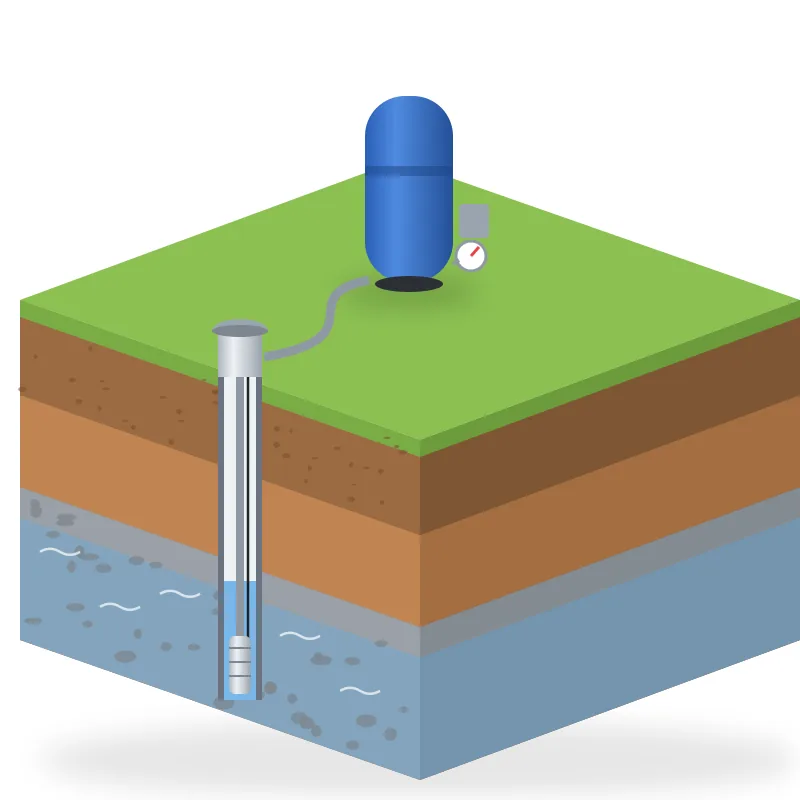
A private well is two separate jobs. Replacing a worn-out pump is a service call priced by the pump itself and the labor to pull it from the well and set a new one. Drilling a new well is a larger project priced mostly by depth, with casing, a pump system, a permit and a water test on top. The EstiCube well pump calculator covers both, so you can budget a repair now or a new well on a rural lot.
For a replacement, choose a submersible or jet pump, the horsepower and the depth of the well, then add a pressure tank, wire, drop pipe or an after-hours call if they apply. For a new well, enter the drilled depth, the ground conditions and the feet of casing. Results are line-by-line national-average estimates, and every unit price can be changed to match a local quote.
A private well usually comes with a septic system. Budget for the septic tank pumping cost. Planning to water a lawn from the well? Try the sprinkler system cost calculator.
Well pump replacement and well drilling cost: unit prices used
A pump replacement is the pump, pull and set labor and a trip charge, plus any optional parts. A new well is drilling by the foot, casing, a pump system and a handful of fixed project costs. Neither mode has a minimum charge.
| Line item | Unit price | Notes |
|---|---|---|
| Submersible pump, 1/2 / 3/4 / 1 HP | $650 / $750 / $900 | Pump only, before labor |
| Submersible pump, 1.5 / 2 HP | $1,250 / $1,500 | Larger pumps for deeper wells or higher demand |
| Jet pump, 1/2 / 3/4 / 1 HP | $400 / $450 / $550 | Above-ground pump, pump only |
| Jet pump, 1.5 / 2 HP | $750 / $900 | Pump only, before labor |
| Pull & set labor, submersible | $500 + $2.50 per ft | $1,000 for a 200 ft well |
| Jet pump installation | $350 | Flat labor; no pump to pull from the well |
| Pump wire replacement | $1.20 per ft | Submersible only; $240 for a 200 ft well |
| Drop pipe replacement | $1.80 per ft | Submersible only; $360 for a 200 ft well |
| Pressure tank | $650 | Optional |
| Pressure switch | $120 | Included by default |
| After-hours service | $250 | Optional |
| Trip charge | $150 | Flat |
| Drilling, sand & gravel / mixed / bedrock | $30 / $45 / $60 per ft | $11,250 for a 250 ft well in mixed ground |
| Steel casing | $14 per ft | $1,120 for 80 ft; never more than the drilled depth |
| Pump, pressure tank & wiring | $2,800 | Flat allowance for a new well |
| Well permit | $450 | Check local requirements |
| Water quality test | $250 | Flat allowance |
| Hydrofracturing | $2,500 | Optional, for low-yield wells |
| Mobilization | $650 | Rig and crew transport |
A default pump replacement (1 HP submersible pump, 200 ft well, pressure switch) comes to $2,170. A default new well (250 ft in mixed ground, 80 ft of casing, permit and water test) comes to $16,520.
How much does it cost to replace a well pump?
With the defaults, a 1 HP submersible pump in a 200 ft well comes to $2,170: $900 for the pump, $1,000 for pull and set labor, $120 for a pressure switch and a $150 trip charge. Pull and set labor is $500 plus $2.50 per foot of well depth, because the crew lifts the pump out on pipe from the full depth of the well and lowers the new one back.
Depth moves the total. The same pump costs $1,920 in a 100 ft well, $2,420 at 300 ft, $2,670 at 400 ft and $2,920 at 500 ft. Optional parts add to it: replacing the wire and drop pipe on a 200 ft well adds $240 and $360, a new pressure tank adds $650 and an after-hours call adds $250. With all four, the default job reaches $3,670.
Real quotes depend on access, the condition of the old wire and pipe, local labor rates and the pump brand. Use the pricing section to enter the figures from your own quote and compare it on the same footing.
Submersible vs jet pump, and how much horsepower
A submersible pump sits down inside the well and pushes water up to the house. A jet pump sits above ground, in the house, a pump house or a well pit, and pulls water up. In this calculator the jet pump is the cheaper job: a 1 HP jet pump replacement costs $1,170 against $2,170 for a submersible, because the pump costs less and there is no pull and set labor, only a flat $350 for the installation. Wire and drop pipe belong to submersible pumps, so those options disappear when you choose a jet pump.
Horsepower is usually matched to how deep the water sits and how much flow the household needs, and a deeper well generally calls for a stronger pump. Across the horsepower options the default 200 ft job costs $1,920 for a 1/2 HP submersible pump, $2,020 for 3/4 HP, $2,170 for 1 HP, $2,520 for 1.5 HP and $2,770 for 2 HP. The jet pump equivalents are $1,020, $1,070, $1,170, $1,370 and $1,520. Your pump installer or the well record can confirm the right size.
Sizing is a decision for the installer, based on the well and the home, so treat the figures here as planning numbers.
Pressure tank, pressure switch and signs a pump is failing
The pressure tank stores a reserve of water under pressure, and the pressure switch turns the pump on and off as the pressure falls and rises. A tank that has lost its air charge or a worn switch can make a pump turn on and off in quick bursts, called short cycling, which wears the pump. That is why the calculator includes a $120 pressure switch by default and offers a $650 pressure tank as an option. Replacing the tank on the default job brings it to $2,820.
Common signs of a pump problem include no water at all, water that sputters or has weak pressure, and a pump that cycles on and off frequently. These signs can also point to the switch, the tank, a tripped breaker or a problem in the well itself, so the pump is not always the cause. A well contractor can test each part before you replace the most expensive one.
How much does it cost to drill a new well?
A new well is priced mostly by the foot. In this calculator drilling is $30 per foot in sand and gravel, $45 per foot in mixed soil and rock, and $60 per foot in hard bedrock, because harder ground drills more slowly and wears bits faster. For a 250 ft well with 80 ft of steel casing that makes $12,770 in sand and gravel, $16,520 in mixed ground and $20,270 in bedrock.
The default $16,520 is $11,250 for drilling, $1,120 for casing at $14 per foot, $2,800 for the pump, pressure tank and wiring, $450 for a permit, $250 for a water quality test and $650 to mobilize the rig. That works out to $66 per foot overall. A deeper well costs less per foot overall because the fixed costs spread out: $80 per foot at 150 ft, $60 at 350 ft and $56 at 500 ft in mixed ground.
Casing lines the top of the well to keep the borehole open and keep surface water out. The calculator never charges for more casing than the drilled depth. If the well will not yield enough water, hydrofracturing adds $2,500, taking the default well to $19,020. Depth, geology, yield and permit rules all vary by site, so the real figure can differ from these planning numbers.
Permits and water testing for a private well
The calculator includes a $450 permit and a $250 water quality test for a new well. Permit rules differ by local authority, so check what yours requires before you hire a driller.
The EPA says private well owners are responsible for delivering safe drinking water to their households. That means testing the water, and treating it if needed, is up to you rather than a utility. Ask a lab or your local health department which tests make sense for your area, and keep the results with your well records.
How to use the well pump calculator
- Choose the service: pump replacement for an existing well, or new well drilling.
- For a replacement, pick the pump type and horsepower and enter the depth of the well. Submersible pump labor depends on depth; a jet pump uses a flat installation charge.
- Tick the parts being replaced: the pressure switch, the pressure tank, and for a submersible pump the wire and drop pipe. Add the after-hours option for an emergency call.
- For a new well, enter the drilled depth, choose the ground conditions and set the feet of casing. Add hydrofracturing if the well is expected to be low-yield.
- Open the pricing section and replace any unit price with the figure from your quote, such as the pump price or the drilling rate per foot. Changing the pump or the ground conditions resets that price to the new default.
- Review the line items and total, then copy the share link or switch to contractor bid mode to add overhead, profit and a proposal.
Well pump calculator FAQ
How much does it cost to replace a well pump?
With the defaults, a 1 HP submersible pump in a 200 ft well costs $2,170: $900 for the pump, $1,000 for pull and set labor, $120 for a pressure switch and a $150 trip charge. A 1 HP jet pump replacement costs $1,170. Depth, horsepower and optional parts change the total.
What is the difference between a submersible and a jet pump?
A submersible pump sits down in the well and pushes water to the house. A jet pump sits above ground and pulls water up. In this calculator the submersible pump costs more, and its labor depends on the depth of the well. The jet pump has a flat $350 installation charge and no wire or drop pipe options.
How much horsepower do I need?
Horsepower is generally matched to the depth of the water and the flow the household needs, so deeper wells usually call for a stronger pump. The calculator offers 1/2, 3/4, 1, 1.5 and 2 HP, with submersible pumps from $650 to $1,500 and jet pumps from $400 to $900. Ask your installer to confirm the size for your well.
How do I know if my well pump is failing?
Common signs are no water, weak or sputtering pressure, and a pump that turns on and off often. The same signs can come from the pressure switch, the pressure tank or a tripped breaker, so have a well contractor check them before you replace the pump.
Do I need a new pressure tank with a new pump?
Not always. The calculator leaves the tank off by default and includes a $120 pressure switch. A tank that no longer holds its air charge can make the pump cycle quickly, so ask your installer to check it. Replacing the tank adds $650 and takes the default job to $2,820.
How much does it cost to drill a well?
With the defaults, a 250 ft well in mixed ground with 80 ft of casing costs $16,520, or about $66 per foot overall. That is $11,250 of drilling at $45 per foot plus casing, a pump system, a permit, a water test and mobilization. Sand and gravel brings it to $12,770 and hard bedrock to $20,270.
Why does drilling cost more in bedrock?
Hard rock drills more slowly and wears equipment faster, so the calculator prices it at $60 per foot against $45 for mixed ground and $30 for sand and gravel. On a 250 ft well that is a difference of $3,750 either way from the mixed-ground price. The real rate depends on what the driller expects to hit.
Who is responsible for testing private well water?
The EPA says private well owners are responsible for delivering safe drinking water to their households. The calculator includes a $250 water quality test for a new well. Ask a lab or your local health department which tests suit your area.
Guides
Sources
- Private Drinking Water Wells — U.S. Environmental Protection Agency
- National Ground Water Association — NGWA
Related calculators
Projects often planned together — jump to a related estimator for the next line item.
Septic
Estimate septic tank pumping, inspection, and new system installation cost from tank size, system type, and soil conditions.
Irrigation
Size sprinkler zones, heads, pipe, and water flow for your lawn. Free irrigation calculator with 2026 US install cost estimates.
Radon
Estimate radon mitigation system cost from foundation type, home size, and pipe routing, including the fan, sealing, and post-install test.
More home services calculators
Septic, radon, crawl space & well systems
Explore all 5 categories
Browse every free EstiCube tool by project type — home & structure, outdoor projects, landscape & lawn, commercial, home services.
View full calculator directory