Commercial Pressure Washing Cost Calculator
Price power washing by surface, soil level, and service frequency. Covers concrete flatwork, asphalt, storefronts, drive-thru lanes, and dumpster pads with 2026 US commercial rates.
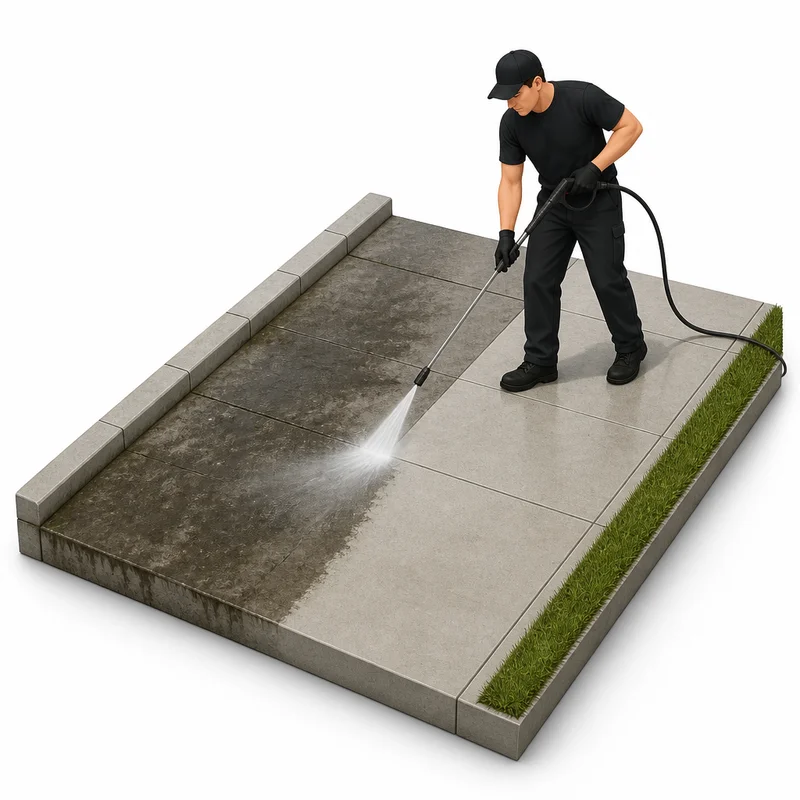
Pressure washing is quoted per square foot, but the rate swings by a factor of three depending on what you are cleaning. Sidewalk concrete and a grease-soaked dumpster pad are not the same job, and a bid that uses one flat rate for the whole property is either overcharging for the easy areas or underbidding the hard ones.
Enter your area, surface type, and soil level to get a per-visit cost, an annual contract total, and an effective cost per square foot. Includes the two line items that most often get missed in commercial bids: gum and stain removal, and water reclaim for stormwater compliance.
Budgeting the whole year? Use the parking lot maintenance cost calculator. Routine debris is cheaper with sweeping; compare parking lot sweeping prices.
Commercial pressure washing cost per square foot
These are the 2026 US base rates behind the calculator, before soil level and add-ons. Heavy soiling multiplies the base rate by about 1.4x; light routine cleaning drops it to about 0.85x.
| Surface | Base rate | Notes |
|---|---|---|
| Asphalt paving | $0.11 / sq ft | Lowest rate, lower pressure to avoid raveling |
| Concrete flatwork & sidewalks | $0.13 / sq ft | The most common commercial scope |
| Building exterior / storefront | $0.18 / sq ft | Vertical work, more setup and masking |
| Drive-thru lane | $0.22 / sq ft | Heavy grease and food traffic |
| Dumpster pad & corral | $0.35 / sq ft | Worst soiling, small area, degreaser required |
| Gum & stain removal | +$0.05 / sq ft | Add-on, priced across the treated area |
| Water reclaim | +$0.04 / sq ft | Vacuum recovery for stormwater compliance |
| Mobilization | $175 per job | Charged once on recurring contracts |
| Minimum charge | $325 per visit | Applies to small scopes |
A 20,000 sq ft concrete sidewalk scope at standard soiling runs about $2,600 per visit before add-ons. Quarterly service is the most common commercial cadence; monthly is typical only for drive-thrus and dumpster areas.
How much does commercial pressure washing cost?
Commercial power washing in the United States runs about $0.10 to $0.35 per square foot depending on surface and soiling. Concrete sidewalks and plaza flatwork sit near $0.13, asphalt slightly lower at $0.11 because it needs gentler pressure, and building exteriors near $0.18 once you account for masking, ladders, or lift time.
The expensive areas are small. A dumpster pad is usually under 400 sq ft but prices near $0.35 per square foot because it needs hot water, degreaser, and containment. Drive-thru lanes are similar. These two areas often account for a third of a property's washing budget while covering less than five percent of its square footage.
Minimum charges dominate small jobs. Most contractors will not roll a truck for under $300 to $400, so a single 800 sq ft entryway costs the minimum rather than the calculated rate. Bundling several small areas into one visit is the single easiest way to lower cost per square foot on a commercial property.
Water reclaim and stormwater compliance
Wash water from commercial cleaning is not permitted to enter a storm drain in most US jurisdictions. Storm drains discharge untreated to surface water, and pressure washing runoff carries detergents, oil, grease, and heavy metals. Under the EPA's NPDES stormwater program, that discharge is regulated, and enforcement usually lands on the property owner rather than the contractor.
Compliant contractors capture wash water with vacuum recovery or berms and dispose of it to sanitary sewer with the local utility's permission, which is why water reclaim adds roughly $0.04 per square foot. A bid that is materially cheaper than the rest is often one that plans to let the water run to the drain.
Ask any bidder how they handle wash water and what they do with it afterward. Get it in writing. The cost difference between a compliant and a non-compliant wash is small; the cost difference between a compliant wash and a stormwater violation is not.
How often should a commercial property be pressure washed?
Quarterly is the standard cadence for general concrete flatwork and building entries at retail, office, and medical properties. It keeps traffic film and organic staining from setting in, which matters because deeply set stains need more aggressive cleaning and cost more to remove than routine soil.
Drive-thru lanes, dumpster pads, and restaurant entries usually need monthly attention. These areas accumulate grease continuously, and grease that sits through a summer bonds to the concrete and needs hot water and chemical treatment rather than pressure alone.
Coordinate washing with the rest of your pavement program. Wash before sealcoating or striping, never after — fresh coatings and paint need a clean, dry substrate to bond, and washing a freshly striped lot at high pressure will lift the paint you just paid for.
How to use the pressure washing calculator
- Measure the area to be cleaned in square feet. Price each surface type separately rather than averaging — a dumpster pad and a sidewalk have very different rates.
- Select the surface type. This sets the base rate, and changing it resets the rate in the price panel below.
- Choose the soil level. Use heavy for oil, grease, and set-in staining; light only for routine dust on well-maintained surfaces.
- Pick your service frequency. Quarterly suits general flatwork; monthly is normal for drive-thrus and dumpster areas.
- Enable gum and stain removal if the area has embedded gum, which is standard for retail entries and sidewalks.
- Leave water reclaim enabled unless you have confirmed your jurisdiction allows uncontained discharge. Review the per-visit and annual totals, then get three local bids.
Commercial pressure washing FAQ
How much does pressure washing cost per square foot?
Commercial rates run about $0.10 to $0.35 per square foot. Asphalt is near $0.11, concrete flatwork $0.13, building exteriors $0.18, drive-thru lanes $0.22, and dumpster pads $0.35. Heavy soiling adds roughly 40 percent to the base rate.
How much does it cost to pressure wash a parking lot?
Full-lot asphalt washing is uncommon because it can damage the surface and is rarely necessary. Most lots get targeted cleaning of entries, walkways, and problem areas instead. A 20,000 sq ft concrete walkway scope runs about $2,600 per visit at standard soiling, before gum removal and water reclaim.
Why does a dumpster pad cost so much more per square foot?
It needs hot water, degreaser, longer dwell time, and containment, and the area is small enough that setup dominates the labor. At $0.35 per square foot a 300 sq ft pad costs about $105 in calculated work, which is usually rolled into a larger visit rather than billed alone against the minimum charge.
Is water reclaim legally required?
In most US jurisdictions, yes for commercial washing. Wash water carrying detergent, oil, and grease is a regulated discharge under the EPA NPDES stormwater program and may not enter a storm drain. Requirements vary by municipality, so confirm locally — but enforcement typically targets the property owner, not the contractor.
How often should sidewalks be pressure washed?
Quarterly is the commercial standard for retail and office concrete. Higher-traffic entries, food-service frontage, and medical properties often move to monthly. Waiting longer than a year lets organic staining set in, which costs more to remove than routine cleaning would have.
Should I pressure wash before or after sealcoating?
Before, always. Sealcoat and striping paint need a clean, dry substrate to bond properly. Washing after a fresh application can lift the coating or paint. The correct order is wash, repair, crack seal, sealcoat, then stripe.
What is the difference between pressure washing and power washing?
Power washing uses heated water, pressure washing does not. Heat matters for grease, gum, and organic staining, which is why drive-thru lanes and dumpster pads are power washed. For general concrete and building exteriors, unheated pressure washing is usually sufficient and cheaper.
Can pressure washing damage asphalt?
Yes, at high pressure. Asphalt binder can be stripped and aggregate loosened, causing raveling. Contractors use lower pressure and wider fan tips on asphalt, which is why it prices below concrete despite being a similar scope. Never let a contractor use concrete pressure settings on an asphalt lot.
Sources
- National Pollutant Discharge Elimination System (NPDES) — Stormwater Program — U.S. Environmental Protection Agency
- Stormwater Best Management Practices — U.S. Environmental Protection Agency
- Pressure Washer Safety — U.S. Consumer Product Safety Commission
Related calculators
Projects often planned together — jump to a related estimator for the next line item.
Lot maintenance planner
Annual parking lot maintenance budget — sweeping, sealcoating, restriping, crack sealing, potholes, snow and lighting on a 1, 3 or 5-year schedule.
Sweeping
Calculate power sweeping cost per visit and annual contract pricing by lot size. Includes curb blow-off, debris level, and mobilization.
Sealcoating
Calculate sealcoat gallons and cost for parking lots and commercial pavement. Includes mobilization, crack prep, traffic control, and two-coat application.
Epoxy
Calculate epoxy floor coating cost for warehouses and commercial spaces. Self-leveling, quartz, and metallic systems with grind prep and mobilization.
Hood cleaning
Estimate commercial kitchen exhaust hood and duct cleaning cost per visit and per year from hood size, cooking volume, and NFPA 96 frequency.
Striping
Estimate pavement marking linear feet, traffic paint gallons, and striping cost. Includes stalls, ADA symbols, fire lanes, arrows, and mobilization.
More commercial calculators
Striping, sealcoating, potholes, signs, sweeping & curbing
Explore all 5 categories
Browse every free EstiCube tool by project type — home & structure, outdoor projects, landscape & lawn, commercial, home services.
View full calculator directory