Parking Lot Line Striping Calculator
Calculate linear feet of pavement markings, traffic paint gallons, and total striping cost for parking lots and drive lanes. Includes mobilization, surface prep, ADA symbols, arrows, stop bars, and fire lane stripes.
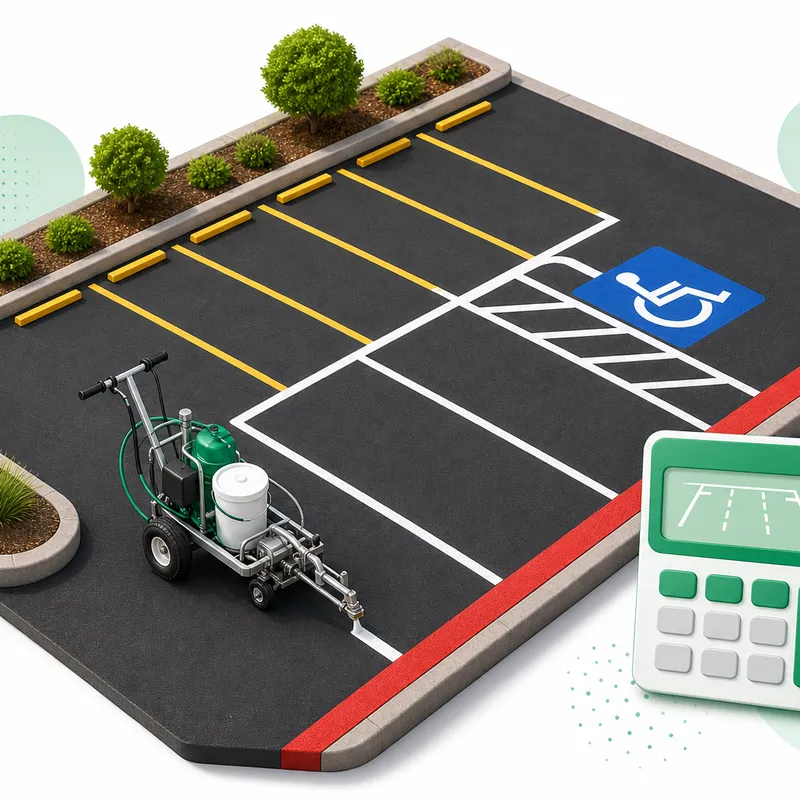
Repainting faded parking lot lines is one of the fastest ways to improve safety, compliance, and curb appeal — but striping bids are hard to compare without a clear takeoff. The EstiCube line striping calculator breaks down what professional pavement marking contractors always include: stall line footage, paint volume, mobilization, layout, surface prep, and specialty markings.
Enter your stall count, choose restriping or a new layout, and add ADA spaces, fire lanes, arrows, and crosswalks. Results show linear feet by marking type, white/yellow and blue/red paint gallons, and a realistic installed cost based on 2026 US averages.
Parking lot striping cost per linear foot and per stall
Striping is quoted by linear foot of paint plus a flat charge per stencil. A standard 90-degree stall takes about 38 linear feet of 4-inch line.
| Line item | Unit price | Notes |
|---|---|---|
| Water-based paint, 4 in. line | $0.30 / linear ft | $0.12 material + $0.18 labor, the default choice |
| Oil-based paint, 4 in. line | $0.36 / linear ft | Better cold-weather cure and wear life |
| Thermoplastic, 4 in. line | $0.77 / linear ft | Longest life, used on high-traffic lanes |
| Standard 90-degree stall | 38 linear ft | About $11 of water-based paint per stall |
| ADA handicap stencil | $38 each | Blue symbol, required signage priced separately |
| Directional arrow stencil | $22 each | 14 linear ft of paint per arrow |
| Stop bar stencil | $18 each | 18 linear ft per bar |
| Surface prep | $4.50 per stall | Sweeping and blow-down before paint |
| Mobilization | $325 per job | Crew and equipment transport |
| Traffic control | $85 per job | Cones and signage for occupied lots |
| Minimum charge | $475 restripe, $650 new layout | New layouts include a $185 layout fee |
A 100-stall restripe in water-based paint runs roughly $1,140 of paint plus prep, mobilization, and stencils. Thermoplastic costs about 2.5x more up front but lasts several times longer under traffic.
How much does parking lot line striping cost?
Parking lot striping in the United States typically costs $0.25–$0.65 per linear foot for standard 4-inch white or yellow lines, with most small-to-mid lots landing at $475–$1,200 for restriping and $650–$2,500 for new layouts. Contractors also enforce minimum trip charges of $350–$750 for mobilization, equipment setup, and traffic control.
Per-stall pricing is common for restriping: $4–$8 per space for touch-up over existing lines, $8–$15 per space for new layout with chalk and measurement. ADA handicap symbols add $35–$75 each. Directional arrows run $20–$40. Stop bars and crosswalks are priced individually or by linear foot.
Thermoplastic markings cost 3–4× more than water-based paint but last 5–8 years vs 1–2 years for acrylic traffic paint. Oil-based alkyd sits in the middle for durability on high-traffic retail lots.
What is always included in a striping estimate
Professional line striping quotes almost always bundle mobilization (truck, airless striping machine, compressor), surface preparation (blow or sweep loose debris), and traffic control (cones or caution tape during dry time). New layouts add chalk lines, measuring tapes, and stall templates before paint is applied.
Material takeoffs count linear feet at standard widths: 4-inch stall lines, 6-inch fire lane stripes, 12-inch stop bars, and stencil work for ADA wheelchair symbols and directional arrows. One gallon of water-based traffic paint covers roughly 350–400 linear feet at 4-inch width with a single coat; restriping often needs two light passes on faded asphalt.
Our calculator uses industry-standard stall footage — about 38 LF per 90° space, 48 LF for 60° angle stalls, and 25 LF for parallel stalls — plus separate line items for handicap markings, fire lanes, crosswalks, and custom centerlines.
ADA, fire lane, and code requirements
The ADA requires at least one accessible parking space per 25 total spaces, with van-accessible spaces needed at larger lots. Accessible stalls need the international symbol of accessibility, proper width (96 inches minimum), and access aisle striping — typically blue and white paint distinct from standard stall lines.
Fire lanes at retail and multifamily properties require red curb or pavement markings with NO PARKING FIRE LANE stencils, often at 6-inch stripe width. Local fire codes dictate spacing and lettering. Stop bars at exits and crosswalks at pedestrian routes are standard traffic engineering details included in striping plans.
Faded markings can create liability if a slip, trip, or parking dispute occurs. Restripe when lines are less than 75% visible, or on a 18–24 month schedule for high-traffic lots.
Striping machine cost: doing it yourself vs hiring a contractor
A walk-behind airless line striper suitable for parking lots runs roughly $1,200 to $3,500 to buy, with entry-level push units around $500 and self-propelled contractor machines reaching $6,000 or more. Daily rental from a tool yard is typically $70 to $120. Add paint, stencils, layout string and chalk, cones, and personal protective equipment on top of the machine itself.
The arithmetic favors DIY only in narrow cases. A small lot that you restripe over existing, clearly visible lines is genuinely doable in a day with a rented machine, and rental plus paint may land well under a contractor minimum. Anything larger, or any lot where the old layout is gone, is a different job: layout is the hard part, not the painting, and a crooked lot is permanent until you pay someone to grind it off and start again.
Hire a contractor whenever the work touches compliance. ADA stall dimensions, access aisle placement, van-accessible signage, and fire lane markings are code-driven and carry real liability if they are wrong. Contractors also carry insurance for overspray onto vehicles, which is the single most common claim in this trade and one a property owner does not want to absorb personally.
How to use the line striping calculator
- Count parking spaces in your lot — include every marked stall, not just tenant spaces.
- Confirm ADA handicap space count (minimum 1 per 25 stalls; adjust if you already know your compliant layout).
- Select stall layout: 90° standard, 60° angle, or parallel head-in stalls.
- Choose restriping over existing lines or new layout (adds measuring and chalk labor).
- Add directional arrows, stop bars, fire lane linear footage, crosswalks, and any extra centerline or edge line footage.
- Review linear feet by marking type, paint gallons, mobilization, prep, labor, and total cost per stall and per foot.
Line striping calculator FAQ
How many linear feet of paint per parking space?
A standard 90° parking stall (9 ft wide × 18 ft deep) uses about 35–42 linear feet of 4-inch line paint when both side stripes and the stall head line are counted. Angle stalls at 60° use roughly 45–52 LF due to longer diagonals. Parallel stalls use about 22–28 LF. Restriping over visible ghost lines uses slightly less paint than a first-time layout.
How much striping paint do I need?
Divide total linear feet by 350–400 for water-based traffic paint at 4-inch width (one coat). A 50-stall lot at 38 LF per stall equals 1,900 LF — about 5 gallons of white or yellow paint, plus extra gallons for blue ADA and red fire lane markings. Oil-based paint covers slightly less per gallon; thermoplastic is applied by weight, not volume.
What is included in a professional striping bid?
Typical bids include mobilization and equipment setup, blowing or sweeping the lot, layout and chalk (for new work), traffic paint application, stencil work for ADA symbols and arrows, traffic cones during dry time, and cleanup. Line striping is rarely sold as paint-only — the machine, crew, and trip charge drive the minimum job price.
Restripe vs new layout — what is the difference?
Restriping traces existing lines and costs less — usually $0.20–$0.35/LF or $4–$8 per stall. New layout requires measuring stall grids, snapping chalk lines, and sometimes adjusting angles for code compliance, adding $150–$400 in layout labor plus 10–15% more paint. Choose new layout when reconfiguring spaces or stripes have fully worn away.
How much do handicap parking symbols cost?
Each ADA pavement marking — wheelchair symbol, access aisle lines, and optional van-accessible sign stencil — typically costs $35–$75 installed. Blue and white paint costs more than standard white stall lines. Our calculator adds about 24 LF of specialty paint plus stencil material per ADA space.
How long does parking lot striping take?
A 50–100 stall restripe takes 3–6 hours including setup and dry time between coats. New layouts add 1–3 hours for measuring. Traffic paint dries to touch in 30–60 minutes but needs 24 hours before full traffic loading. Most contractors schedule early morning or weekend work to minimize business disruption.
Water-based vs thermoplastic striping — which should I use?
Water-based acrylic is standard for retail and office parking lots — lower cost, fast dry, 1–2 year life. Oil-based alkyd lasts slightly longer on oily asphalt. Thermoplastic (hot-applied) costs 3–4× more but survives 5–8 years and is common on roads, airports, and high-traffic drive lanes. Match material to traffic volume and budget cycle.
When should I restripe my parking lot?
Restripe when stall lines, stop bars, or fire lane markings fall below 75% visibility, or every 18–24 months on busy retail lots. ADA and fire lane markings should never fade — inspect quarterly. Fresh striping improves night visibility, reduces parking disputes, and supports ADA and fire code compliance during inspections.
Sources
- Accessible Parking Spaces — ADA.gov (U.S. Department of Justice)
- ADA Compliance Brief: Restriping Parking Spaces — ADA.gov (U.S. Department of Justice)
- Chapter 5: Parking Spaces — U.S. Access Board
- Pavement Markings Regulations / Standards — Federal Highway Administration
- Manual on Uniform Traffic Control Devices — Chapter 3B: Pavement and Curb Markings — Federal Highway Administration
Related calculators
Projects often planned together — jump to a related estimator for the next line item.
Sealcoating
Calculate sealcoat gallons and cost for parking lots and commercial pavement. Includes mobilization, crack prep, traffic control, and two-coat application.
Signs
Estimate regulatory, ADA, stop, and wayfinding sign counts with posts, footings, and installation cost for commercial parking lots.
Wheel Stop
Calculate rubber and concrete parking wheel stop supply and installation cost. Includes rebar pins, reflective stripes, and mobilization.
Lot lighting
Price LED retrofits and new pole installs, then see annual energy savings and simple payback period for a commercial parking lot.
Bollard
Estimate steel, concrete, and removable bollard supply and installation cost. Core drill, surface mount, paint, and mobilization for storefront protection.
Sweeping
Calculate power sweeping cost per visit and annual contract pricing by lot size. Includes curb blow-off, debris level, and mobilization.
More commercial calculators
Striping, sealcoating, potholes, signs, sweeping & curbing
Explore all 4 categories
Browse every free EstiCube tool by project type — home builds, outdoor hardscape, landscape, and commercial pavement.
View full calculator directory