Concrete Slab Calculator
Estimate cubic yards, bag count, rebar, delivery, and installed cost for garage slabs, sidewalks, and driveways. Rectangle or round areas with adjustable thickness and waste allowance.
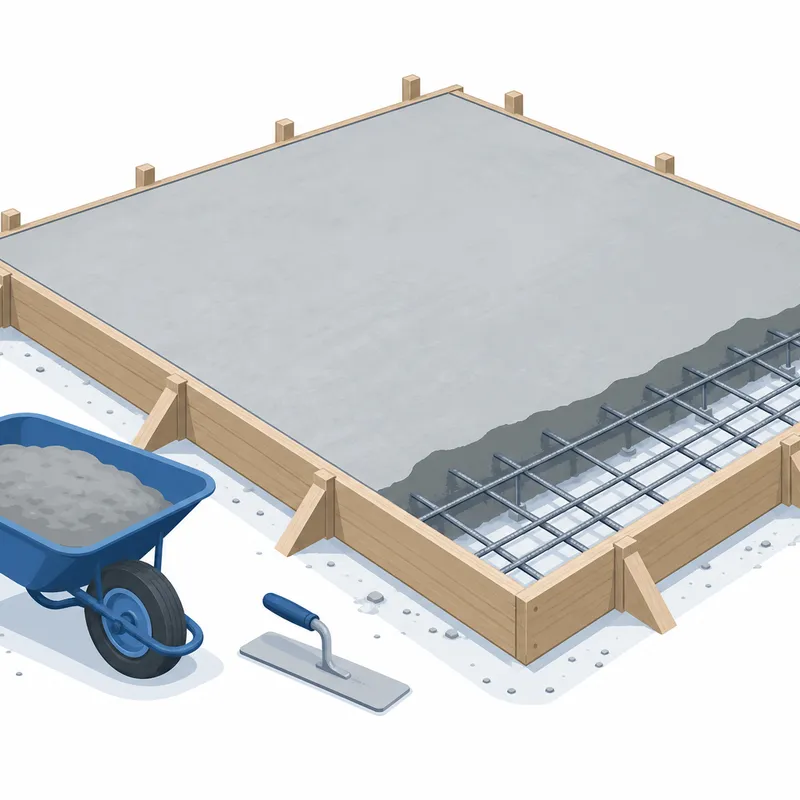
Ordering the wrong amount of concrete is expensive — too little stops the pour mid-slab; too much means paying for unused yards on the truck. The EstiCube concrete calculator converts your slab dimensions into cubic yards, bag quantities, and a realistic budget using 2026 US ready-mix and labor averages.
Enter length and width (or diameter for round pads), choose project type and thickness, and get order quantities with optional rebar, delivery, and finish labor — before you schedule the concrete truck or buy bags at the home center.
How much does concrete cost in the US?
Ready-mix concrete in the United States typically costs $130–$165 per cubic yard for 3000–4000 PSI mix, plus $100–$200 short-load delivery on orders under 8–10 cubic yards. A 20×12 ft garage slab at 4 inches needs about 3 cubic yards — roughly $435–$495 in concrete plus delivery. Finish labor (pour, screed, float, cure) adds $6–$12 per square foot depending on region and access.
Bagged concrete suits small pads under 1 cubic yard. An 80 lb bag yields about 0.6 cubic feet; you need roughly 45 bags per cubic yard. At $6–$8 per bag, bagged mix costs significantly more per yard than ready-mix but avoids minimum load fees.
Rebar (#4 bar at 18-inch grid) adds $0.75–$1.25 per linear foot installed. Fiber mesh is a lower-cost alternative for light residential slabs but does not replace rebar for driveways or structural pads.
How thick should a concrete slab be?
Standard residential slabs: garage floors and patios 4 inches; sidewalks and paths 4 inches; driveways 5–6 inches over compacted gravel base. Shed pads and hot-tub bases often use 4 inches with rebar or wire mesh. Always check local building codes — frost-depth footings and thickened edges may be required.
Subgrade preparation matters as much as thickness. Remove topsoil, compact 4–6 inches of gravel base, and use form boards level to finished grade. Order concrete for early morning pours in summer heat; specify 3000 PSI for foot traffic and 4000 PSI for vehicle loads.
Concrete ordering tips
Measure in feet and thickness in inches — the calculator converts to cubic yards with a 10% waste allowance for spill and over-excavation. For irregular shapes, divide into rectangles and add volumes.
Confirm the plant's minimum load, wait-time charges, and whether pump truck access is needed. Have enough helpers for screeding and finishing — concrete waits for no one once the truck arrives.
How to use the concrete calculator
- Choose project type — slab, sidewalk, or driveway sets a recommended thickness.
- Enter dimensions: length × width for rectangles, or diameter for round pads.
- Adjust thickness and waste allowance (10% is standard for residential pours).
- Enable rebar if you need a reinforced grid; enable delivery for ready-mix under 10 cu yd.
- Enable finish labor if hiring a crew to pour, screed, and cure the slab.
- Review cubic yards, bags (if under 1 cu yd), material cost, and total before ordering.
Concrete calculator FAQ
How do I calculate cubic yards of concrete?
Multiply length × width × depth in feet to get cubic feet, then divide by 27. Example: 20 ft × 12 ft × (4/12) ft = 80 cu ft ÷ 27 = 3.0 cubic yards. For circles use π × radius² × depth ÷ 27. Add 10% for waste. Our calculator does this automatically.
How many 80 lb bags of concrete per cubic yard?
One 80 lb bag yields about 0.6 cubic feet. A cubic yard is 27 cubic feet, so you need approximately 45 bags per cubic yard. Bagged mix is practical for pads under 1 cubic yard; larger pours should use ready-mix delivery.
How much does a cubic yard of ready-mix concrete cost?
In 2026, ready-mix concrete averages $130–$165 per cubic yard for standard 3000–4000 PSI mix in most US markets. Short-load fees of $100–$200 apply on orders under 8–10 cubic yards. Colored or high-strength mixes cost more.
Do I need rebar in a concrete slab?
Rebar is recommended for driveways, garage slabs, and any pad supporting vehicles or heavy loads. Sidewalks and small shed pads may use wire mesh or fiber instead. Our calculator estimates #4 rebar on an 18-inch grid when rebar is enabled.
How thick should a concrete driveway be?
Residential driveways should be 5–6 inches of concrete over 4–6 inches of compacted gravel base. Light foot-traffic paths and patios can be 4 inches. Increase thickness and rebar spacing for heavy trucks or poor soil conditions.
What is the minimum ready-mix order?
Most ready-mix plants have a 1 cubic yard minimum but charge short-load fees under 8–10 cubic yards. A single truck holds 9–11 cubic yards. Plan your pour to use a full truck when possible to minimize per-yard cost.
How long before I can drive on new concrete?
Keep foot traffic off for 24–48 hours. Wait 7 days before light vehicle traffic and 28 days for full strength on driveways. Cure with water or curing compound for the first week — premature drying causes surface cracking.
Can I pour concrete in cold weather?
Concrete can be poured above 40°F with cold-weather admixtures and insulated blankets. Below freezing, defer the pour or use heated enclosures. Hot weather above 90°F requires retarding admixtures and rapid finishing to prevent crusting.
Sources
- ACI PRC-330-21: Commercial Concrete Parking Lots and Site Paving Design and Construction — American Concrete Institute
- CIP 6 — Joints in Concrete Slabs on Grade — National Ready Mixed Concrete Association
- CIP 11 — Curing In-Place Concrete — National Ready Mixed Concrete Association
- CIP 27 — Cold Weather Concreting — National Ready Mixed Concrete Association
Related calculators
Projects often planned together — jump to a related estimator for the next line item.
Asphalt
Calculate tons of hot-mix asphalt for driveways and overlays. Includes gravel base, sealcoating, and paving cost estimates.
Paver
Calculate paver count, gravel base, bedding sand, and patio install cost. Includes pattern waste, edge restraint, and polymeric sand.
Gravel
Calculate cubic yards and tons of gravel for driveways, paths, and base fill. Free gravel calculator with delivery and spreading cost estimates.
House
Full home construction estimator — foundation, basement, framing, roof, MEP & finishes. Cost ranges for every building phase.
Deck
Estimate decking boards, joists, footings, and total installed cost. Free deck material calculator with 2026 US price averages for wood, composite, and PVC.
Curbing
Estimate linear feet of mountable, barrier, and valley curb with concrete volume and install cost. Includes demo and mobilization for parking lots.
More home & structure calculators
Whole-home builds, drywall, siding, insulation & finishes
Explore all 4 categories
Browse every free EstiCube tool by project type — home builds, outdoor hardscape, landscape, and commercial pavement.
View full calculator directory