ADA Parking & Curb Ramp Cost Calculator
Price an ADA upgrade for a parking lot: the accessible and van-accessible stalls your lot size calls for under the 2010 ADA Standards, curb ramps, detectable warning panels, signs on posts and an optional route ramp. Then switch to contractor bid mode to build a proposal.
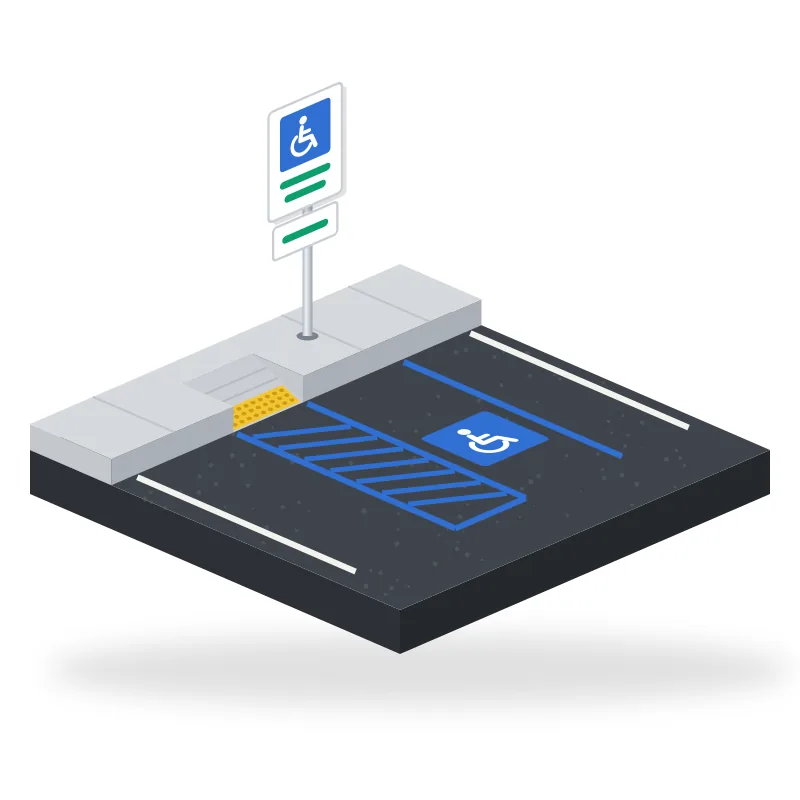
An ADA parking upgrade is a short list of small jobs that add up: new or rebuilt curb ramps, painted accessible stalls and access aisles, a sign on a post for every accessible space, a VAN ACCESSIBLE plaque, and sometimes detectable warning panels or a short route ramp. The EstiCube ADA parking and curb ramp calculator prices each one as its own line, plus mobilization, and works out how many accessible and van-accessible spaces a lot of your size needs.
Enter the number of stalls in the lot, the curb ramps and warning panels you plan to build, and choose whether the ramps are new or retrofits. Results are national-average estimates for a private lot, and every unit price can be replaced with a figure from a contractor quote. This is general information, not legal advice.
For the space-count table and the aisle widths, read the guide to ADA parking lot striping requirements. Only repainting lines? Use the parking lot striping cost calculator.
ADA parking and curb ramp cost: unit prices used
Ramps, panels and signs are priced each, stall markings per stall and a route ramp per foot. The examples are for a 60-stall lot, which needs 3 accessible spaces, one of them van accessible. The total is never less than the minimum job charge.
| Line item | Unit price | Notes |
|---|---|---|
| Curb ramp, new | $2,500 each | 2 ramps, $5,000 |
| Curb ramp, retrofit | $1,200 each | Optional instead of a new ramp; 2 ramps, $2,400 |
| Detectable warning panel | $350 each | 2 panels, $700 |
| Accessible stall marking (car) | $75 per stall | 2 car stalls, $150 |
| Van-accessible stall marking | $95 per stall | 1 van stall, $95 |
| Accessible sign on a post | $290 each | 3 signs, $870; the parking sign calculator's $145 sign, $45 post, $35 footing and $65 install |
| VAN ACCESSIBLE plaque | $35 each | 1 plaque, $35 |
| Accessible route ramp | $450 per ft | Optional concrete ramp with handrails; 12 ft, $5,400 |
| Mobilization | $500 | Flat charge to bring crew and equipment |
| Minimum job charge | $750 | Floor for a small job or a zero-quantity estimate |
A default job (60-stall lot, 3 accessible spaces with signs, 2 new curb ramps, 2 warning panels, no route ramp) comes to $7,350.
How much does an ADA parking upgrade cost?
With the defaults, a 60-stall lot that needs 3 accessible spaces (2 car and 1 van), 2 new curb ramps, 2 detectable warning panels and signs comes to $7,350. The two ramps are the largest line at $5,000, then $870 for three accessible signs on posts, $700 for the panels, $500 of mobilization, $245 of stall markings ($150 for the car spaces and $95 for the van space) and $35 for the VAN ACCESSIBLE plaque. Rebuilding existing ramps instead of cutting new ones takes the default to $4,750, and leaving the signs out takes it to $6,445.
Lot size changes the price through the number of accessible spaces. With everything else at the default, a 20-stall lot needs 1 accessible space, which must be a van space, and comes to $6,620. A 100-stall lot needs 4 and comes to $7,715, 150 stalls need 5 and cost $8,080, 300 stalls need 7 (two of them van spaces) and cost $8,865, and 500 stalls need 9 and cost $9,595. Past 500 stalls the count is 2 percent of the total, rounded up, so 501 stalls need 11 spaces and cost $10,325, and 1,000 stalls need 20 spaces and cost $13,720. A separate route ramp is the biggest optional add: a 12 ft concrete ramp with handrails adds $5,400, which takes the default to $12,750.
For a public benchmark, the City of Grand Island, Nebraska, reports in a December 2021 memo that its annual curb ramp program built 1,122 curb ramps for $1,813,384, an average of $1,915 per ramp, and that the 4,612 ramps it still needs would cost $8,832,000 at present-day prices. Those are sidewalk ramps built in bulk by a city. A single ramp on a private lot has no volume discount and carries its own mobilization, which is why the calculator's new-ramp default is $2,500, about 30 percent higher. Treat all unit prices as starting points and replace them with a contractor quote.
What the 2010 ADA Standards require for parking
ADA.gov says the number of accessible spaces is worked out separately for each parking facility, not from the total on a site. The calculator's automatic count uses the same 2010 table: 1 space for a lot of 1 to 25, 2 for 26 to 50, 3 for 51 to 75, 4 for 76 to 100, 5 for 101 to 150, 6 for 151 to 200, 7 for 201 to 300, 8 for 301 to 400 and 9 for 401 to 500, then 2 percent of the total for 501 to 1,000 and 20 plus 1 for each 100 over 1,000. Hospital outpatient, rehabilitation and residential facilities have different rules, so enter your own count when the automatic one does not apply.
At least one of every six accessible spaces, or fraction of six, must be van accessible, and always at least one. The calculator rounds up the same way: 1 to 6 accessible spaces need 1 van space, 7 to 12 need 2 and 13 to 18 need 3. A car space is at least 96 inches wide with a 60-inch access aisle. A van space is either 132 inches wide with a 60-inch aisle or 96 inches wide with a 96-inch aisle, and needs 98 inches of vertical clearance.
Each accessible space needs a sign with the international symbol of accessibility mounted at least 60 inches above the ground, measured to the bottom of the sign, and a van space needs a second sign saying it is van accessible. Where a site has four or fewer spaces in total, the accessible space does not need an identifying sign. ADA.gov notes that state or local laws may address the color and manner of marking the spaces and aisles, and the calculator prices the markings as a stencil plus aisle hatching, not as a specific pattern.
Curb ramps, route ramps and detectable warnings
The Access Board's guide to the standards says ramps and curb ramps are required along accessible routes wherever the change in level is greater than half an inch. The running slope can be no steeper than 1:12 and the cross slope no steeper than 1:48. A curb ramp needs a landing at the top, 36 inches deep for a built-up ramp, and a built-up curb ramp cannot project into parking spaces, access aisles or vehicle traffic lanes. ADA.gov adds that ramps must not extend into an access aisle and that an accessible route is at least 3 feet wide with a firm, stable, slip-resistant surface.
A separate route ramp is more involved. The Access Board's guide says ramp runs need a clear width of at least 36 inches, level landings at the top and bottom of each run, a rise of no more than 30 inches per run, and handrails on both sides of any ramp with a rise greater than 6 inches. The calculator's route ramp is a rough allowance of $450 per foot for a concrete ramp with handrails. Get a site-specific design before you trust it.
Detectable warnings need more care. According to the Access Board's guide, the 2010 Standards require them on curb ramps only at transit facilities covered by the Department of Transportation's standards. They are not required at non-transit facilities subject to the Department of Justice's standards, and the guide says the Standards apply primarily to facilities located on sites. The same guide says DOT requires detectable warnings on curb ramps in projects funded by the Federal Highway Administration, and that the Board's public right-of-way guidelines address them along public streets and sidewalks. Local codes and project specifications often ask for them anyway, so the calculator keeps the panel count as its own input: set it to 0 if your project does not need panels, or to one per ramp plus any flush crossings if it does.
A standalone ADA job vs adding accessible spaces to a restripe
ADA.gov states that when a business or a state or local government restripes a parking lot, it must provide accessible spaces under the 2010 Standards, and that businesses also have a continuing duty to remove barriers in existing parking where that is readily achievable. A restripe is therefore the cheapest moment to fix a lot. In the EstiCube striping calculator, a 50-stall restripe with no arrows, stop bars, fire lane or crosswalks and with 2 accessible spaces is $1,181 and with 3 is $1,233, so each extra accessible space adds about $52.
The same space costs more as its own job in this calculator. A standalone job to add one van space, with its sign and plaque, comes to $920: $95 for the markings, $290 for the sign, $35 for the plaque and $500 of mobilization. Each extra car space adds $75 of markings and $290 for a sign on a post, which is $365, and each extra van space adds $420. Three accessible spaces with signs and no ramps or panels come to $1,650. Most of the gap is the sign. The striping calculator does not include signs, so its $52 covers only paint and stencil, while a standalone space adds $75 of markings, about $23 more, and $290 for a sign on a post. Mobilization ($500) is charged once per job, and the $750 minimum is a floor that sets the price only when a job adds up to less. Neither changes the cost of each added space.
Because the work is cheaper when it is combined, many owners add the ramps, the signs and the accessible spaces to the next restripe. Check the lot against the 2010 table first, and confirm with an ADA specialist or your local code office, since state and local rules can add to the federal ones. This is general information, not legal advice.
How to use the ADA parking and curb ramp calculator
- Enter the number of stalls in the parking lot. Count each parking facility separately if the site has more than one lot.
- Leave the automatic accessible space count on to use the 2010 ADA table, or turn it off and enter the number your lot needs, for example for a hospital outpatient or residential facility.
- Choose whether to include a sign on a post for each accessible space and a VAN ACCESSIBLE plaque for each van space.
- Enter how many curb ramps you will build, and choose between new ramps cut into the curb and sidewalk and retrofits of existing ramps.
- Enter the detectable warning panels you need, usually one per ramp plus any flush crossings, or 0 if your project does not require them.
- Add a route ramp and its length in feet if the accessible route needs one.
- Open the pricing section and replace any unit price with a contractor quote. Then review the line items and the total, copy the share link, or switch to contractor bid mode to add overhead, profit and a proposal.
ADA parking and curb ramp cost FAQ
How much does it cost to make a parking lot ADA compliant?
With the defaults (a 60-stall lot, 3 accessible spaces with signs, 2 new curb ramps and 2 detectable warning panels) the calculator gives $7,350. A 20-stall lot comes to $6,620 and a 500-stall lot to $9,595 with the same ramps. Adding one van space, its sign and plaque as a standalone job is $920. The real figure depends on the work your lot needs, such as regrading, drainage or a route ramp.
How many accessible parking spaces does a lot need?
Under the 2010 ADA Standards, a lot of 1 to 25 spaces needs 1, 26 to 50 needs 2, 51 to 75 needs 3 and 76 to 100 needs 4, rising to 9 for 401 to 500. From 501 to 1,000 it is 2 percent of the total. The count is worked out for each parking facility, and some facility types have different rules. A 60-stall lot needs 3.
How many of the accessible spaces must be van accessible?
At least one of every six accessible spaces, or fraction of six, and always at least one. A lot with 3 accessible spaces needs 1 van space, 7 need 2 and 13 need 3. A van space is either 132 inches wide with a 60-inch aisle or 96 inches wide with a 96-inch aisle, with 98 inches of vertical clearance.
How much does an ADA curb ramp cost?
The calculator defaults to $2,500 for a new ramp and $1,200 for a retrofit of an existing one. For comparison, Grand Island, Nebraska reported an average of $1,915 per ramp across 1,122 sidewalk ramps built in its annual program, in a December 2021 memo. Single ramps on private lots usually cost more per ramp than a bulk city program.
Are detectable warnings required on curb ramps?
Not under the 2010 ADA Standards at most private sites. The Access Board says they are required on curb ramps at transit facilities covered by DOT's standards and not at non-transit facilities subject to the Justice Department's standards. DOT requires them on curb ramps in projects funded by the Federal Highway Administration, and local codes or project specs may ask for them too. Set the panel count to 0 if they are not required.
What slope can a curb ramp have?
The Access Board's guide says the running slope can be no steeper than 1:12 and the cross slope no steeper than 1:48. A curb ramp needs a landing at the top, and a built-up curb ramp cannot project into a parking space, access aisle or traffic lane. Side flares, where provided, can be no steeper than 1:10.
Does restriping a parking lot trigger ADA requirements?
ADA.gov states that when a business or a state or local government restripes a parking lot, it must provide accessible spaces under the 2010 ADA Standards. It also says businesses have a continuing duty to remove barriers in existing parking when that is readily achievable. Confirm what applies to your lot with a specialist.
Why does a standalone ADA job cost more per space than adding spaces to a restripe?
In these calculators one more accessible space adds about $52 to a 50-stall restripe, while a standalone job adds $75 of markings plus $290 for a sign on a post for each car space, which is $365, and $420 for each van space. Most of the gap is the sign, which the striping calculator does not include; the markings themselves differ by about $23 ($75 against $52). The standalone job also pays a flat $500 of mobilization and has a $750 minimum floor, while a restripe already pays its own mobilization for the whole lot.
Guides
Sources
- ADA Compliance Brief: Restriping Parking Spaces (space counts, van ratio, widths, restriping duty) — ADA.gov (U.S. Department of Justice)
- Chapter 5: Parking Spaces (signs, access aisles, van spaces) — U.S. Access Board
- Chapter 4: Ramps and Curb Ramps (slopes, landings, handrails, detectable warnings) — U.S. Access Board
- Americans with Disabilities Act (ADA) Program: 2022 ADA Curb Ramp Program Update (cost per curb ramp) — City of Grand Island, Nebraska
Related calculators
Projects often planned together — jump to a related estimator for the next line item.
Striping
Estimate pavement marking linear feet, traffic paint gallons, and striping cost. Includes stalls, ADA symbols, fire lanes, arrows, and mobilization.
Sidewalk repair
Estimate commercial sidewalk trip hazard repair cost from grinding by inch-foot, panel replacement, saw cuts, curb ramps, and truncated dome pads.
Signs
Estimate regulatory, ADA, stop, and wayfinding sign counts with posts, footings, and installation cost for commercial parking lots.
Curbing
Estimate linear feet of mountable, barrier, and valley curb with concrete volume and install cost. Includes demo and mobilization for parking lots.
Concrete
Calculate cubic yards of concrete for slabs, driveways, and sidewalks. Includes bags, rebar, delivery, and pour cost estimates.
Wheel Stop
Calculate rubber and concrete parking wheel stop supply and installation cost. Includes rebar pins, reflective stripes, and mobilization.
More pavement & parking calculators
Striping, paving, ADA, sealcoating, signs, sweeping & curbing
Explore all 6 categories
Browse every free EstiCube tool by project type — pavement & parking, commercial property, outdoor projects, home & structure, landscape & lawn, home services.
View full calculator directory