Cost to build a parking lot: per space, per square foot and what the number leaves out
Updated
“How much does it cost to build a parking lot?” has no single answer, because the number depends on what you count. This guide builds a surface lot up from bare ground with the EstiCube parking lot cost calculator, then shows what that number leaves out, how gravel compares with asphalt, and how lot size changes the cost per space.
The figures use the calculator’s default prices, which are planning estimates. They are set from public bids and DOT averages, and some are plain estimates. All of the bids behind them are public jobs; no private-job price was found, and a private rural lot may differ. Replace them with local quotes before you budget.
Per space or per square foot
The default job is 50 spaces at 300 sq ft each, which is 15,000 sq ft, with 4 in of asphalt over 8 in of aggregate on a lightly vegetated site, barrier curb around the perimeter and new striping. It comes to $122,863: asphalt $45,313, aggregate base $23,625, curb $20,580, excavation $13,889, fine grading $5,250, clearing $2,583, silt fence $1,715, striping $1,370, accessible signs $500 and mobilization $8,038.
Divide that by the spaces and you get $2,457. Divide it by the area and you get $8.19. The two move differently. The Victoria Transport Policy Institute says off-street parking typically requires 250 to 350 sq ft per space, including access lanes and landscaping, and that a survey of six typical lots averaged 85 spaces per acre, which works out to about 512 sq ft per space. Changing the area per space changes the cost per space far more than the cost per sq ft, so a per-space figure means little until you know the area behind it.
A paving-only price per sq ft reads lower because it covers less. At the defaults, the asphalt line is $3.02 per sq ft and asphalt plus aggregate base is $4.60 per sq ft, against $8.19 for the whole bare site.
| Area per space | Lot area | Total | Per space | Per sq ft |
|---|---|---|---|---|
| 250 sq ft | 12,500 sq ft | $104,601 | $2,092 | $8.37 |
| 300 sq ft | 15,000 sq ft | $122,863 | $2,457 | $8.19 |
| 350 sq ft | 17,500 sq ft | $140,930 | $2,819 | $8.05 |
| 400 sq ft | 20,000 sq ft | $158,898 | $3,178 | $7.94 |
| 500 sq ft | 25,000 sq ft | $194,445 | $3,889 | $7.78 |
What the number leaves out
The calculator’s figure is the bare site. It does not include lighting, landscaping, sidewalks, gates, street frontage work, stormwater detention, utilities, permits or design fees. It also does not include the land.
The clearest public example we found is the City of Sequim, Washington’s W Spruce St parking lot, bids opened February 12, 2025, a new lot the Sequim Gazette (March 5, 2025) reported as 40 spots, 4 of them pay-to-use EV spots, gated. The low bid was $618,901.46, lowest of 10, which is $15,473 per space. That is the whole bid, with electrical, lighting, gates and EV chargers, and 8.9% sales tax on Schedules B and C. Without Schedule B, which holds the electrical, lighting, gate and charger items, the three lowest bids work out to $9,344 to $10,991 per space. Neither is the same scope as a bare-site $2,457 at 300 sq ft per space.
The other bids ran up to $813,573.90. Another total on the tab, $4,994,728.69, is not a real price: a $21,000 unit price on a 200 SY asphalt removal item was extended to $4.2 million, and the tab marks it as a bid proposal error corrected in accordance with Section 1-03.1.
Sequim also used more ground and more curb per space. The only area on the tab is 0.44 acre of clearing, about 479 sq ft per space, and its four curb items add up to 1,015 LF, about 25 LF per space against 10 LF per space in the calculator’s default. On Sequim’s own quantities for clearing, curb, base, ballast, asphalt, paint, drain pipe and catch basins, the calculator’s unit prices give $150,788, which is 78% of the lowest total for those items across the ten bids ($193,878) and 62% of the median ($242,181).
Gravel vs asphalt
At the default prices, the same 50-space lot with 4 in of gravel instead of 4 in of asphalt comes to $89,885, which is $1,798 per space and $5.99 per sq ft, $32,978 less than asphalt. The gravel line is $15,863 at $47 per ton against $45,313 of asphalt at $125 per ton, and the $1,370 striping line goes, because paint needs a paved surface. Everything else stays, including the curb. Without curb, the gravel lot is $67,865, or $1,357 per space. A 6 in gravel surface with curb is $100,849.
The gravel price comes from the private road paving calculator and was not researched separately for parking lots, so treat the comparison as a planning figure. It covers the build only. The calculator does not say how long either surface lasts or price regrading a gravel lot.
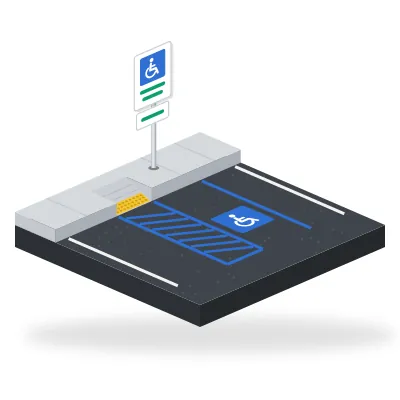
A gravel lot is not free of accessibility requirements. The U.S. Access Board’s guide says “including gravel or grass lots, parking spaces and access aisles must be marked and have firm, stable, and slip resistant surfaces”. The calculator keeps the accessible signs on gravel, but it does not price marking those spaces or a firmer surface for them, so ask your contractor how the accessible spaces will be built.
| Line | Asphalt, 4 in | Gravel, 4 in |
|---|---|---|
| Surface | $45,313 | $15,863 |
| Striping | $1,370 | Not priced |
| Mobilization, 7% | $8,038 | $5,880 |
| All other lines | $68,142 | $68,142 |
| Total | $122,863 | $89,885 |
| Per space | $2,457 | $1,798 |
| Per sq ft | $8.19 | $5.99 |
How lot size changes the cost per space
At the default prices the cost per space falls at each step of this table, though it can tick up by a dollar or two where one more accessible space is required. The paving, base and excavation lines follow the area, so they cost the same per space at any size. Curb and silt fence follow the perimeter, which grows more slowly: the calculator estimates 310 LF for 20 spaces, or 15.5 LF per space, and 980 LF for 200 spaces, or 4.9 LF per space. Mobilization is a percent of the lines, so it does not add a size effect of its own.
That perimeter is 4 times the square root of the area, a square lot. A long, narrow lot has more curb per space than the table shows, so enter the real curb length if you have it.
The $5,000 minimum is a floor that sets the price only when the job adds up to less. In this table it never does.
| Spaces | Asphalt total | Asphalt per space | Gravel total | Gravel per space |
|---|---|---|---|---|
| 10 | $31,036 | $3,104 | $24,030 | $2,403 |
| 20 | $55,043 | $2,752 | $41,558 | $2,078 |
| 50 | $122,863 | $2,457 | $89,885 | $1,798 |
| 100 | $231,278 | $2,313 | $165,797 | $1,658 |
| 200 | $441,674 | $2,208 | $311,292 | $1,556 |
Pavement section and drainage
We found no public source that gives a default section for a parking lot. The Colorado Asphalt Pavement Association’s Parking Lot Design Guide (2nd edition, December 2016) recommends “that the thickness of the asphalt pavement section for parking lots be designed by a qualified and licensed Professional Engineer.” It gives 4 in as the minimum thickness of untreated aggregate base course for Class 6 (3/4 in) material. So the calculator’s 4 in of asphalt over 8 in of aggregate is an estimate, and the bid tabs we read do not state a section beyond the aggregate. At the default prices, 3 in over 6 in comes to $100,706 and 6 in over 12 in to $167,175.
Trucks matter. The same guide says that if a small, low-traffic lot has a weekly or bi-weekly trash truck, it would be more economical to construct the entire parking lot to handle the truck traffic than to build a heavy lane just for trucks.
Drainage is off by default in the calculator. Two catch basins and 100 LF of 12 in storm pipe add $15,000 of lines, which takes the default job to $138,913, or $2,778 per space. That moves water off the lot; it is not a stormwater design, and detention is not included. Earthwork is the weakest line in the estimate, because small-job prices appear only as lump sums. Hauling all the spoil off-site at the estimated $45 per CY takes the default to $149,613.
How the estimate compares with a real bid
The closest bid comparison we found is the bid tab titled “Collection Systems Operations Facility Parking Lot, Capital Project No. 2217”, published at fourrivers.illinois.gov. It prints no date, and its file path shows 2023/08. It lists two bidders and no stall count. It gives three lines at the tab’s quantities plus its lump-sum earthwork. On the three measured lines, 12 in aggregate, asphalt and curb and gutter, the calculator is $175,768 against $135,054 for the low bid and $144,716 for the second bid, which is 130% and 121%.
The earthwork item is a lump sum with no stated quantity, $85,552 and $61,825, and the job also has 3,229 SY of topsoil and seeding, so it may cover more ground than the paved area. The calculator’s $34,308 for a 17 in box under the paved area, a depth we derived from the tab’s tons, plus fine grading, is not a like-for-like price for that item, so we do not add the four lines into a total. That is one project with two bidders, so it does not validate any single unit price, and the test leaves out mobilization, which that tab has no line for.
Regional spread matters as much. Tennessee DOT’s 2025 aggregate base price, for one item in one state, ran from $29.34 to $53.47 per ton by region. The bid tabs behind the calculator come from Illinois and Washington. Treat the defaults as a starting point and get local prices.
Run your numbers with the Parking Lot Cost Calculator: Cost to Build Per Space
Change any unit price to match your quote and see every line item add up. It is free, needs no sign-up and works on your phone.
Open the New parking lot calculatorFrequently asked questions
How much does it cost to build a parking lot per space?
At the EstiCube default prices, a 50-space asphalt lot at 300 sq ft per space is $2,457 per space for the bare site, and the same lot in gravel is $1,798. Finished public lots cost more, partly because they include lighting, gates, landscaping and other items: Sequim, Washington’s 2025 low bid was $15,473 per space for the whole bid. They also use more ground, curb and pavement per space: on Sequim’s direct lot items alone, the bids were about $4,847 to $7,162 per space.
How much does it cost to build a parking lot per square foot?
The default asphalt job is $8.19 per sq ft for the bare site, and $7.36 to $10.35 per sq ft from 200 spaces down to 10. The asphalt line alone is $3.02 per sq ft. Those are the calculator’s default prices, not contractor quotes.
Is gravel cheaper than asphalt for a parking lot?
To build, yes at the calculator’s default prices and at every size in the table above: 50 spaces are $89,885 in gravel and $122,863 in asphalt. The calculator does not price upkeep or how long either surface lasts, and accessible spaces on gravel still have to be marked and have firm, stable, and slip resistant surfaces.
What is not included in a parking lot estimate?
The calculator leaves out lighting, landscaping, sidewalks, gates, street frontage work, stormwater detention, utilities, permits, design fees and the land. Ask any contractor quoting you which of those are in their number.
How much land does a parking space take?
The Victoria Transport Policy Institute says off-street parking typically requires 250 to 350 sq ft per space, including access lanes and landscaping, and reports a survey of six typical lots that averaged 85 spaces per acre, about 512 sq ft per space. Local code governs the layout.
Do I need an engineer to design a parking lot?
The Colorado Asphalt Pavement Association’s Parking Lot Design Guide recommends that the pavement thickness be designed by a qualified and licensed Professional Engineer. Your local permit office can tell you what it requires. The calculator’s section is an estimate for budgeting, and it does not price design fees or permits.
Sources
- Bid Tabulation for W Spruce St Parking Lot, CFL-110NC (bids opened February 12, 2025) — City of Sequim (Washington)
- Collection Systems Operations Facility Parking Lot, Capital Project No. 2217: bid tabulation — fourrivers.illinois.gov
- Parking Lot Design Guide, 2nd edition (December 2016) — Colorado Asphalt Pavement Association
- Transportation Cost and Benefit Analysis II, Parking Costs (3 October 2022) — Victoria Transport Policy Institute
- Guide to the ADA Accessibility Standards, Chapter 5: Parking — U.S. Access Board
More guides