Septic Tank Pumping & Installation Cost Calculator
Price a septic pump-out from your tank size, or a new septic system from bedrooms, soil and system type. See every line item, from the tank and drain field to the perc test and permit, and switch to contractor bid mode to build a proposal.
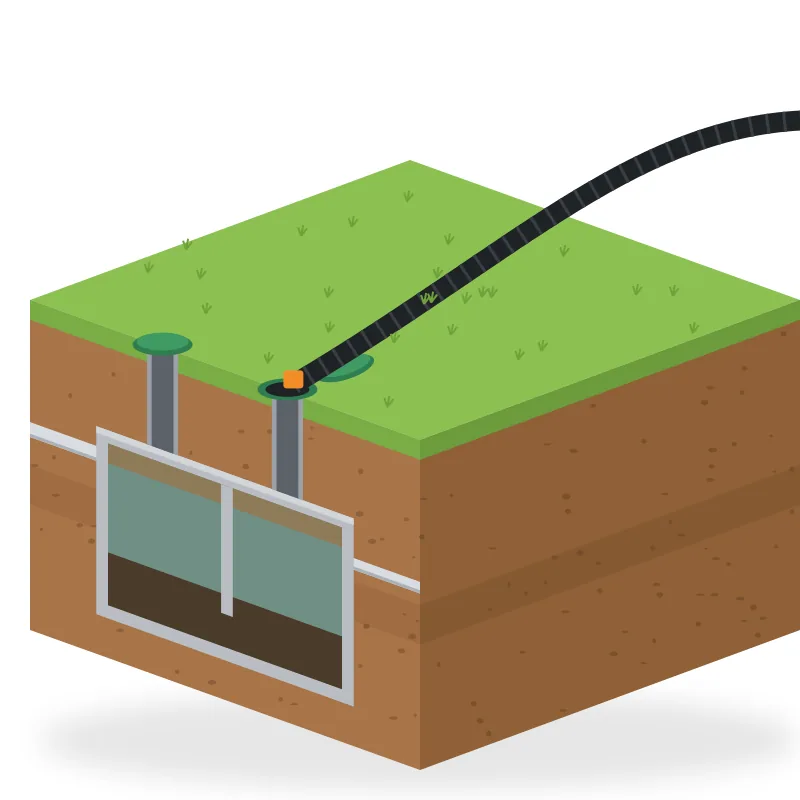
A septic job is two very different purchases. Pumping is a routine, few-hundred-dollar service priced mostly by tank size. Installing a new system is typically a five-figure project where the drain field, not the tank, drives the bill. The EstiCube septic calculator handles both, so you can budget a maintenance visit this year or a replacement system on a new lot without switching tools.
For pumping, enter the tank size, how long since the last pump-out, and any extras such as buried lids, risers, an inspection or effluent filter cleaning. For installation, enter bedrooms, soil drainage and system type. Results are line-by-line national-average estimates, and every unit price can be changed to match a local quote.
On a rural lot with a private well? Compare well pump replacement cost. Testing a house with a basement or slab? Check radon mitigation cost.
Septic pumping and installation cost: unit prices used
Pumping is quoted as a base trip charge plus a per-gallon rate. Installation is priced from the tank, the drain field area and a handful of fixed project costs.
| Line item | Unit price | Notes |
|---|---|---|
| Pump-out, 1,000-gallon tank | $475 | $225 base charge + $0.25 per gallon |
| Pump-out, 750 / 1,500 / 2,000-gallon tank | $413 / $600 / $725 | Same base charge, larger tanks cost more per visit |
| Heavy sludge surcharge | $50 or $125 | $50 if last pumped 3–5 years ago, $125 if over 5 years or unknown |
| Dig up a buried lid | $85 per lid | Applies when the access lid is under soil |
| Riser installation | $325 per lid | Brings the lid up to grade for future pump-outs |
| Septic inspection | $250 | Optional add-on to a pump-out |
| Effluent filter cleaning | $75 | Included by default when the tank has a filter |
| Minimum pumping charge | $325 | Floor for small jobs |
| New septic tank | $1.60 per gallon | $1,600 for a 1,000-gallon tank |
| Drain field, conventional | $12 per sq ft | Gravity trench, the baseline system |
| Drain field, chamber | $14 per sq ft | Open-bottomed chambers instead of gravel |
| Drain field, aerobic system | $13 per sq ft | Field area is cut 30% after aerobic treatment |
| Drain field, mound | $28 per sq ft | Raised sand mound for poor or shallow soils |
| Aerobic treatment unit | $4,800 | Added to aerobic systems only |
| Excavation & backfill | $1,800 | Flat allowance |
| Perc test, design & permit | $2,000 | Optional line; check your local health department |
| Mobilization | $600 | Equipment and crew transport |
A default pumping job (1,000-gallon tank, last pumped 3–5 years ago, filter cleaned) comes to $600. A default installation (3 bedrooms, conventional system, average soil, permit included) comes to $13,200.
How much does it cost to pump a septic tank?
In this calculator a pump-out is a $225 base charge plus $0.25 per gallon of tank capacity. That puts a 750-gallon tank at $413, a 1,000-gallon tank at $475, a 1,500-gallon tank at $600 and a 2,000-gallon tank at $725 before any add-ons. Larger tanks cost more because the truck hauls and disposes of more waste.
Add-ons move the total. A tank that has not been pumped in over five years carries a $125 heavy sludge surcharge in this model, or $50 at 3–5 years. Lids buried under soil cost $85 each to dig up, and risers that bring them to grade cost $325 per lid. An inspection adds $250 and cleaning the effluent filter adds $75.
With the defaults (1,000 gallons, last pumped 3–5 years ago, filter cleaned) the total is $600. Adding two buried lids with risers and an inspection to that job brings it to $1,670. Prices vary by region and truck access, so use the pricing section to enter the numbers from your own quote.
How much does a new septic system cost?
The calculator sizes the tank from bedrooms: 750 gallons for one or two bedrooms, 1,000 for three, 1,250 for four, 1,500 for five or six and 2,000 for seven or eight. The drain field is sized as bedrooms times 125, 200 or 300 square feet for fast, average or slow-draining soil. Local health departments set the real sizing rules, so treat these as planning figures.
For a three-bedroom home in average soil, the default conventional system costs $13,200: a $1,600 tank, a 600 sq ft drain field at $7,200, $1,800 for excavation, $2,000 for the perc test, design and permit, and $600 for mobilization. Soil matters a great deal. The same house costs $10,500 in fast-draining soil and $16,800 in slow-draining soil.
Bedroom count scales the whole project. With a conventional system in average soil the calculator gives $8,000 for one bedroom, $10,400 for two, $13,200 for three, $16,000 for four, $18,800 for five, $21,200 for six, $24,400 for seven and $26,800 for eight. Leaving out the permit line takes $2,000 off any of them.
Conventional, chamber, mound and aerobic systems compared
A conventional system sends tank effluent through gravel-filled trenches in the soil. A chamber system uses open-bottomed plastic chambers instead of gravel. A mound system builds the drain field above the natural grade and is used where soil is shallow, drains slowly or sits over a high water table. An aerobic treatment unit adds oxygen to treat wastewater before it reaches a smaller drain field. The EPA septic pages describe each type.
For a three-bedroom home in average soil the calculator gives $13,200 for a conventional system, $14,400 for a chamber system, $16,260 for an aerobic system and $22,800 for a mound system. The mound costs the most mainly because of its $28 per sq ft drain field rate. The aerobic system adds a $4,800 treatment unit but needs 30% less drain field.
You rarely choose the system on price alone. Soil tests, the depth to groundwater, lot size and local rules decide which systems are allowed, so the perc test and design step usually comes before a firm quote.
How often to pump a septic tank
The EPA says typical household septic tanks need pumping every three to five years, and that a system should be inspected regularly by a professional. The right interval depends on tank size, household size and how much water and solid waste goes into the system.
As a rough planning guide the calculator shows a pump-out every 2 years for a 750-gallon tank, 3 years for 1,000 gallons, 4 years for 1,250 gallons and 5 years for 1,500 gallons or more. Smaller tanks fill with solids sooner, which is why they should be pumped more often. Your inspector or pumper can give a better schedule for your household.
Routine care keeps pump-outs cheap. The EPA advises conserving water, keeping non-flushable items out of the system, and avoiding driving or building over the drain field. Skipping a pump-out can lead to the sludge surcharge in this calculator, or to a far more expensive drain field repair.
How to use the septic calculator
- Choose the service: pumping and inspection for an existing system, or new system installation.
- For pumping, select your tank size and how long it has been since the last pump-out. If you do not know either, use 1,000 gallons and over 5 years.
- Add buried lids, risers, an inspection or filter cleaning if they apply. Lids you cannot see usually mean extra digging time.
- For installation, enter the number of bedrooms, the system type and your soil drainage. Switch the permit line off if it is already paid for.
- Open the pricing section and replace any unit price with the figure from your quote, such as the pump-out base charge or the drain field rate per square foot.
- Review the line items and total, then copy the share link or switch to contractor bid mode to add overhead, profit and a proposal.
Septic calculator FAQ
How much does it cost to pump a septic tank?
In this calculator a 1,000-gallon tank costs $475 to pump: a $225 base charge plus $0.25 per gallon. A 750-gallon tank is $413, a 1,500-gallon tank is $600 and a 2,000-gallon tank is $725. Surcharges, buried lids, risers, inspection and filter cleaning are added on top.
How often should a septic tank be pumped?
The EPA says typical household septic tanks need pumping every three to five years. The calculator suggests every 2 years for a 750-gallon tank, 3 for 1,000 gallons, 4 for 1,250 gallons and 5 for 1,500 gallons or more. Household size and water use change the real interval, so ask your inspector.
Why is there a heavy sludge surcharge?
A tank that has gone a long time between pump-outs holds thicker sludge and takes more time to empty. The calculator adds $50 if the last pump-out was 3–5 years ago and $125 if it was over 5 years ago or is unknown. Choose Under 3 years ago in the last-pumped field to remove it.
What do risers and buried lids cost?
Digging up a buried lid is $85 per lid and installing a riser is $325 per lid in this calculator. A riser brings the access lid up to ground level, so future pump-outs and inspections need no digging. Two buried lids with risers add $820.
How much does a new septic system cost?
With the defaults, a three-bedroom home with a conventional system in average soil comes to $13,200, including a $1,600 tank, a $7,200 drain field, excavation, a perc test and permit, and mobilization. A mound system for the same house is $22,800 and an aerobic system is $16,260. Local rules and site conditions change the real figure.
How big a septic tank do I need?
The calculator uses 750 gallons for one or two bedrooms, 1,000 for three, 1,250 for four, 1,500 for five or six and 2,000 for seven or eight. Local health departments set the minimum tank size, so confirm it before you order.
What is a perc test and is it included?
A percolation test measures how quickly soil absorbs water, and the result guides drain field design and size. The calculator includes a $2,000 allowance for the perc test, system design and permit. Turn the permit option off if those costs are covered separately.
Why does a mound system cost more than a conventional one?
A mound system builds the drain field above the natural ground, using imported sand and fill, so it is priced at $28 per square foot against $12 for a conventional field. It is used where soil is shallow or drains slowly. For a three-bedroom home in average soil that makes $22,800 against $13,200.
Guides
Sources
- Septic Systems — U.S. Environmental Protection Agency
- How to Care for Your Septic System — U.S. Environmental Protection Agency
- Types of Septic Systems — U.S. Environmental Protection Agency
Related calculators
Projects often planned together — jump to a related estimator for the next line item.
Well pump
Estimate well pump replacement or new well drilling cost from well depth, pump type, casing, and pressure tank options.
Radon
Estimate radon mitigation system cost from foundation type, home size, and pipe routing, including the fan, sealing, and post-install test.
Crawl space
Estimate crawl space encapsulation cost from square footage, vapor barrier, dehumidifier, drainage, and insulation choices.
Topsoil
Calculate cubic yards of topsoil for lawn prep, garden beds, and yard leveling. Includes delivery and spreading cost estimates.
Sod
Calculate sod pallets and rolls for a new lawn. Square footage, delivery, and installation cost for Bermuda, bluegrass, and St. Augustine turf.
Explore all 5 categories
Browse every free EstiCube tool by project type — home & structure, outdoor projects, landscape & lawn, commercial, home services.
View full calculator directory