Parking Lot Lighting Cost Calculator
Price an LED retrofit or a new pole install per fixture, then see what it saves. Calculates annual energy cost before and after, plus simple payback period, using 2026 US commercial rates.
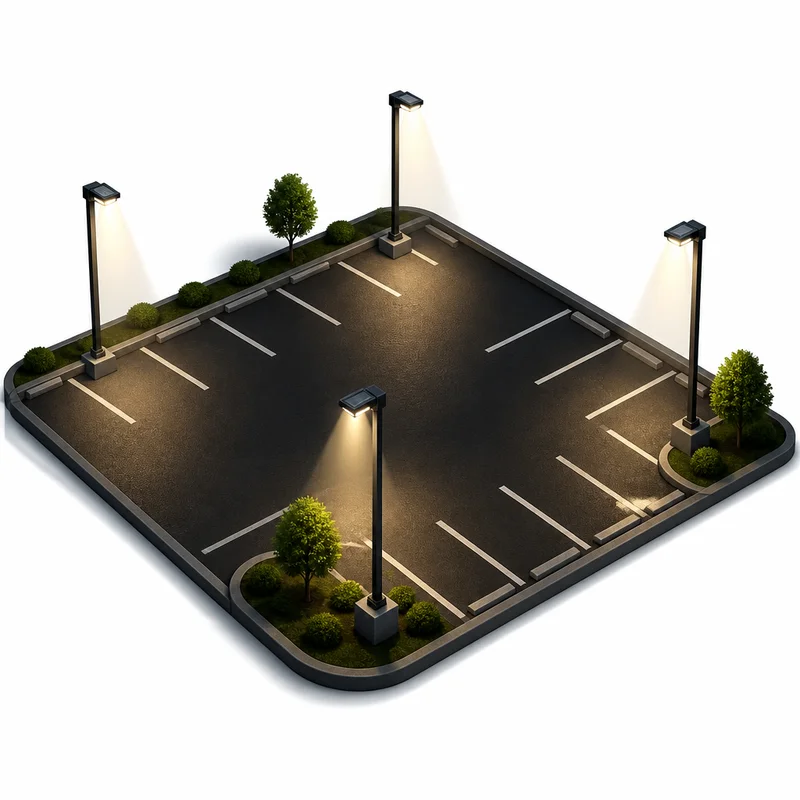
Parking lot lighting is one of the few facility upgrades that pays for itself, but only if you price the whole job rather than the fixtures. A retrofit that keeps existing poles runs a fraction of a new pole install, and the difference decides whether payback lands in three years or twelve.
Enter your pole count, the fixture you are replacing, and your electricity rate to get a full project cost broken out by line item, alongside annual energy use before and after and a simple payback period. Built for US property managers evaluating an LED conversion.
Budgeting the whole year? Use the parking lot maintenance cost calculator. Night sweeping needs lit lots; compare parking lot sweeping prices.
Parking lot lighting cost per pole
These are the 2026 US rates behind the calculator. The scope you choose matters more than any other input: reusing a sound pole cuts roughly two thirds of the cost.
| Line item | Unit cost | Notes |
|---|---|---|
| LED retrofit — fixture | $385 each | Keeps the existing pole and base |
| LED retrofit — labor | $225 each | Typical installed labor per fixture |
| New LED pole + fixture — material | $1,450 each | Pole, fixture, and hardware |
| New LED pole + fixture — labor | $890 each | Set and wire per pole |
| Remove existing pole | $340 each | Full replacement scope only |
| Concrete pole base | $650 each | New installs, varies with soil and wind load |
| Trenching & conduit | $28 / linear ft | Only when running new circuits |
| Photocell / controls | $95 each | Dusk-to-dawn or networked control |
| Mobilization & bucket lift | $975 per job | $450 mobilization + $525 lift rental |
A 12-pole LED retrofit with photocells runs about $9,300 all in. The same 12 poles as new installs with bases pass $40,000, which is why condition of the existing poles is the first thing to assess.
How much does parking lot lighting cost?
An LED retrofit on existing poles runs about $600 to $800 per fixture installed, so a 12-pole lot lands near $8,000 to $10,000 including mobilization and a bucket lift. This is the scenario most commercial properties are actually in: the poles are structurally fine, the fixtures are 400W metal halide or high pressure sodium, and the whole project is a fixture swap.
A new pole install is a different order of magnitude — roughly $2,300 to $3,000 per pole for material and labor, plus about $650 per concrete base and $28 per linear foot of trenching if circuits do not already reach. Twelve new poles with bases and modest trenching passes $40,000.
Full replacement adds demolition of the old pole at roughly $340 each. Before assuming replacement, have the poles inspected: a steel or aluminum pole with sound anchor bolts and no base corrosion often has decades of service left, and reusing it is the single largest cost lever in the project.
LED retrofit payback and energy savings
A 400W metal halide fixture draws about 458 watts once ballast losses are counted, and a 400W high pressure sodium about 465. A modern LED replacement delivering comparable light typically draws 150 watts. At 12 hours per night and $0.15 per kWh, that is roughly $206 saved per fixture per year — around $2,470 a year across 12 poles.
Against a retrofit cost near $9,300, that puts simple payback under four years, with the fixtures rated for 50,000 to 100,000 hours of service. Replacing 1000W metal halide is dramatically better: those draw about 1,080 watts, and payback often lands inside two years.
Simple payback understates the real return because it counts energy only. Metal halide lamps last 15,000 to 24,000 hours and lose significant output long before failure, so you are also paying for relamping, ballast replacement, and a bucket truck visit every few years. Many utilities offer prescriptive rebates for commercial LED conversions — check before you buy, since some require pre-approval.
Specifying the fixtures and avoiding rework
Do not match wattage — match light output and distribution. Replacing a 400W metal halide with a 400W LED wildly overlights the lot and wastes the savings. Ask the supplier for a photometric layout showing footcandle levels across your lot; most manufacturers produce one free for a project of this size.
Check local lighting ordinances before ordering. Many US municipalities now regulate uplight and trespass, requiring full cutoff or dark-sky compliant fixtures and capping light at the property line. Fixtures that fail the ordinance have to come back down, and that is a second bucket lift you pay for.
Color temperature matters for both perception and compliance. 4000K reads as clean, neutral white and is the common commercial default; 5000K appears brighter and harsher and is increasingly restricted by ordinance. Add photocells or networked controls so the lights actually run dusk to dawn rather than around the clock, which is a surprisingly common finding on older lots.
How to use the parking lot lighting calculator
- Enter the number of poles or fixtures in scope. Count fixtures, not poles, if any pole carries two heads.
- Choose the scope. Retrofit keeps the existing pole and is by far the cheapest; pick full replacement only if the poles are corroded or failing.
- Select the fixture you are replacing. This sets the energy baseline, so pick the actual lamp type — the difference between 400W and 1000W metal halide changes payback dramatically.
- Set the new LED wattage. Aim for comparable light output, not comparable wattage; 150W typically replaces a 400W metal halide.
- Enter your electricity rate from a recent utility bill and how many hours the lights actually run each night.
- Add trenching only if new circuits are needed. Review the total, the annual savings, and the payback period — then check your utility's commercial rebate program before ordering.
Parking lot lighting FAQ
How much does it cost to replace a parking lot light?
An LED retrofit on an existing pole runs about $600 to $800 per fixture installed. A complete new pole with fixture runs $2,300 to $3,000 plus roughly $650 for a concrete base. Add about $975 per project for mobilization and bucket lift rental.
What is the payback period on an LED parking lot retrofit?
Typically two to four years on energy alone. Replacing 400W metal halide at 12 hours a night and $0.15 per kWh saves roughly $206 per fixture per year against a retrofit cost near $775. Replacing 1000W metal halide often pays back in under two years.
What LED wattage replaces a 400W metal halide?
Around 150W of LED usually delivers comparable usable light, because LED directs output downward instead of scattering it. Never match wattage one for one — request a photometric layout from the manufacturer showing footcandle levels for your specific lot before ordering.
How many light poles does a parking lot need?
It depends on pole height, fixture distribution, and the footcandle level you are targeting, not on a fixed spacing rule. As a rough planning figure, 25-foot poles with modern LED optics commonly cover 70 to 100 feet of spacing. A photometric layout is the only reliable way to size this.
Can I reuse my existing poles?
Usually yes, and it is the biggest cost saving available. Have the poles inspected for base corrosion, anchor bolt condition, and wind load rating. Steel and aluminum poles in sound condition often have decades of service left, and reusing them cuts roughly two thirds of the project cost.
Are there rebates for commercial LED lighting?
Many US utilities offer prescriptive or custom rebates for commercial LED conversions, sometimes covering a meaningful share of fixture cost. Programs vary by utility and often require pre-approval before purchase, so check with your provider before ordering rather than after.
What color temperature should parking lot lights be?
4000K is the common commercial default — neutral white, good color rendering, widely accepted. 5000K appears brighter but harsher and is increasingly restricted by dark-sky ordinances. Check your municipality's lighting code before specifying, since non-compliant fixtures have to be removed and replaced.
Do I need photocells or timers?
Yes, and it is inexpensive at roughly $95 per fixture. Older lots frequently run lights well beyond dusk-to-dawn, sometimes around the clock after a control failure. Photocells or networked controls ensure you only pay for the hours you actually need lit.
Sources
- Solid-State Lighting Program — U.S. Department of Energy
- ENERGY STAR — Commercial Lighting — U.S. Environmental Protection Agency / U.S. Department of Energy
- Electric Power Monthly — Average Price of Electricity to Ultimate Customers — U.S. Energy Information Administration
Related calculators
Projects often planned together — jump to a related estimator for the next line item.
Lot maintenance planner
Annual parking lot maintenance budget — sweeping, sealcoating, restriping, crack sealing, potholes, snow and lighting on a 1, 3 or 5-year schedule.
Signs
Estimate regulatory, ADA, stop, and wayfinding sign counts with posts, footings, and installation cost for commercial parking lots.
Bollard
Estimate steel, concrete, and removable bollard supply and installation cost. Core drill, surface mount, paint, and mobilization for storefront protection.
Striping
Estimate pavement marking linear feet, traffic paint gallons, and striping cost. Includes stalls, ADA symbols, fire lanes, arrows, and mobilization.
Sweeping
Calculate power sweeping cost per visit and annual contract pricing by lot size. Includes curb blow-off, debris level, and mobilization.
Snow removal
Compare per-push, seasonal, and per-inch snow contracts for any lot size. Includes sidewalk clearing, trigger depth, and a separate salting budget.
More commercial calculators
Striping, sealcoating, potholes, signs, sweeping & curbing
Explore all 5 categories
Browse every free EstiCube tool by project type — home & structure, outdoor projects, landscape & lawn, commercial, home services.
View full calculator directory