Deck Cost Calculator
Estimate decking boards, joists, beams, footings, railing, and total build cost in seconds. Built for US homeowners planning wood, cedar, composite, or PVC deck projects.
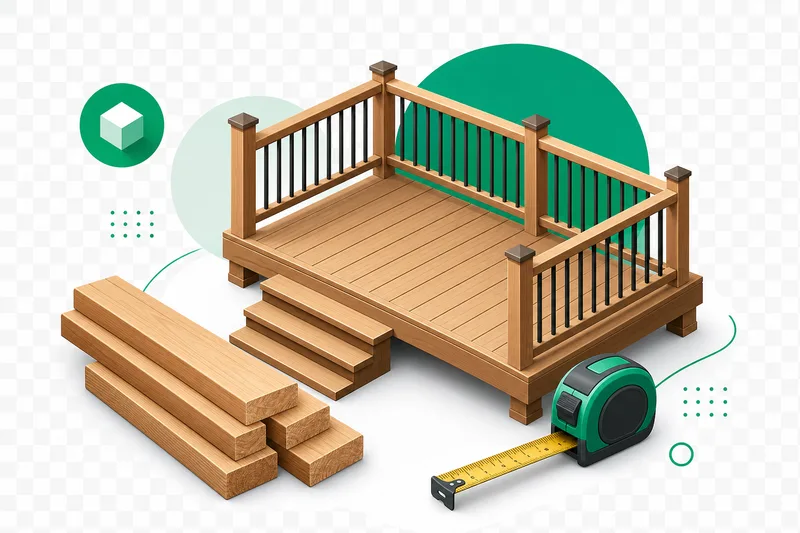
Planning a new deck starts with knowing exactly how much material you need and what it will cost. The EstiCube deck calculator gives you an instant material takeoff and installed cost estimate based on your deck dimensions, decking type, and joist spacing — using 2026 US national averages for materials and labor.
Whether you are budgeting for a 12×16 pressure-treated platform or a 400 sq ft composite entertainment deck, enter your measurements below to get board counts, framing quantities, concrete footing estimates, and a realistic cost range before you talk to contractors or visit the lumber yard.
How much does a deck cost in the US?
Deck costs in the United States typically range from $25 to $60 per square foot installed, depending on size, materials, height, railing, and your region. A basic 12×16 ft (192 sq ft) pressure-treated wood deck often runs $4,800–$6,700 installed, while the same size in composite decking can reach $8,600–$11,500.
Material alone accounts for roughly 40–55% of total cost. Pressure-treated pine is the most affordable decking at $2.50–$4.50 per linear foot. Cedar runs $5–$8/ft, composite $7–$12/ft, and PVC $9–$14/ft. Labor adds $12–$18 per square foot depending on complexity, permits, and local contractor rates.
Use the calculator above to get a customized estimate. Add 10–15% to your budget for unexpected site work, permits ($150–$500 in most municipalities), and upgrades like built-in benches, lighting, or stairs.
Deck materials this calculator estimates
Our deck material calculator estimates 5/4×6 decking boards (8 ft length), floor joists based on your on-center spacing, support beams, concrete footings, deck screws, and optional railing by the linear foot. Joist spacing of 16 inches on-center is the US residential standard for most decking products.
Pressure-treated Southern yellow pine remains the most popular choice for budget-conscious builds. Composite and PVC decking cost more upfront but require virtually no staining or sealing. Cedar offers a natural look with moderate maintenance. Select your material in the calculator to compare costs side by side.
Deck planning tips before you build
Check local building codes before finalizing your design. Most US jurisdictions require permits for decks attached to a home, decks over 30 inches above grade, or any deck with guardrails. Typical requirements include 36–42 inch railing height, 4×4 inch posts spaced no more than 6 feet apart, and footings below the frost line.
Measure twice: record length and width at multiple points since yards are rarely perfectly square. Account for stairs, angles, and picture-frame borders separately. For DIY builds, order 10% extra decking for cuts and waste. For contractor quotes, use our estimate as a baseline and get three local bids.
How to use the deck cost calculator
- Measure your planned deck length and width in feet. For L-shaped decks, calculate each rectangle separately and add the areas together.
- Select your decking material — pressure-treated pine for budget builds, composite or PVC for low maintenance, cedar for natural aesthetics.
- Choose joist spacing: 16 inches on-center is standard; use 12 inches for diagonal board layouts or heavy hot tub loads.
- Enable railing if your deck surface is more than 30 inches above ground. Enter the number of sides that need guardrails.
- Review your instant results: board count, joist and beam quantities, footing count, material cost, labor estimate, and total cost per square foot.
- Use the material list for shopping and the total cost to compare contractor quotes in your area.
Deck calculator FAQ
How many deck boards do I need?
Divide your deck square footage by 5.33 — the effective coverage of one 5/4×6 inch board at 16-inch joist spacing — then add 10% for waste and offcuts. For a 12×16 ft deck (192 sq ft), you need approximately 40 boards plus 4 extra for waste. The EstiCube deck board calculator performs this automatically based on your exact dimensions and joist spacing.
How much does it cost to build a 12×16 deck?
A 12×16 foot deck (192 sq ft) typically costs $4,800–$6,700 installed with pressure-treated wood, or $8,600–$11,500 with composite decking. Material-only costs run $1,800–$2,800 for wood and $3,500–$5,000 for composite. Actual prices vary by state, site access, railing requirements, and whether the deck is freestanding or attached to your home.
What is the average deck cost per square foot in 2026?
In 2026, average installed deck costs in the US are: pressure-treated wood $25–$35/sq ft, cedar $35–$45/sq ft, composite $45–$55/sq ft, and PVC $50–$60/sq ft. These figures include framing, decking, hardware, and labor. Elevated decks, complex shapes, and premium railing systems push costs toward the higher end.
What joist spacing should I use for a deck?
Sixteen inches on-center (16" OC) is the most common joist spacing for residential decks in the US. Use 12" OC for diagonal decking patterns, commercial loads, or when required by composite decking manufacturers. Twenty-four inch spacing is only suitable for select structural panels — not standard decking boards.
How many joists do I need for my deck?
Count one joist every 16 inches along the deck length, plus one at each end. A 16-foot long deck at 16" OC needs 13 joists. Our calculator accounts for your exact length and spacing. Joists typically run perpendicular to decking boards and sit on top of beams or a ledger board attached to the house.
Is composite decking worth the extra cost?
Composite decking costs 50–80% more than pressure-treated wood upfront but eliminates annual staining, sealing, and most splinter repairs. Over a 15–25 year lifespan, many US homeowners break even or save money with composite — especially in humid climates where wood degrades faster. Factor in your maintenance tolerance and how long you plan to stay in the home.
Do I need a permit to build a deck?
Most US cities and counties require a building permit for attached decks, decks over 30 inches high, or decks exceeding 200 square feet. Permit fees range from $150 to $500. Your local building department will specify footing depth (often 36–48 inches below frost line), railing height, and structural connection requirements. Always check before you build.
How deep should deck footings be?
Deck footings must extend below the frost line in your region — typically 36 inches in the South, 42–48 inches in the Midwest and Northeast. Each footing is usually 12 inches in diameter filled with concrete. Our calculator estimates footing count based on beam layout. Consult local codes for exact depth and diameter requirements in your zip code.
How much does deck railing cost?
Deck railing costs $40–$75 per linear foot installed in the US. Wood railing is the most affordable at $40–$50/ft. Cable railing runs $80–$120/ft. For a 12×16 deck with railing on three sides (44 linear feet), budget $1,760–$3,300. The calculator includes a basic wood/composite railing estimate when you enable the railing option.
Can I use this deck calculator for a DIY project?
Yes. EstiCube is designed for both DIY homeowners and contractors. Use the material quantities to build your shopping list at Home Depot, Lowe's, or a local lumber yard. The cost breakdown separates materials from labor — if you are building yourself, focus on the material cost line and add 10% for hardware and fasteners you might overlook.
Sources
- Prescriptive Residential Wood Deck Construction Guide (DCA 6) — American Wood Council
- Section R312 — Guards — International Code Council (2021 IRC)
- Home Safe: Outdoor Repairs Checklist — U.S. Consumer Product Safety Commission
- Frost Depth in Regions of the Central U.S. — National Oceanic and Atmospheric Administration
Related calculators
Projects often planned together — jump to a related estimator for the next line item.
Fence
Estimate fence posts, panels, pickets, and installed cost per foot. Free fence material calculator for wood, vinyl, chain-link, and aluminum.
Paver
Calculate paver count, gravel base, bedding sand, and patio install cost. Includes pattern waste, edge restraint, and polymeric sand.
Concrete
Calculate cubic yards of concrete for slabs, driveways, and sidewalks. Includes bags, rebar, delivery, and pour cost estimates.
Gravel
Calculate cubic yards and tons of gravel for driveways, paths, and base fill. Free gravel calculator with delivery and spreading cost estimates.
House
Full home construction estimator — foundation, basement, framing, roof, MEP & finishes. Cost ranges for every building phase.
More outdoor projects calculators
Decks, pavers, asphalt driveways, fences & hardscape
Explore all 4 categories
Browse every free EstiCube tool by project type — home builds, outdoor hardscape, landscape, and commercial pavement.
View full calculator directory