Gravel Calculator
Estimate cubic yards, tons, and total cost for crushed stone, pea gravel, crusher run, limestone, and river rock. Rectangle or round areas with depth, waste, delivery, and spreading labor.
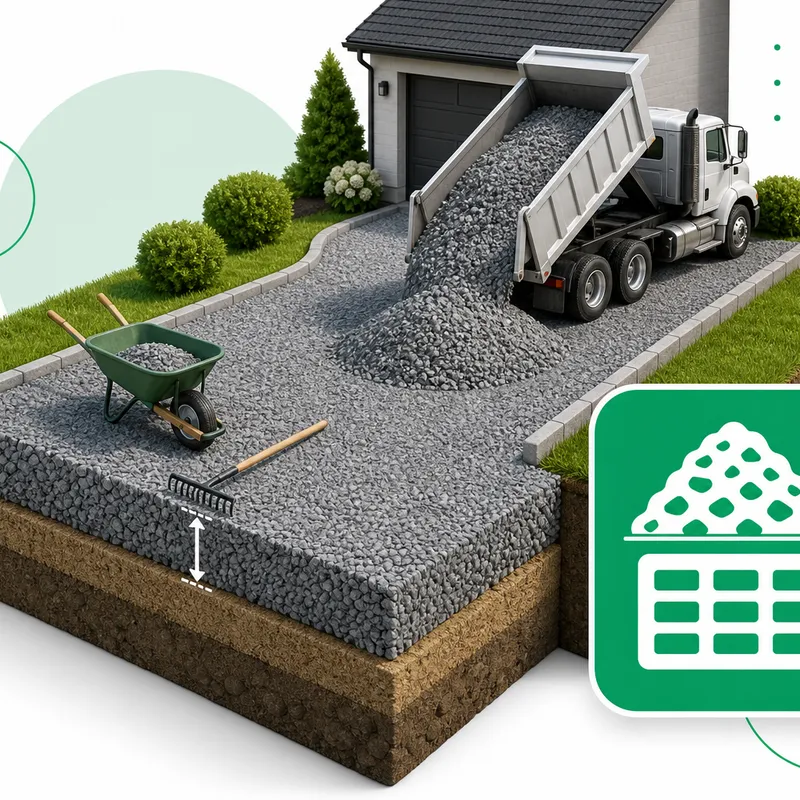
Ordering too little gravel means a second delivery fee; ordering too much leaves a pile you do not need. The EstiCube gravel calculator converts your driveway, path, or patio base dimensions into cubic yards, tons, and a realistic material budget using 2026 US supplier averages.
Enter length and width (or diameter for round beds), choose gravel type and depth, and get order quantities with optional delivery and spreading labor — before you call the landscape supply yard or schedule a dump truck.
How much does gravel cost in the US?
Bulk gravel in the United States typically costs $40–$85 per cubic yard for material, plus $75–$175 delivery on loads under 10–12 cubic yards. #57 crushed stone and crusher run are the most affordable at $38–$55/cu yd. Decorative river rock runs $70–$95/cu yd. A 12×40 ft driveway at 4-inch depth needs about 6 cubic yards — roughly $290–$420 in stone plus delivery.
Gravel is sold by the cubic yard loose or by the ton at quarries. Crushed stone weighs about 1.35 tons per cubic yard; crusher run about 1.5 tons. Always order 10% extra for compaction and spillage. Truck capacities: single-axle dump 5–8 cu yd, tandem 10–14 cu yd.
Professional spreading and compaction adds $25–$40 per cubic yard. DIY homeowners rent a plate compactor for $60–$90/day. Geotextile fabric under driveways prevents stone from sinking into clay — budget $0.10–$0.20/sq ft additional.
Gravel types this calculator supports
#57 crushed stone is angular 3/4-inch rock — the standard base for driveways, paver patios, and French drains. Crusher run (road base) includes fines that compact into a solid surface. Pea gravel is rounded and best for walkways and decorative beds, not vehicle traffic. #411 limestone compacts well in wet climates. River rock is decorative only — too round for structural base.
Depth guidelines: paver and shed bases 4 inches compacted; residential gravel driveways 4–6 inches; footpaths 2–3 inches; drainage trenches 6–12 inches. Compact each lift with a plate compactor in 2-inch layers for driveways.
Gravel ordering tips
Measure your area in feet and depth in inches — the calculator converts to cubic yards automatically. For irregular shapes, break the project into rectangles and add the volumes together.
Schedule delivery when you can spread the same day — a full dump truck will block your driveway. Confirm the quarry's minimum load and whether tailgate spreading is included. Wet gravel weighs more but volume is what you order.
How to use the gravel calculator
- Measure the area — rectangle for driveways and paths, diameter for round garden beds.
- Enter depth in inches after compaction (4 in. is standard for driveways and paver base).
- Select gravel type: #57 stone for most base work, crusher run for driveways, pea gravel for paths.
- Keep 10% waste for compaction settlement unless your supplier recommends otherwise.
- Enable delivery if ordering under 12 cubic yards. Enable spreading labor if hiring help.
- Review cubic yards, tons, material cost, and total price before placing your order.
Gravel calculator FAQ
How do I calculate cubic yards of gravel?
Multiply length × width × depth in feet to get cubic feet, then divide by 27. Example: 40 ft × 12 ft × (4/12) ft = 160 cu ft ÷ 27 = 5.9 cubic yards. For round areas use π × radius² × depth ÷ 27. Add 10% for compaction waste. Our calculator does this automatically.
How many tons of gravel are in a cubic yard?
Crushed stone (#57) weighs about 1.35 tons per cubic yard. Crusher run about 1.5 tons. Pea gravel about 1.4 tons. River rock about 1.35 tons. Tons matter for quarry pickups; cubic yards matter for volume when ordering by truck.
How deep should a gravel driveway be?
Residential gravel driveways need 4–6 inches of compacted crushed stone over a geotextile fabric on clay soil. Light foot traffic paths need 2–3 inches. Paver patios require 4 inches of #57 stone plus 1 inch of sand. Heavier truck traffic may need 8+ inches of crusher run in lifts.
How much does gravel delivery cost?
Local delivery of 3–8 cubic yards typically runs $75–$175 depending on distance and market. Many suppliers waive or reduce delivery on loads over 10–12 cubic yards. Our calculator adds a $125 planning allowance for loads under 12 cu yd when delivery is selected.
Pea gravel vs crushed stone — which should I use?
Use angular crushed stone (#57 or crusher run) for any surface that supports weight — driveways, shed pads, paver base. Pea gravel is rounded, shifts under tires, and is best for decorative paths, dry creek beds, and garden mulch. Never use pea gravel as a structural driveway base.
Should I compact gravel in layers?
Yes for driveways and paver bases. Spread and compact in 2-inch lifts with a plate compactor until the surface is firm with no footprint indentation. A single thick dump-and-flatten pass leads to settling ruts within months.
How many 0.5 cu ft bags equal a cubic yard?
One cubic yard equals 54 half-cubic-foot bags. Bags suit small pothole repairs and garden paths under 2–3 cubic yards total. Above that, bulk delivery is far cheaper per yard than bagged retail from big-box stores.
Can I use this for French drain gravel?
Yes — enter your trench length as rectangle length, trench width as width, and depth as gravel fill depth. Use #57 clean crushed stone for drainage; avoid crusher run fines that can clog perforated pipe. Wrap pipe in filter fabric and surround with stone.
Sources
- Earth and Aggregate Surfacing Design Guide (Technical Note 210-AEN-04) — USDA Natural Resources Conservation Service
- Gravel Drainage Specifications — Penn State Center for Sports Surface Research
- Heavy Use Area Protection — Conservation Practice Standard (Code 561) — USDA Natural Resources Conservation Service
Related calculators
Projects often planned together — jump to a related estimator for the next line item.
Paver
Calculate paver count, gravel base, bedding sand, and patio install cost. Includes pattern waste, edge restraint, and polymeric sand.
Concrete
Calculate cubic yards of concrete for slabs, driveways, and sidewalks. Includes bags, rebar, delivery, and pour cost estimates.
Mulch
Calculate cubic yards and bags of mulch for landscape beds and tree rings. Includes delivery and install cost for hardwood, cedar, and rubber mulch.
Topsoil
Calculate cubic yards of topsoil for lawn prep, garden beds, and yard leveling. Includes delivery and spreading cost estimates.
Asphalt
Calculate tons of hot-mix asphalt for driveways and overlays. Includes gravel base, sealcoating, and paving cost estimates.
More outdoor projects calculators
Decks, pavers, asphalt driveways, fences & hardscape
Explore all 4 categories
Browse every free EstiCube tool by project type — home builds, outdoor hardscape, landscape, and commercial pavement.
View full calculator directory