Homeowners compare fence quotes by the price per foot, but a contractor who builds the bid that way loses money on the jobs that do not fit the average: the short run with two gates, the yard with six corners, the slope. A fence bid holds up when the takeoff is done first and the per-foot rate, the gates and the extras are priced from it. This guide walks through that process using the EstiCube fence calculator, which works as a fence bid calculator when you switch it to Contractor bid mode. If you are a homeowner comparing quotes, the fence cost per foot guide is the better read.
All figures are national planning numbers from the calculator, not a market rate. Enter your own material, labor, gate and concrete prices in its pricing section and use the examples here to check the method.
Measuring the job
Walk the line with the customer and measure each side separately, rather than taking one total off a plat. Note every corner and end, each gate with its width and swing, any change in grade, trees, slabs or utilities in the line, and where the customer believes the property line is. If the line is in doubt, a survey is the customer's call to make before you set posts, and the quote should say so.
The calculator takes the total length, the height, the material, the number of gates and the post spacing, and produces a takeoff. For its default job, 150 feet of 6-foot wood privacy with one gate at 8-foot spacing, that is 19 sections, 22 posts, 57 rails, 328 pickets and 33 bags of 80-pound concrete. The rails and pickets are a count for ordering; their cost sits inside the per-foot material rate.
The post count assumes one straight run: one post per section plus one, and two more per gate. A layout with three or four sides needs extra corner and end posts that the count does not include. At the calculator's rates each extra post adds 1.5 bags of concrete, $9, and the post itself is material you should add from your own supplier price.
Posts go in the ground, so the locate is part of the job. The 811 site lists installing fences among common projects and says every digging project, regardless of depth, calls for contacting 811 a few business days before you dig. Decide who requests it and put that in the quote.
Building per-foot and gate prices
A quote that separates the run from the gates is easier to defend and adjusts cleanly when the customer adds a gate. The table gives the calculator's cost per foot for a 6-foot fence with no gate at 8-foot post spacing, which includes about $1.20 per foot of line-post concrete, and the same rate after 10% overhead and 20% profit. Price each gate on top: $168 in cost or $221.76 marked up, covering the $150 gate and concrete for its two posts.
Height scales the material and labor rates in the calculator by height divided by 6, so a 4-foot fence is two thirds of these rates and an 8-foot fence a third more, while gates and concrete stay the same. Build a separate row for each height you commonly install.
| 6-ft fence, 8-ft spacing | Cost per foot | Quote per foot (10% overhead, 20% profit) |
|---|---|---|
| Chain link | $21.20 | $27.98 |
| Wood picket | $25.20 | $33.26 |
| Wood privacy | $31.20 | $41.18 |
| Vinyl | $43.20 | $57.02 |
| Aluminum | $49.20 | $64.94 |
| Each gate, any material | $168 | $221.76 |
Short runs, extra gates and minimum charges
A gate spread over 24 feet weighs much more than the same gate spread over 300. The table runs 6-foot wood privacy with one gate at different lengths. Cost per foot climbs from $31.73 on 300 feet to $38.50 on 24 feet, which is why a single per-foot rate that includes gates underprices small jobs.
The calculator has no minimum job charge. A 24-foot run with no gate costs $756 in it, and nothing stops a quote from going out at that figure plus markup. On a short run, the truck, the auger and the crew's travel and setup can be a large share of what the job really costs you, so set a minimum from what a crew day and a trip actually cost you and state it on the quote.
Extra gates are similar. On the default 150 feet, each one adds $168: $4,680 with none, $4,848 with one, $5,016 with two and $5,184 with three. Wide drive gates, double gates and upgraded hardware cost more than the calculator's basic walk gate, so change the gate price in the pricing section or quote them as separate items.
| Wood privacy, 6 ft, 1 gate | Cost | Per foot | Quote (10% overhead, 20% profit) |
|---|---|---|---|
| 24 ft | $924 | $38.50 | $1,219.68 |
| 40 ft | $1,422 | $35.55 | $1,877.04 |
| 60 ft | $2,049 | $34.15 | $2,704.68 |
| 100 ft | $3,294 | $32.94 | $4,348.08 |
| 150 ft | $4,848 | $32.32 | $6,399.36 |
| 300 ft | $9,519 | $31.73 | $12,565.08 |
Adding overhead and profit with Contractor bid mode
The fence calculator's estimate is your direct cost: material, gates, concrete and labor. Switch the result panel to Contractor bid mode and it breaks that cost into line items, then adds markup. For the default job the lines are gates $150, post concrete $198, fence materials $2,700 and installation labor $1,800, which add up to the same $4,848. At the bid mode defaults, 10% overhead and then 20% profit on cost plus overhead, the job carries $484.80 of overhead and $1,066.56 of profit, for a customer price of $6,399.36, about $42.66 per foot.
The two steps compound to 32% over cost, which is about a 24% margin on the selling price. Set the percentages from your own books, not from a competitor's per-foot price. Bid mode also has contingency, which is added before overhead, and a material tax percentage that applies to the materials only. On the default job a 7% material tax adds $213.36 and brings the price to $6,612.72, and a 5% contingency on its own adds a $242.40 line before the markup and brings it to $6,719.33.
Extra line items are where bid mode handles the work the takeoff leaves out. Add up to five, such as tear-out and haul-away, permits or a survey. They go in with the cost before the markup, so they carry overhead and profit like everything else. A $600 tear-out line on the default job takes the price from $6,399.36 to $7,191.36.
Lines to price separately
The calculator prices new fence on open, level ground. These items are outside it, and each is better as its own line than buried in the per-foot rate, because they vary from yard to yard:
- Tear-out and haul-away of an old fence, per foot plus disposal.
- Extra corner and end posts on multi-sided layouts.
- Stepping or racking panels on a slope, and extra time for rock or roots.
- Wide drive gates, double gates, latches and self-closing hardware.
- Permits, HOA submittals and a survey if the customer wants one.
- Clearing brush or relocating plants along the line.
Writing the fence quote
The FTC's advice to homeowners says a written estimate should include a description of the work, the materials, the completion date and the price, and that a contract should carry the contractor's name, address, phone number and license number with estimated start and completion dates. It tells homeowners not to pay the full amount up front, and says a contract signed in their home, or anywhere other than the seller's permanent place of business, should include a written statement of their right to cancel within three business days. Customers who have read that will look for those items.
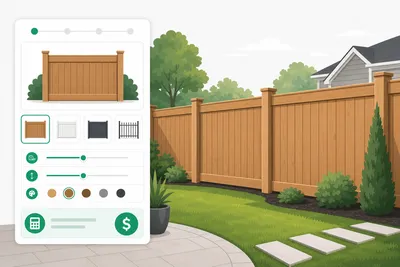
In Contractor bid mode the fence calculator prints a branded proposal with your company name, logo, phone, email and license number, the client and job address, the date and a valid-until date (30 days by default), the line items, the markup and the total. Use Print or Save PDF to send it, or copy a link that reopens the same bid. The scope, terms and cancellation notice are yours to add, so check that the quote you send lists:
- Linear feet by side, height, material and style, and post spacing.
- Gates by width, swing and hardware, each priced separately.
- Post setting method and concrete, and who requests the 811 locate.
- Included and excluded items: tear-out, haul-away, permits, survey, slope work.
- Price, deposit and payment schedule, start and completion dates, warranty and how long the quote is valid.
Run your numbers with the Fence Calculator
Change any unit price to match your quote and see every line item add up. It is free, needs no sign-up and works on your phone.
Open the Fence calculatorFrequently asked questions
How do I bid a fence job?
Measure each side, count gates, corners and slopes, and run the takeoff. Price the run per foot and each gate separately, add tear-out and other extras, then apply overhead and profit. In the EstiCube fence calculator, 150 feet of 6-foot wood privacy with one gate costs $4,848, and Contractor bid mode takes it to $6,399.36 with 10% overhead and 20% profit.
How much should I charge per foot to install a fence?
Build it from your costs. In the calculator, a 6-foot fence costs about $21.20 per foot in chain link, $25.20 in wood picket, $31.20 in wood privacy, $43.20 in vinyl and $49.20 in aluminum before gates. With 10% overhead and 20% profit those become about $27.98, $33.26, $41.18, $57.02 and $64.94 per foot.
How should I price fence gates?
As separate line items. The calculator adds $168 per gate in cost, the $150 gate plus concrete for its two posts, or $221.76 with the default markup. Price wide drive gates and double gates at your own figure in the pricing section.
Is there a fence estimate template or fence quote calculator?
Yes. The EstiCube fence calculator works as a fence quote calculator: posts, sections, rails, pickets, concrete, material, labor and cost per foot, with every rate editable. Contractor bid mode adds overhead, profit, contingency and extra lines, and prints a branded proposal with your company details and a valid-until date, which you can save as a PDF or share as a link.
What minimum should a fence contractor charge?
The calculator has no minimum charge, and a 24-foot run with no gate costs $756 in it. Set a minimum from what a crew day, the trip and equipment setup cost you, and state it on every quote so small jobs still cover their overhead.
Sources
- How To Avoid a Home Improvement Scam — Federal Trade Commission
- 811 Before You Dig — Common Ground Alliance
More guides