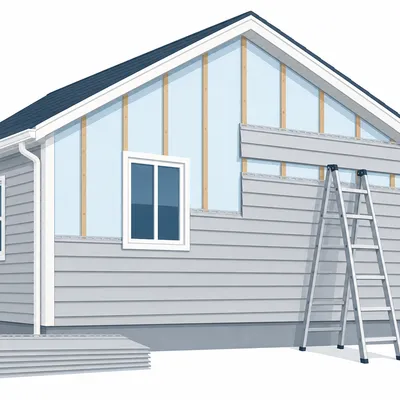
A siding quote usually goes wrong in one of three places: the takeoff misses wall area, the trim and accessories are guessed instead of counted, or the markup is applied in a way that leaves less profit than intended. This guide walks through building a siding bid in the order a contractor works: measure the walls, convert to squares, add waste and trim, price labor and the extras, then add overhead and profit and put it in writing. The EstiCube siding calculator does the takeoff and, in Contractor bid mode, the markup and a printable proposal, so it can serve as your siding quote calculator.
Dollar figures come from the EstiCube siding calculator and are national planning numbers, not a market survey. Your supplier price, crew rate and local rules will differ, so enter your own rates in the calculator's pricing section and use the examples here to check the method.
Measuring the walls and converting to squares
Measure each wall as width times height and add gables as half of base times height. One common approach is to deduct only large openings such as garage doors and picture windows and leave ordinary windows and doors in the area, on the reasoning that cutting around them produces offcuts anyway; some installers deduct every opening instead. Whichever rule you use, use it the same way on every bid so your rates stay comparable.
The calculator takes the total wall area, the number of stories, the material and a waste percentage between 5% and 15%. It adds the waste, rounds up to whole squares and prices the siding on the area with waste. Its default job is 1,800 sq ft of wall on a two-story house in vinyl with 10% waste: 1,980 sq ft of siding to buy, or 20 squares. The house size changes the takeoff like this:
| Wall area (2 stories, 10% waste) | Squares to buy | Trim (linear ft) | Vinyl job cost |
|---|---|---|---|
| 1,200 sq ft | 14 | 360 | $9,156 |
| 1,800 sq ft | 20 | 540 | $13,734 |
| 2,500 sq ft | 28 | 750 | $19,075 |
| 3,500 sq ft | 39 | 1,050 | $26,705 |
Waste, trim and stories
Waste changes what you buy, not what you install. On the default job, 5% waste means 19 squares and $7,182 of material, 10% means 20 squares and $7,434, and 15% means 21 squares and $7,686. Labor stays at $6,300 in all three, because the calculator prices installation on the 1,800 sq ft of wall. A simple, boxy house can sit at the low end; a house with many corners, dormers and gables typically needs the high end.
Trim covers corners, J-channel around openings and similar accessories. The calculator estimates it at 0.15 linear feet per sq ft of wall for each story and prices it at $3.50 per linear foot. On the default wall area that is 270 feet ($945) for one story, 540 feet ($1,890) for two and 810 feet ($2,835) for three, giving totals of $12,789, $13,734 and $14,679. Treat that as a starting figure and count the real corners and openings on the walk-around.
Note what the stories setting does not do: it does not raise the labor rate. On a two- or three-story house, ladders, pump jacks or scaffolding and fall protection take time and equipment that a one-story job does not. OSHA notes that falls are among the most common causes of serious work-related injuries and deaths, so plan and price that setup as its own line rather than hoping the per-square rate absorbs it.
Material and labor rates by siding type
The calculator carries a material rate and a labor rate per sq ft for four sidings, plus the $3.50 trim rate. The table runs the same default job, 1,800 sq ft on two stories with 10% waste and trim, in each one. The per-square figure is the total divided by 18 squares of wall, which is how many contractors talk about price, and the last column applies 10% overhead and 20% profit.
Fiber cement and wood cost more on both lines, because the boards cost more and each piece takes longer to cut and fasten. If your crew is faster or slower on a given product, change the labor rate in the pricing section rather than adjusting the total by eye.
| Siding (1,800 sq ft wall) | Material + labor rate | Job cost | Per square of wall | With overhead and profit |
|---|---|---|---|---|
| Vinyl | $2.80 + $3.50 per sq ft | $13,734 | $763 | $18,128.88 |
| Aluminum | $4.00 + $4.50 per sq ft | $17,910 | $995 | $23,641.20 |
| Fiber cement | $4.50 + $5.50 per sq ft | $20,700 | $1,150 | $27,324.00 |
| Wood or cedar | $5.50 + $6.00 per sq ft | $23,580 | $1,310 | $31,125.60 |
Tear-off, lead-safe work and other lines to add
The calculator prices new siding, trim and installation. Everything below is outside it, and these are the lines that turn a profitable siding job into a break-even one when they are left off. Price each from your own costs and list it separately so the homeowner can see what it covers.
Lead deserves particular care. EPA's Renovation, Repair and Painting rule says anyone paid to perform work that disturbs paint in housing built before 1978 must be certified, and that this includes all firms, even sole proprietorships. Tearing off painted wood siding or trim on an older house is that kind of work, so check the build year before you bid and include the lead-safe setup, containment and cleanup in the price.
- Tear-off of the old siding, dumpster and disposal.
- Sheathing repair found once the old siding is off, priced as a per-sheet or allowance line.
- Weather barrier or house wrap and flashing, if not in your material rate.
- Staging, scaffolding and fall protection for upper stories.
- Lead-safe work practices on pre-1978 houses.
- Permits, if your jurisdiction requires one for re-siding.
Adding overhead and profit with Contractor bid mode
The siding calculator's estimate is your direct cost of material and labor. Switch the result panel to Contractor bid mode and it splits that cost into line items: siding, trim and accessories, and installation labor. Lines for trim or labor drop out when you untick those options. For the default vinyl job the lines are $5,544 of siding on 1,980 sq ft, $1,890 of trim on 540 linear feet and $6,300 of labor on 1,800 sq ft, which add up to the same $13,734. Bid mode then applies overhead first and profit on cost plus overhead. At its defaults of 10% and 20%, the job carries $1,373.40 of overhead and $3,021.48 of profit, for a customer price of $18,128.88, about $1,007 per square of wall.
Those two steps compound to a 32% markup over cost. That is not a 32% margin: as a share of the selling price it is about 24%. Mixing up markup and margin is an easy way for a bid to come in thinner than planned, so decide which one your books target and work back to the percentages. Bid mode also has a contingency percentage, applied before overhead, and a material tax percentage that applies to the siding and trim only. On the default job a 7% material tax adds $520.38 and brings the price to $18,649.26, and a 5% contingency on its own adds a $686.70 line before the markup and brings it to $19,035.32.
The extra lines from the previous section go in as bid mode extras, up to five, such as tear-off and disposal, sheathing allowance or lead-safe setup. They are added to the cost before the markup, so overhead and profit are earned on them too. A $1,800 tear-off line on the default job takes the price from $18,128.88 to $20,504.88.
Writing the siding quote
A siding quote the homeowner can check heads off most disputes before they start. The FTC's advice to homeowners says a written estimate should include a description of the work, the materials, the completion date and the price, and that a contract should carry the contractor's name, address, phone number and license number with estimated start and completion dates. It also tells homeowners not to pay the full amount up front, and that a contract signed in their home should include a written statement of their right to cancel within three business days. Writing those items in from the start makes your quote easier to say yes to.
In Contractor bid mode the siding calculator prints a branded proposal with your company name, logo, phone, email and license number, the client and job address, the date and a valid-until date (30 days by default), the line items, the markup and the total. Use Print or Save PDF to send it, or copy a link that reopens the same bid. The scope, terms and cancellation notice are yours to add, so check that the siding quote you send covers these points:
- Wall area, squares and waste allowance, and the siding product, profile and color.
- Trim, corners and accessories, and what is being wrapped or flashed.
- Tear-off and disposal, and how hidden sheathing damage will be priced.
- Lead-safe certification and practices on homes built before 1978.
- Price, deposit and payment schedule, start and completion dates, and warranty.
- How long the price is valid, since siding material prices can move.
Run your numbers with the Siding Cost Calculator
Change any unit price to match your quote and see every line item add up. It is free, needs no sign-up and works on your phone.
Open the Siding calculatorFrequently asked questions
How do you quote a siding job?
Measure the wall area, add waste and round up to squares, count the trim, then price material, labor and any tear-off, disposal, staging and lead-safe work. Add overhead and profit on top of that cost. In the EstiCube siding calculator, 1,800 sq ft of two-story vinyl costs $13,734, and Contractor bid mode takes it to $18,128.88 with 10% overhead and 20% profit.
How much should I charge per square to install siding?
Work it out from your costs rather than a single market rate. In the calculator, the default two-story job costs about $763 per square of wall in vinyl, $995 in aluminum, $1,150 in fiber cement and $1,310 in wood before markup. With 10% overhead and 20% profit, vinyl comes to about $1,007 per square.
How many squares of siding do I need for 1,800 sq ft of wall?
With 10% waste, 1,800 sq ft becomes 1,980 sq ft, which the calculator rounds up to 20 squares. At 5% waste it is 19 squares and at 15% it is 21.
Does the siding calculator have a bid mode?
Yes. Switch the result panel to Contractor bid mode and the siding calculator lists siding, trim and labor as line items, then adds overhead, profit, contingency, material tax and up to five extra lines such as tear-off. It prints a branded proposal with your company details and a valid-until date, which you can save as a PDF or share as a link. At the defaults, the two-story vinyl job comes to $18,128.88.
Do I need lead certification to replace siding?
On a house built before 1978, if the work disturbs painted surfaces, very likely yes. EPA says anyone paid to perform work that disturbs paint in pre-1978 housing must be certified, including sole proprietorships. Check the EPA Renovation, Repair and Painting program for the details that apply to your job.
Sources
- Lead Renovation, Repair and Painting Program — U.S. Environmental Protection Agency
- Fall Protection — Occupational Safety and Health Administration
- How To Avoid a Home Improvement Scam — Federal Trade Commission
More guides