Private Road Paving Cost Calculator
Price an HOA road, a commercial access road or a long private drive from its length and width, the aggregate base and the surface: gravel, single or double chip seal, or hot-mix asphalt. Then switch to contractor bid mode to build a proposal.
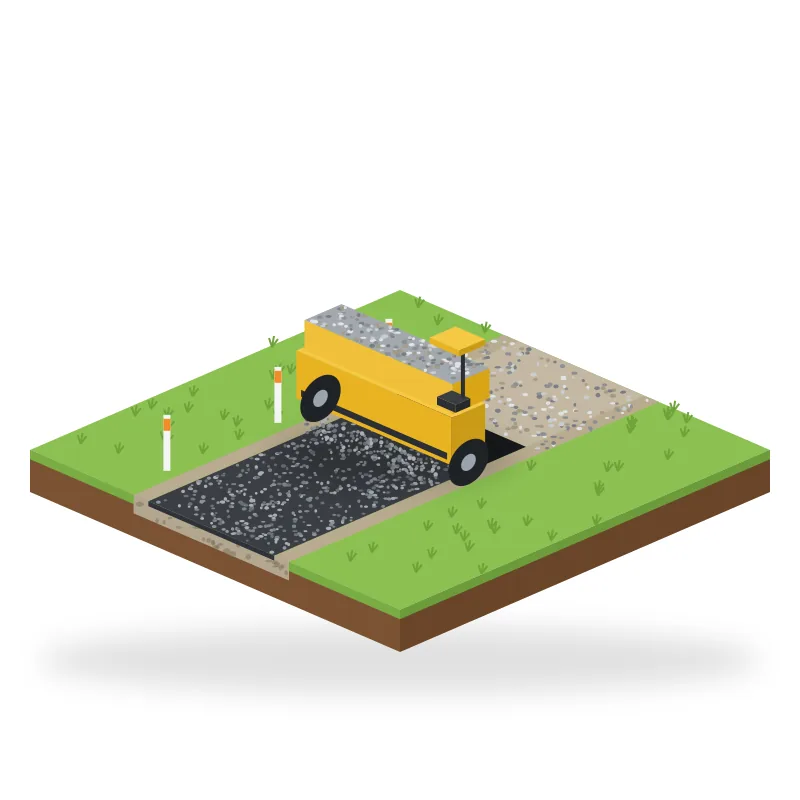
A private road is priced by the square yard and by the mile, not by the driveway. The EstiCube private road paving calculator takes the road length (in feet or miles) and width, works out the area in square yards, and prices grading and subgrade compaction, an aggregate base, the surface, any culverts and mobilization as separate lines.
Choose a 4 in gravel surface course, a single or double chip seal, or 2, 3 or 4 in of hot-mix asphalt, and set the base depth. Results are national-average estimates for a private owner, and every unit price can be replaced with a figure from a contractor quote. The calculator shows the total, the cost per square yard and the cost per mile, and it does not price ditching, striping, signs, drainage structures other than culverts, or engineering.
Want a hot-mix price on a smaller area? Use the asphalt paving cost calculator. Need the gravel volume for a different depth or shape? Use the gravel calculator.
Private road paving cost: unit prices used
Grading and chip seal are priced per square yard of road, and the base, gravel and asphalt per ton at 135 lb per cubic foot for aggregate and 145 for asphalt. The examples are for the default road: 1,320 ft long and 18 ft wide (0.25 mi, 23,760 sq ft or 2,640 sq yd) with a 6 in base. The total is never less than the minimum job charge.
| Line item | Unit price | Notes |
|---|---|---|
| Grading and subgrade compaction | $3.15 per sq yd | Default on; 2,640 sq yd, $8,316 |
| Aggregate base | $32 per ton | 6 in default; 801.9 tons, $25,661 |
| Gravel surface course, 4 in | $47 per ton | Optional surface; 534.6 tons, $25,126 |
| Single chip seal (tar and chip) | $3.00 per sq yd | Optional surface; 2,640 sq yd, $7,920 |
| Double chip seal | $5.50 per sq yd | Default surface; 2,640 sq yd, $14,520 |
| Hot-mix asphalt | $105 per ton | Optional surface; 3 in is 430.7 tons, $45,218 (2 in $30,146, 4 in $60,291) |
| Culvert, 18 in pipe | $3,400 each | About 30 ft with two end sections; none by default, 2 culverts $6,800 |
| Mobilization | $3,000 | Flat charge to bring the distributor, spreader, rollers and crew |
| Minimum job charge | $5,000 | Floor for a very short road or a zero-length estimate |
A default job (a 1,320 ft by 18 ft road with grading, a 6 in aggregate base, a double chip seal and no culverts) comes to $51,497, or $19.51 per sq yd and $205,988 per mile.
How much does private road paving cost?
With the defaults, a 1,320 ft by 18 ft road with grading, a 6 in aggregate base and a double chip seal comes to $51,497. Grading is $8,316, the base $25,661, the chip seal $14,520 and mobilization $3,000. That is $19.51 per square yard and $205,988 per mile. The aggregate base is half the job. The surface is the choice that moves the total: with everything else at the default, a single chip seal brings it to $44,897, a 4 in gravel surface to $62,103 and hot-mix asphalt to $67,123 at 2 in, $82,195 at 3 in and $97,268 at 4 in.
The base depth is the next biggest lever. A 4 in base takes the default to $42,943, 8 in to $60,050 and 12 in to $77,158, because each inch adds 133.7 tons of aggregate on this road. Turning grading off removes $8,316, and each culvert adds $3,400. Width scales the area: a 12 ft road comes to $35,331 and a 24 ft road to $67,662, because the area-based lines scale while mobilization does not.
Per mile, the same 18 ft road with grading and a 6 in base costs $170,587 with a single chip seal, $196,987 with a double chip seal, $239,412 with a gravel surface and $319,780 with 3 in of asphalt. Mobilization is spread across the whole length, so a long road costs less per mile than a short one. An existing road with a sound base is much cheaper than these figures: a 1 mile by 18 ft gravel surface course with grading and no new base comes to $136,769, and with neither base nor grading it is $103,505. Treat every unit price as a starting point and replace it with a quote.
Chip seal, gravel or asphalt: what each surface needs
A chip seal is a surface treatment, not a structure. It is a spray of asphalt emulsion covered with a layer of stone, and it needs a base that already carries the traffic. The FHWA chip seal checklist says to check that the project is a good candidate and that chip seals should not be used on pavements with structural distress. It also says to limit the average daily traffic and the share of commercial vehicles to the agency requirement, and to have the surface swept clean and dry with existing distresses repaired before the seal goes down. On a new private road, the aggregate base and grading lines are what give the chip seal something to sit on.
A single chip seal is one application of binder and stone. A double chip seal puts a second course over the first. The calculator prices the double seal as one price per square yard for both courses, $5.50, against $3.00 for a single, and the double price is an estimate. Either way, the FHWA checklist asks for traffic to be kept slow, 25 mph or less, over a fresh emulsion chip seal until it is swept and opened, so plan for traffic control and a slow reopening. That matters for an HOA road with one way in.
Hot-mix asphalt is the only paved option here that adds thickness and structure, which is why it costs the most. It is priced per ton at 145 lb per cubic foot, so each extra inch of thickness adds about 144 tons to the default road. Gravel has no seal over it, so it has to be graded and re-graveled from time to time, a maintenance cost the gravel roads manual asks owners to plan for. The calculator prices a 4 in crushed surface course, which is 534.6 tons on the default road: $25,126, more than the $7,920 of a single chip seal or the $14,520 of a double.
Gravel road crown, drainage and when you need culverts
Whatever the surface, water is what destroys a road, and the base and surface are only as good as the drainage under and beside them. The FHWA and South Dakota LTAP gravel roads manual says a properly drained gravel road should have a crown, and that an ideal crown is a straight slope of about one half inch per foot, or approximately 4 percent, up from the shoulder to the centerline. A road with no crown collects water on the surface, which softens it, and the traffic then pounds out ruts and potholes. The calculator does not price shaping to a crown separately: it is what the grading line is for.
A culvert is needed wherever water has to cross the road, such as a creek, a ditch that changes sides or a low point. The default price is for 18 in pipe about 30 ft long with an end section on each side, and 18 in is the minimum pipe size the manual gives as an example of a design standard. Culverts plug with eroded soil and debris and eventually have to be replaced, so a private road with culverts also needs someone to inspect and clean them. Enter the number of crossings and the calculator adds $3,400 for each, which is $6,800 for two. Trenching, bedding in poor soil, headwalls and ditch work can cost more.
The calculator leaves out a few things on purpose: ditching, shoulders, geotextile fabric or underdrains over wet or spring-fed ground, dust control on gravel, striping and signs, and engineering and permits. If the road crosses soft ground, ask for those as separate quotes.
DOT bid prices, private jobs and how the numbers compare
Several unit prices are anchored to state DOT bid tabulations, and those are priced for far bigger jobs than a private road. The Washington State DOT 2024 Eastern Region chip seal contract (opened March 27, 2024) covered 1,358,230 sq yd. Adding up its emulsion, 3/8 to No. 4 screenings and No. 4 to 0 screenings items and dividing by that area gives about $2.62 per sq yd for the low bidder, $2.82 for the second and $3.04 for the third. Those sums are our arithmetic, not prices WSDOT publishes, and they leave out mobilization, traffic control, fog seal and the contract's price adjustment item. The calculator's $3.00 for a single chip seal sits near the top of that range, because a private road is far smaller.
The other prices follow the same pattern. The South Dakota DOT 2024 Bid Item Price Report shows a base course average low bid of $30.14 per ton, gravel surfacing of $47.43 per ton and Class E asphalt concrete of $80.14 per ton, against the calculator's $32, $47 and $105. The asphalt gap is the largest: the DOT price is for 132,867 tons let in large contracts, and it may exclude binder, because the same report lists PG asphalt binder as separate bid items, while the calculator's $105 is the price a small private job pays per ton, and it matches the parking lot resurfacing calculator. The small-job premium is otherwise in the mobilization and minimum lines, which the DOT unit prices do not include.
A like-for-like check on culverts shows the match. At the same report's average low bids, 30 ft of 18 in corrugated metal pipe costs $29.84 per ft to furnish plus $39.52 per ft to install, or $2,081, and two flared end sections at $309.65 furnished plus $366.06 installed add $1,351. That is about $3,432 for pipe and ends, against the calculator's $3,400 for the same pipe and two end sections. Trenching, bedding and headwalls are not in those items. The double chip seal price of $5.50 and the $3,000 mobilization are estimates, so replace them with a quote.
How to use the private road paving calculator
- Enter the road length and width. Use the unit switch to type the length in feet or in miles: the calculator keeps the length in feet, so switching units does not change the road.
- Choose the surface: a 4 in gravel surface course, a single or double chip seal, or hot-mix asphalt. For asphalt, pick 2, 3 or 4 in of thickness.
- Enter the aggregate base depth in inches, from 0 to 12. Use 0 if the road already has a sound base and you are only paying for a new surface.
- Leave grading and subgrade compaction on for a new road or a rebuilt one, or turn it off for a road that is already shaped.
- Enter the number of culverts, one for each place where water has to cross the road.
- Open the pricing section and replace any unit price with a contractor quote. Then review the line items, the cost per square yard and the cost per mile, copy the share link, or switch to contractor bid mode to add overhead, profit and a proposal.
Private road paving cost FAQ
How much does it cost to pave a private road?
With the defaults (a 1,320 ft by 18 ft road with grading, a 6 in aggregate base and a double chip seal) the calculator gives $51,497, or $19.51 per square yard and $205,988 per mile. Hot-mix asphalt at 3 in brings the same road to $82,195 and a single chip seal to $44,897. The real figure depends on soil, base thickness, haul distance and local labor.
How much does a mile of private road cost?
For a 1 mile road 18 ft wide with grading and a 6 in base, the calculator gives $170,587 with a single chip seal, $196,987 with a double chip seal, $239,412 with a 4 in gravel surface and $319,780 with 3 in of hot-mix asphalt. The aggregate base alone is $102,643 of those totals. With no new base the figures fall sharply: a gravel surface with grading is $136,769, and with neither base nor grading it is $103,505.
How much does chip seal cost per square yard?
The calculator uses $3.00 per square yard for a single chip seal and $5.50 for a double. The Washington State DOT 2024 Eastern Region chip seal contract (1,358,230 sq yd) has emulsion and screenings items that add up to about $2.62, $2.82 and $3.04 per square yard for its three lowest bids, before mobilization, traffic control, fog seal and a price adjustment item. Smaller jobs cost more per unit, and the $5.50 double seal price is an estimate.
Does this work for a tar and chip driveway?
Yes. Choose the single chip seal, enter the driveway length and width in feet, and set the base depth to 0 and grading off if the base is sound. A 500 ft by 14 ft driveway (777.8 sq yd) comes to $5,333, of which $3,000 is mobilization and $2,333 is the chip seal. Short jobs are mostly mobilization, so get a quote.
Is chip seal cheaper than asphalt for a private road?
Yes, on the same base. With the defaults, a single chip seal is $44,897, a double chip seal is $51,497 and 3 in of asphalt is $82,195. The difference is the surface line: $7,920 for a single chip seal, $14,520 for a double and $45,218 for 3 in of asphalt. A chip seal also depends on a sound base under it, while the asphalt adds thickness.
What does a chip seal need underneath it?
A sound base. The FHWA chip seal checklist says chip seals should not be used on pavements with structural distress, asks you to limit the average daily traffic and the share of commercial vehicles to the agency requirement, and wants existing distresses repaired and the surface swept clean and dry first. On a new road, that is what the aggregate base and grading lines are for: $25,661 and $8,316 on the default road.
When does a private road need a culvert?
Wherever water has to cross the road, such as a creek, a ditch that changes sides or a low point. The FHWA and South Dakota LTAP gravel roads manual gives 18 in as the minimum culvert pipe in its example of a design standard. The calculator prices an 18 in pipe about 30 ft long with two end sections at $3,400 each, so two culverts add $6,800.
Why do DOT bid prices differ from this calculator?
State DOT bid tabs come from lettings of hundreds of thousands of square yards or tons, where mobilization and traffic control are a small share of the job. A private road is far smaller. The base, gravel and single chip seal prices are close to DOT averages, while the asphalt price is a small-job price above the DOT average, and the double chip seal, grading and mobilization are estimates. The small-job premium sits mainly in a $3,000 mobilization and a $5,000 minimum job.
Sources
- Pavement Preservation Checklist Series 2: Chip Seal Checklist (candidate projects, surface preparation, traffic control) — Federal Highway Administration
- Gravel Roads Maintenance and Design Manual (crown, culverts, design standards) — Federal Highway Administration and South Dakota LTAP, hosted by the U.S. EPA
- 2024 Bid Item Price Report (base course, gravel surfacing, asphalt concrete and culvert pipe average low bids) — South Dakota Department of Transportation
- Bid check report, 2024 Eastern Region Chip Seal, contract XE3519, bids opened March 27, 2024 (emulsion and screenings unit prices) — Washington State Department of Transportation
Related calculators
Projects often planned together — jump to a related estimator for the next line item.
Asphalt
Calculate tons of hot-mix asphalt for driveways and overlays. Includes gravel base, sealcoating, and paving cost estimates.
Gravel
Calculate cubic yards and tons of gravel for driveways, paths, and base fill. Free gravel calculator with delivery and spreading cost estimates.
Land clearing
Estimate land clearing cost per acre from acreage, vegetation density, and method (forestry mulching, haul-off, or burn), plus grubbing and silt fence.
Sealcoating
Calculate sealcoat gallons and cost for parking lots and commercial pavement. Includes mobilization, crack prep, traffic control, and two-coat application.
Crack Seal
Estimate linear feet of crack sealant, hot-pour blocks, and routing cost for parking lot pavement maintenance. Includes mobilization and minimum trip charges.
Pothole
Estimate pothole patch count, cold mix bags, saw-cut prep, and repair cost for parking lots and commercial pavement. Includes mobilization minimums.
More pavement & parking calculators
Striping, paving, ADA, sealcoating, signs, sweeping & curbing
Explore all 6 categories
Browse every free EstiCube tool by project type — pavement & parking, commercial property, outdoor projects, home & structure, landscape & lawn, home services.
View full calculator directory