Commercial Sidewalk Trip Hazard Repair Cost Calculator
Price trip-hazard grinding by the inch-foot, panel replacement, saw cutting, curb ramps and detectable warning pads for commercial and property-manager sidewalks. Copy the share link, or switch to contractor bid mode to build a proposal.
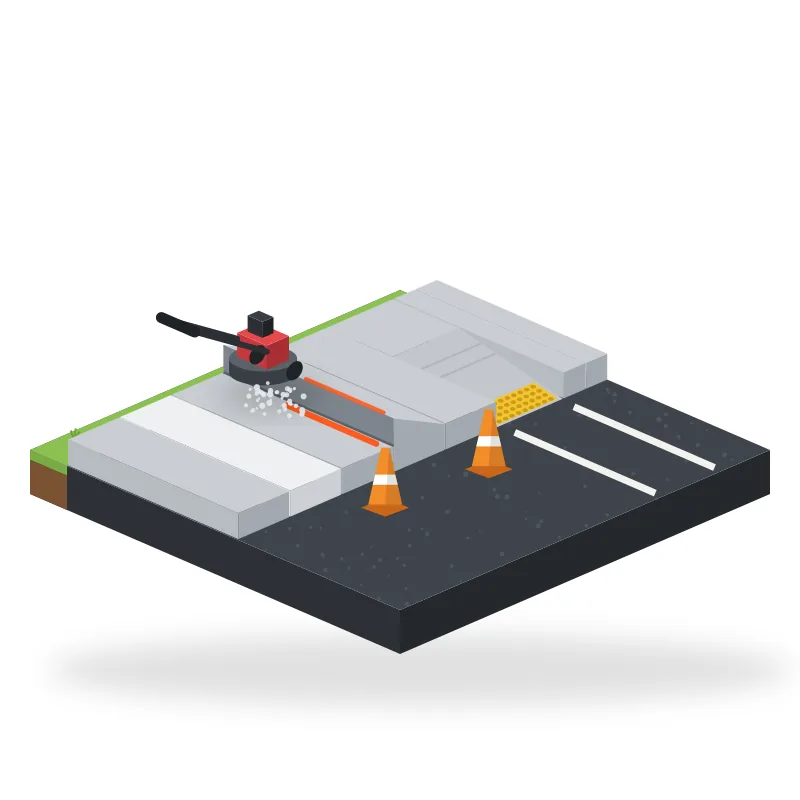
Property managers, HOAs, retail owners and the contractors who bid their walks buy sidewalk repair as a short list of items: grind the small lips, replace the panels that are too far gone, cut them out cleanly, rebuild a curb ramp, and set detectable warning pads. The EstiCube sidewalk trip hazard calculator prices each on its own line: grinding by the inch-foot, panels by the square foot, saw cutting by the linear foot, curb ramps by the square foot and detectable warning pads each. Pedestrian control, when you turn it on, and mobilization are charges on top, and the $1,500 minimum is a floor that sets the price only when the job adds up to less.
Count your trip hazards in two bands, 1/4 to 1/2 in and 1/2 to 2 in, with an average length for each, and say how many panels to replace and their size. The calculator turns hazards into inch-feet, which is how Federal Way’s bid tab below prices grinding. Public bids are municipal-volume prices, and a small private job usually prices higher, so the unit prices here are planning estimates that you can replace with a contractor quote. This is an estimate, not a quote, and it does not decide what the ADA requires of your property.
Upgrading accessible stalls, curb ramps and signs in the lot as well? Use the ADA parking and curb ramp cost calculator. Repairing a homeowner’s slab, driveway or walk rather than a commercial one? Use the concrete slab calculator. For the ADA 303 thresholds, grind versus replace, and who is responsible for a sidewalk, read the guide to sidewalk trip hazards and ADA requirements.
Sidewalk trip hazard repair cost: unit prices used
Grinding is priced per inch-foot: the vertical offset in inches times the length in feet. The calculator uses 0.375 in for the 1/4 to 1/2 in band and 1.25 in for the 1/2 to 2 in band, the middle of each band. The examples use the default job: 20 hazards in the lower band averaging 5 ft, 4 hazards in the upper band averaging 4 ft, 6 panels of 5 x 5 ft, 100 LF of saw cutting, a 40 sq ft curb ramp, 2 detectable warning pads and pedestrian control.
| Line item | Unit price | Notes |
|---|---|---|
| Grinding, 1/4 to 1/2 in hazards | $88 per inch-foot | 37.5 inch-feet (20 hazards x 5 ft x 0.375 in), $3,300; Federal Way’s 2025 bids were $61.95, $88.00 and $150.00 |
| Grinding, 1/2 to 2 in hazards | $140 per inch-foot | 20 inch-feet (4 hazards x 4 ft x 1.25 in), $2,800; Federal Way’s 2025 bids were $61.95, $140.00 and $250.00 |
| Panel replacement | $15 per sq ft | 6 panels of 5 x 5 ft is 150 sq ft, $2,250; Union’s bids for its remove-and-replace 4 in concrete item were $12 to $18 per sq ft |
| Saw cutting | $4 per LF | 100 LF, $400; Happy Valley’s 2025 bids were $2.00 to $7.50 per LF |
| Curb ramp, remove and replace | $16 per sq ft | 40 sq ft, $640; Union’s bids for its typical curb ramp item were $12.50 to $50 per sq ft |
| Detectable warning pad (truncated domes) | $275 each | 2 pads, $550; Union’s bids for its truncated domes item were $240 to $500 each, and its sheet does not state the size of an each |
| Pedestrian control | $600 | Flat charge when it is turned on; an estimate with no public unit price |
| Mobilization | $750 | Flat charge to bring the crew and equipment, once per job |
| Minimum job charge | $1,500 | Floor for a very small job; the total is raised to it only if it would be lower |
| Hazards over 2 in | Not ground | Count those panels under panels to replace |
A default job (24 hazards, 57.5 inch-feet of grinding, 6 panels, 100 LF of saw cutting, a 40 sq ft ramp, 2 pads, pedestrian control) comes to $11,290, which is $376.33 per repair location (24 hazards ground plus 6 panels replaced; the ramp and pads are in the cost but not in the count). The grinding defaults are the middle of three 2025 Federal Way bids, an estimate chosen above the low bid; the panel and pad defaults are estimates above the median of Union’s six bids; pedestrian control, mobilization and the minimum are estimates. The calculator does not price foam lifting, mudjacking, curbs, excavation, tree roots, drainage or permits.
How much does commercial sidewalk trip hazard repair cost?
With the defaults the job comes to $11,290. Grinding the lower band is $3,300 (37.5 inch-feet) and the upper band $2,800 (20 inch-feet), panel replacement is $2,250, saw cutting is $400, the curb ramp is $640, the 2 detectable warning pads are $550, pedestrian control is $600 and mobilization is $750. That is $376.33 per repair location, counting the 24 hazards and 6 panels as 30 locations.
Inch-feet are the offset in inches times the length in feet. The calculator takes the middle of each band as the offset (0.375 in and 1.25 in), which is an estimate: the Federal Way tab below prices “Inch Feet” without saying how the city measures one. A 3/8 in offset along 5 ft is 1.875 inch-feet, or $165 at $88. A 4 ft hazard in the upper band is 5 inch-feet, or $700 at $140. A 5 x 5 ft panel is $375, or $455 with 20 LF of saw cutting. So at the default prices, grinding one 4 ft upper-band hazard costs more than replacing a 5 x 5 ft panel, while a 5 ft lower-band hazard costs less; measure your own hazards rather than relying on the band alone.
Pedestrian control is $600, so turning it off takes the default job to $10,690. Saw cutting is its own input and is not worked out from the panels, so enter the length you expect to cut: at the defaults, cutting 120 LF around 6 panels with no grinding, ramp or pads, and no pedestrian control, adds up to $3,480.
The $1,500 minimum is a floor that sets the price only when the job adds up to less. One 5 ft hazard in the lower band with the $750 mobilization adds up to $915, so the minimum sets the price at $1,500. With every quantity at zero and pedestrian control on, the lines add up to $1,350 and the total is the $1,500 minimum. Mobilization is a charge on every job.
How the defaults compare with public sidewalk bids
The City of Federal Way (Washington) tabulated three bids (bid review May 8, 2025) for RFB 25-004, a concrete sidewalk beveling on-call contract, with estimated quantities of 300 inch-feet of repairs from 1/4 to 1/2 in and 200 inch-feet from 1/2 to 2 in. The lower band was $61.95 (Precision Concrete Cutting, the lowest bid), $88.00 (BP Construction LLC) and $150.00 (Goldrock Invt LLC) per inch-foot; the upper band was $61.95, $140.00 and $250.00. Each bid also had a $100 lump-sum item, “Re-Mobilization for Small Quantities”. The totals printed on the tab were $31,075, $54,500 and $95,000; the highest is $100 less than the sum of its three printed items, and the tab does not say why. The tab marks no bid as flagged.
At the same 300 and 200 inch-feet as Federal Way’s estimate and no mobilization, the calculator’s grinding lines come to $54,400 at its default prices, $30,975 at the low bid’s $61.95 in both bands and $95,000 at $150 and $250. The defaults are BP Construction’s unit prices, so the $54,400 matches that bid’s two grinding items by construction; it is not an independent check. The calculator adds a $750 mobilization in place of the $100 item, and Federal Way’s is an on-call contract.
The City of Union (Kentucky) file titled “2025 Concrete Bids” (its web address is in the city’s March 2025 uploads) has six bidders, and the sheet shows no bid date. For 400 SF of its remove-and-replace 4 in concrete item the six totals ran from $4,800 to $7,200 ($12 to $18 per SF), and the lowest total bid on the sheet was Hendy’s at $32,795. The sheet marks no bid as flagged. The calculator’s 16 panels of 5 x 5 ft (400 sq ft) at $15 is $6,000. For 800 SF of “Typical Curb Ramp” the totals ran from $10,000 to $40,000 ($12.50 to $50 per SF), against $12,800 at the calculator’s $16, and detectable warnings were a separate item. For 8 “ADA Detectable Truncated Domes” (EA) the totals ran from $1,920 ($240) to $4,000 ($500), against $2,200 at $275. The tab does not say what size an each is, or whether the panel price includes saw cutting, which the calculator prices separately at $4 per LF.
The City of Happy Valley (Oregon) 2025 Sidewalk Maintenance Project (CIP-06-25) had nine bidders, and the lowest total bid was TTE, Inc. at $279,925; the highest was $820,825. Its “Saw Cut AC & Concrete” item, 5,000 LF, was $2.00 to $7.50 per LF, and TTE’s was $4.00, which is the calculator’s default. Its item for 4-inch concrete sidewalk, including 2-inch leveling course rock, 400 SY, was $140 to $245 per SY, or $15.56 to $27.22 per SF, and TTE’s was $180 per SY, $20.00 per SF. Excavation (“Common Excavation for Sidewalks, Driveways and Asphalt”, 675 CY, $43 to $175 per CY) and the saw cut above are separate items on the tab, with their own prices. The per-SF figure is for the item as the tab names it, so it is not a like-for-like price for the calculator’s panel line, and the calculator’s $15 per sq ft is about $0.56 below the lowest of the nine. It also bid traffic control and pedestrian protection as a lump sum of $25,000 to $200,000 on a project of $279,925 to $820,825, so it gives no price for the calculator’s $600 pedestrian control, which is an estimate.
Treat these as reference points, not as our prices. They are municipal-volume bids from 2025 tabs and Union’s undated 2025 file, the scope and quantities differ, and a small private job usually prices higher. The calculator carries that as the $750 mobilization and the $1,500 minimum job, and in three unit-price choices that are estimates, not figures from any bid tab: grinding at the middle Federal Way bid, 42% above the low bid in the lower band and 126% above it in the upper band; panel replacement at $15, above the median of $13.50 and the low of $12 of Union’s six bids; and pads at $275, above the median of $262.50 and the low of $240. The curb ramp default of $16 is below the median of $18 of Union’s six bids.
ADA 303: the grind, bevel or ramp thresholds
The 2010 ADA Standards for Accessible Design, section 303 “Changes in Level”, as published on ADA.gov, say: 303.2 Vertical. “Changes in level of 1/4 inch (6.4 mm) high maximum shall be permitted to be vertical.” 303.3 Beveled. “Changes in level between 1/4 inch (6.4 mm) high minimum and 1/2 inch (13 mm) high maximum shall be beveled with a slope not steeper than 1:2.” 303.4 Ramps. “Changes in level greater than 1/2 inch (13 mm) high shall be ramped, and shall comply with 405 or 406.”
The calculator’s two bands follow Federal Way’s two bid items, which are 1/4 to 1/2 in and 1/2 to 2 in; they are not an ADA reading of which repair is allowed. Section 303 is about changes in level, and the calculator cannot tell you whether a particular repair meets it. Offsets over 2 in are outside the grinding bands: count those panels under panels to replace. Polyurethane foam lifting and mudjacking are other ways to correct a settled panel; the calculator does not price them, because there is no public bid source for them here.
The ADA.gov page says the 2010 Standards set minimum requirements for newly designed and constructed or altered State and local government facilities, public accommodations and commercial facilities. It says adopting them also establishes a revised reference point for Title II entities that choose to make structural changes to existing facilities to meet their program accessibility requirements, and a similar reference for Title III entities undertaking readily achievable barrier removal. This page does not say that the ADA requires an owner to repair a particular sidewalk by a particular date; whether and when work is needed depends on the facts of your property, and an accessibility consultant or attorney can advise you.
Panels, curb ramps and detectable warning pads
Panel replacement is priced per square foot from the number of panels and their length and width, 5 x 5 ft by default. Six panels of 4 x 4 ft instead of 5 x 5 ft take the default job from $11,290 to $10,480. Saw cutting is a separate input in linear feet, and the curb ramp is priced per square foot of ramp with the detectable warning pads as their own item, as on the Union sheet.
ADA 705.1 says: “Detectable warnings shall consist of a surface of truncated domes and shall comply with 705.” That describes what a detectable warning is made of; this page does not say where one is required. The calculator counts each pad as one unit at $275, so use the number your contractor will install, and match the price to its size.
The calculator prices the repair items above and nothing else: not curbs, excavation or base, tree roots, drainage, permits, engineering, lighting, or restoring grass and landscaping. Add anything else as a bid-mode extra.
How to use the sidewalk trip hazard repair calculator
- Count the trip hazards with a vertical offset of 1/4 to 1/2 in and enter their average length in feet, then do the same for hazards from 1/2 to 2 in. Count hazards over 2 in as panels to replace.
- Enter the number of panels to replace and their length and width in feet.
- Enter the saw cutting you expect, in linear feet, then the curb ramp area in square feet and the number of detectable warning pads.
- Tick pedestrian control if the work area needs cones, barricades or signs.
- Open the pricing section and replace any unit price, mobilization or the minimum job with a contractor quote.
- Review the line items, the inch-feet ground, the total and the cost per repair location, then copy the share link or switch to contractor bid mode to add overhead, profit and a printable proposal.
Sidewalk trip hazard repair cost FAQ
How much does commercial sidewalk trip hazard repair cost?
With the defaults (24 hazards totalling 57.5 inch-feet, 6 panels of 5 x 5 ft, 100 LF of saw cutting, a 40 sq ft curb ramp, 2 detectable warning pads and pedestrian control) the calculator gives $11,290, or $376.33 per repair location. Grinding is $6,100 of that. Federal Way’s 2025 bids for its two beveling items alone ran from $61.95 to $250 per inch-foot. Replace the unit prices with a contractor’s quote.
How is sidewalk grinding priced?
By the inch-foot: the vertical offset in inches times the length in feet. The calculator uses 0.375 in for hazards from 1/4 to 1/2 in and 1.25 in for hazards from 1/2 to 2 in, the middle of each band, at $88 and $140 per inch-foot. Those are the middle of Federal Way’s three 2025 bids; the low bid was $61.95 in both bands and the highest were $150 and $250. Federal Way’s tab does not say how the city measures an inch-foot.
What does ADA section 303 say about changes in level?
On ADA.gov, section 303.2 says changes in level of 1/4 inch high maximum are permitted to be vertical. Section 303.3 says changes in level between 1/4 inch high minimum and 1/2 inch high maximum shall be beveled with a slope not steeper than 1:2. Section 303.4 says changes in level greater than 1/2 inch high shall be ramped, and shall comply with 405 or 406. The calculator does not decide whether a repair meets those sections.
Should I grind a trip hazard or replace the panel?
It depends on the offset, the length and the panel’s condition, and the calculator prices both so you can compare. At the default prices a 5 ft hazard in the lower band is $165 to grind, a 4 ft hazard in the upper band is $700, and a 5 x 5 ft panel is $375, or $455 with 20 LF of saw cutting. Offsets over 2 in are not ground by the calculator: count those panels under panels to replace.
Does the ADA say I must repair my sidewalk by a certain date?
The ADA.gov page for the 2010 Standards says they set minimum requirements for newly designed and constructed or altered facilities, and that they are a reference point for Title II program accessibility changes and for Title III readily achievable barrier removal. That page is about design standards for new construction, alterations and those reference points, not a repair schedule for an existing sidewalk. What an owner must do, and when, depends on the facts; ask an accessibility consultant or an attorney.
How much do truncated domes or detectable warning pads cost?
The calculator uses $275 each. In the City of Union’s file titled “2025 Concrete Bids”, six bidders priced 8 “ADA Detectable Truncated Domes” (EA) at $240 to $500 each, with $240 the lowest and $500 the highest. The sheet does not say how large an each is, so match the price to your contractor’s pad. ADA 705.1 says detectable warnings consist of a surface of truncated domes.
Why do private quotes come in higher than public bid prices?
The public bids are municipal-volume prices, and a small private job usually prices higher. The calculator carries that as a $750 mobilization and a $1,500 minimum job, and by setting grinding at the middle Federal Way bid, 42% above the low bid in the lower band. The minimum is a floor that sets the price only when the job adds up to less. Bids also vary: Federal Way’s three printed totals were $31,075, $54,500 and $95,000 for the same estimated quantities.
What does the calculator not include?
It does not price polyurethane foam lifting or mudjacking, because there is no public bid source for them here, nor curbs, excavation and base, tree roots, drainage, permits, engineering or landscaping. It grinds only offsets up to 2 in; count larger ones under panels to replace. Add other costs as bid-mode extras. Use the concrete slab calculator for a homeowner’s slab or driveway.
Guides
Sources
- RFB 25-004 Concrete Sidewalk Beveling, On-Call Contract: bid tabulation (bid review May 8, 2025) — City of Federal Way (Washington)
- File titled “2025 Concrete Bids”: bid tabulation (no bid date on the sheet; in the city’s March 2025 uploads) — City of Union (Kentucky)
- CIP-06-25 2025 Sidewalk Maintenance Project: bid tabulations — City of Happy Valley (Oregon)
- 2010 ADA Standards for Accessible Design, sections 303 and 705 — ADA.gov, U.S. Department of Justice
Related calculators
Projects often planned together — jump to a related estimator for the next line item.
ADA upgrades
Estimate ADA parking upgrade cost from lot size, accessible and van-accessible stalls, curb ramps, detectable warning panels, and signs.
Curbing
Estimate linear feet of mountable, barrier, and valley curb with concrete volume and install cost. Includes demo and mobilization for parking lots.
Concrete
Calculate cubic yards of concrete for slabs, driveways, and sidewalks. Includes bags, rebar, delivery, and pour cost estimates.
Pressure washing
Estimate power washing cost per square foot for concrete, asphalt, storefronts, and dumpster pads. Includes gum removal and water reclaim.
Lot maintenance planner
Annual parking lot maintenance budget — sweeping, sealcoating, restriping, crack sealing, potholes, snow and lighting on a 1, 3 or 5-year schedule.
Bollard
Estimate steel, concrete, and removable bollard supply and installation cost. Core drill, surface mount, paint, and mobilization for storefront protection.
More commercial property calculators
Floors, roofs, sidewalks, sports courts, snow, washing & hood cleaning
Explore all 6 categories
Browse every free EstiCube tool by project type — pavement & parking, commercial property, outdoor projects, home & structure, landscape & lawn, home services.
View full calculator directory