Sidewalk trip hazards and ADA requirements: grind, replace or ramp, and what it costs
Updated
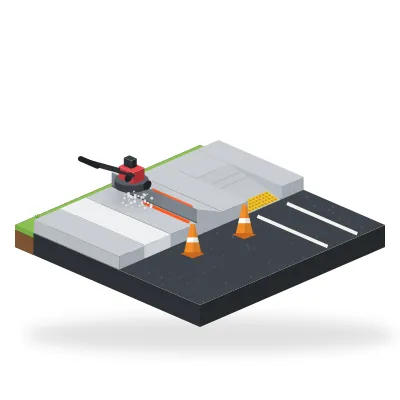
A sidewalk trip hazard is a vertical offset in the walking surface, often at a joint where one panel sits higher than the next. Property managers, HOAs and retail owners ask two questions about it: what the ADA says, and what fixing it costs. This guide quotes the 2010 ADA Standards on changes in level, explains how contractors grind, replace or ramp, and prices each with the EstiCube sidewalk trip hazard repair calculator.
The calculator's prices are planning estimates set against public bids, which are municipal-volume prices; a small private job usually prices higher. This is general information, not legal advice: whether a sidewalk must be repaired, by whom and by when depends on the jurisdiction and on the facts of the property.
What ADA section 303 says about changes in level
The 2010 ADA Standards for Accessible Design, as published on ADA.gov, set the rule in section 303, Changes in Level. 303.1 General: “Where changes in level are permitted in floor or ground surfaces, they shall comply with 303.” 303.2 Vertical: “Changes in level of 1/4 inch (6.4 mm) high maximum shall be permitted to be vertical.” 303.3 Beveled: “Changes in level between 1/4 inch (6.4 mm) high minimum and 1/2 inch (13 mm) high maximum shall be beveled with a slope not steeper than 1:2.” 303.4 Ramps: “Changes in level greater than 1/2 inch (13 mm) high shall be ramped, and shall comply with 405 or 406.”
The advisory note to 303.3 adds: “A change in level of 1/2 inch (13 mm) is permitted to be 1/4 inch (6.4 mm) vertical plus 1/4 inch (6.4 mm) beveled. However, in no case may the combined change in level exceed 1/2 inch (13 mm). Changes in level exceeding 1/2 inch (13 mm) must comply with 405 (Ramps) or 406 (Curb Ramps).” Section 405.2 says: “Ramp runs shall have a running slope not steeper than 1:12.” It has an exception allowing steeper slopes, within limits, in existing sites, buildings and facilities where space is limited.
For walking surfaces on an accessible route, section 403.4 says: “Changes in level shall comply with 303.” The ADA.gov page says the 2010 Standards set minimum requirements for newly designed and constructed or altered State and local government facilities, public accommodations and commercial facilities. It says adopting them also establishes a revised reference point for Title II entities that choose to make structural changes to existing facilities to meet their program accessibility requirements, and a similar reference for Title III entities undertaking readily achievable barrier removal. The Standards do not use the phrase trip hazard; section 303 is written in terms of changes in level.
Grind, replace or ramp
Grinding, which the title of Federal Way's contract calls beveling, takes the high edge down. Federal Way's bid tab prices two bands, 1/4 to 1/2 in and 1/2 to 2 in, and the calculator uses the same two. The bands follow that bid tab, not an ADA reading: section 303 treats 1/4 to 1/2 in as beveled and more than 1/2 in as ramped, and the calculator cannot tell you whether a ground hazard meets either. Ask the contractor what slope the finished grind will have.
Replacement removes the panel and pours a new one. The calculator grinds only offsets up to 2 in, so count panels with larger offsets under panels to replace. It prices panels by the square foot from their number and size, and prices saw cutting as a separate line in linear feet. Lifting a settled panel with polyurethane foam or mudjacking is another approach; the calculator does not price it.
Ramping is building a slope that complies with 405 or 406. Where a curb ramp has to be rebuilt, the calculator prices it, remove and replace, by the square foot, with detectable warning pads as their own item. ADA 705.1 says: “Detectable warnings shall consist of a surface of truncated domes and shall comply with 705.” That describes what a detectable warning is made of; this guide does not say where one is required.
How inch-foot pricing works
Grinding is priced by the inch-foot: the vertical offset in inches times the length of the hazard in feet. A hazard 3/8 in high along a 4 ft joint is 1.5 inch-feet. Federal Way's bid tab prices both bands in “Inch Feet” and does not say how the city measures one.
The calculator does not ask for each offset. It takes the middle of each band as the offset, 0.375 in for 1/4 to 1/2 in and 1.25 in for 1/2 to 2 in, which is an estimate, and multiplies it by the number of hazards and their average length. At the default $88 and $140 per inch-foot, a foot of hazard is $33 in the lower band and $175 in the upper band. The table shows the grinding line for one hazard; measure your own offsets, because a hazard near the top of a band has more inch-feet than the midpoint gives.
Those are grinding lines alone. Every job adds a $750 mobilization, and the $1,500 minimum is a floor that sets the price only when the job adds up to less: one 5 ft hazard in the lower band adds up to $915, so the minimum sets the price at $1,500. Ten 4 ft hazards in the lower band come to $2,070, or $2,670 with pedestrian control, and 50 lower-band hazards of 5 ft to $9,000 without pedestrian control.
The City of Federal Way (Washington) tabulated three bids for RFB 25-004, a concrete sidewalk beveling on-call contract, at its bid review on May 8, 2025, with estimated quantities of 300 inch-feet from 1/4 to 1/2 in and 200 inch-feet from 1/2 to 2 in. The lower band was $61.95 (Precision Concrete Cutting, the lowest total), $88.00 (BP Construction LLC) and $150.00 (Goldrock Invt LLC) per inch-foot, and the upper band $61.95, $140.00 and $250.00. Each bid also had a $100 lump-sum “Re-Mobilization for Small Quantities”. The printed totals were $31,075, $54,500 and $95,000. The tab marks no bid as flagged, and Goldrock's printed total is $100 less than the sum of its three items.
At Federal Way's 300 and 200 inch-feet and with no mobilization, the calculator's two grinding lines come to $54,400 at its default prices. That matches BP Construction's two grinding items ($26,400 and $28,000) by construction, because the defaults are its unit prices; it is not an independent check. The low bid's two grinding items were $30,975 and the high bid's $95,000. Federal Way's is an on-call municipal contract with a $100 re-mobilization item; the calculator charges a $750 mobilization for a single visit instead.
| Hazard length | 1/4 to 1/2 in band (taken as 0.375 in) | 1/2 to 2 in band (taken as 1.25 in) |
|---|---|---|
| 2 ft | 0.75 inch-feet, $66 | 2.5 inch-feet, $350 |
| 3 ft | 1.125 inch-feet, $99 | 3.75 inch-feet, $525 |
| 4 ft | 1.5 inch-feet, $132 | 5 inch-feet, $700 |
| 5 ft | 1.875 inch-feet, $165 | 6.25 inch-feet, $875 |
| 6 ft | 2.25 inch-feet, $198 | 7.5 inch-feet, $1,050 |
| 8 ft | 3 inch-feet, $264 | 10 inch-feet, $1,400 |
| 10 ft | 3.75 inch-feet, $330 | 12.5 inch-feet, $1,750 |
What a sidewalk repair job costs
With the defaults (20 hazards of 1/4 to 1/2 in averaging 5 ft, 4 hazards of 1/2 to 2 in averaging 4 ft, 6 panels of 5 x 5 ft, 100 LF of saw cutting, a 40 sq ft curb ramp, 2 detectable warning pads and pedestrian control) the calculator gives $11,290: grinding $3,300 and $2,800, panels $2,250, saw cutting $400, curb ramp $640, pads $550, pedestrian control $600 and mobilization $750. That is $376.33 per repair location, counting the 24 hazards and 6 panels. Grinding the same 24 hazards with nothing else is $6,850, or $7,450 with pedestrian control.
Grind or replace? At the default prices a 5 x 5 ft panel is $375 to replace, or $455 with 20 LF of saw cutting around it. A 1/2 to 2 in hazard (taken as 1.25 in high) costs more than that to grind once it is longer than 2.6 ft, while a 1/4 to 1/2 in hazard (taken as 0.375 in high) stays below it up to about 13.8 ft. Cost is not the only test: a panel that is cracked or broken may need replacing whatever the offset, so ask the contractor which repair suits each location.
The City of Union (Kentucky) file titled “2025 Concrete Bids” (in the city's March 2025 uploads, with no bid date on the sheet) has six bidders. For 400 SF of its remove-and-replace 4 in concrete item they bid $12 to $18 per SF (Hendy and Jefferson $12, Szabo $13, Husac $14, TMS $15, Humphrey $18), or $4,800 to $7,200; the calculator's 16 panels of 5 x 5 ft (400 sq ft) at $15 come to $6,000. For 800 SF of “Typical Curb Ramp” they bid $12.50 to $50 per SF, $10,000 to $40,000, against $12,800 at the calculator's $16, and for 8 “ADA Detectable Truncated Domes” (EA) $240 to $500 each, $1,920 to $4,000, against $2,200 at $275. The lowest total bid on the sheet was Hendy's, $32,795, and the sheet marks no bid as flagged. It does not say what size an each is, or whether the concrete price includes saw cutting, which the calculator prices separately at $4 per LF.
Treat these as reference points, not as our prices. They are municipal bids, and a small private job usually prices higher. The calculator carries that as its $750 mobilization and $1,500 minimum, and in unit prices that are estimates: grinding at the middle Federal Way bid, panels at $15 and pads at $275, both above the median of Union's six bids.
Who is responsible for repairing a sidewalk
This guide does not say who must repair your sidewalk. It depends on the jurisdiction: who maintains a public sidewalk next to a property, and who pays for repairs, is set by state and local law and differs from place to place. For a walk on private property, leases, HOA documents and contracts can also decide who maintains it. Check your city or county code, or ask its public works department.
The ADA thresholds above describe changes in level. This guide does not say that the ADA requires an owner to repair a particular sidewalk by a particular date. Whether and when work is required depends on who owns and controls the walk, whether the work is part of new construction or an alteration, and the facts of the property; an accessibility consultant or an attorney can advise you.
For a quote, a contractor needs the hazards counted by offset with their lengths, the panels to replace with their size, the saw cutting, any curb ramp area and detectable warning pads, and whether pedestrian control is needed. Those are the calculator's inputs, so a walk-through with a tape and a straightedge gives you both a budget and a scope to send out for bids.
Run your numbers with the Sidewalk Trip Hazard Repair Cost Calculator
Change any unit price to match your quote and see every line item add up. It is free, needs no sign-up and works on your phone.
Open the Sidewalk repair calculatorFrequently asked questions
What does the ADA say about sidewalk trip hazards?
The 2010 ADA Standards do not use the phrase trip hazard. Section 303 covers changes in level: up to 1/4 inch high maximum is permitted to be vertical, between 1/4 inch high minimum and 1/2 inch high maximum shall be beveled with a slope not steeper than 1:2, and greater than 1/2 inch high shall be ramped and comply with 405 or 406. Section 403.4 applies 303 to walking surfaces on an accessible route.
How much does sidewalk grinding cost per inch-foot?
The calculator uses $88 per inch-foot for 1/4 to 1/2 in hazards and $140 for 1/2 to 2 in, the middle of three 2025 Federal Way bids. The low bid was $61.95 in both bands and the high bid $150 and $250. A 5 ft hazard taken as 3/8 in high is 1.875 inch-feet, $165 at $88, before the $750 mobilization.
Is it cheaper to grind a trip hazard or replace the panel?
It depends on the offset and the length. At the default prices a 5 x 5 ft panel is $375 to replace, or $455 with 20 LF of saw cutting. Grinding a 1/2 to 2 in hazard (taken as 1.25 in high) costs more than $455 once it is longer than 2.6 ft; a 1/4 to 1/2 in hazard (taken as 0.375 in high) stays below it up to about 13.8 ft. The calculator grinds only offsets up to 2 in; count larger ones under panels to replace.
What size trip hazard needs a ramp under the ADA?
Section 303.4 says changes in level greater than 1/2 inch high shall be ramped, and shall comply with 405 or 406. Section 405.2 says ramp runs shall have a running slope not steeper than 1:12, with an exception for existing sites where space is limited. The calculator does not decide whether a repair meets those sections.
Who is responsible for repairing a sidewalk trip hazard?
It depends on the jurisdiction. Who maintains a public sidewalk next to a property, and who pays, is set by state and local law and differs from place to place, and leases or HOA documents can decide it for a private walk. Check your city or county code or ask its public works department. This is not legal advice.
Does the ADA require me to repair my sidewalk by a certain date?
The ADA.gov page for the 2010 Standards says they set minimum requirements for newly designed and constructed or altered facilities, and that they are a reference point for Title II program accessibility changes and Title III readily achievable barrier removal. That page is about design standards for new construction, alterations and those reference points, not a repair schedule for an existing sidewalk. What an owner must do, and when, depends on the facts; ask an accessibility consultant or an attorney.
Sources
- 2010 ADA Standards for Accessible Design (sections 303, 403.4, 405.2 and 705.1) — ADA.gov, U.S. Department of Justice
- RFB 25-004 Concrete Sidewalk Beveling, On-Call Contract: bid tabulation (bid review May 8, 2025) — City of Federal Way (Washington)
- File titled “2025 Concrete Bids”: bid tabulation (no bid date on the sheet; in the city's March 2025 uploads) — City of Union (Kentucky)
More guides