Warehouse Floor Striping Cost Calculator
Price aisle and lane lines by width in paint, epoxy, polyurea or floor tape, with symbols, corner marks, layout, cleaning and optional grinding on their own lines. Then switch to contractor bid mode to build a proposal.
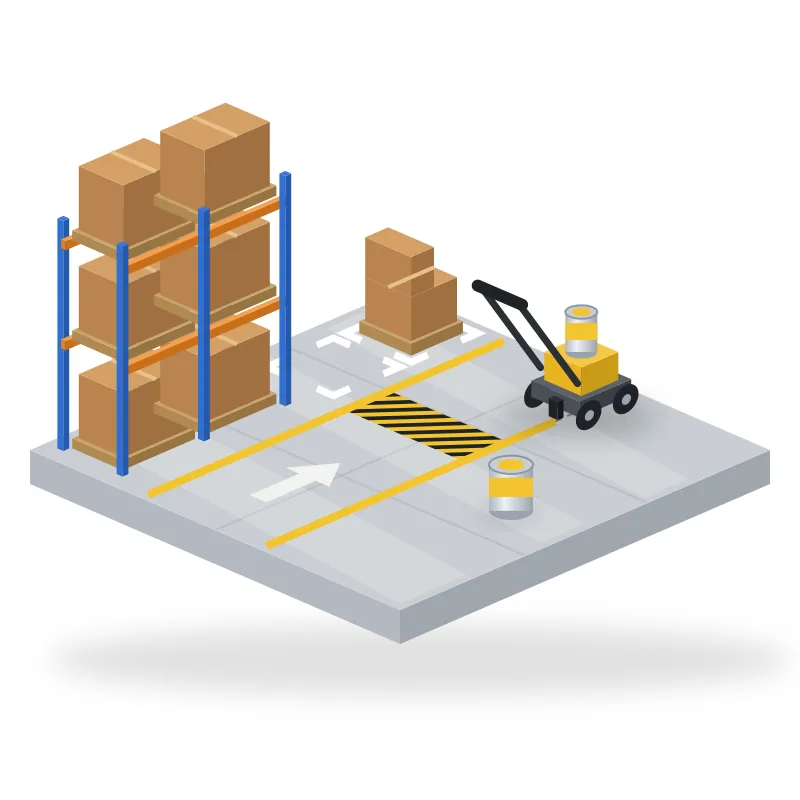
Floor lines mark aisles, forklift lanes, work cells and pallet positions, and they are priced by the linear foot. The EstiCube warehouse floor striping calculator works the way a striping crew does: material by the linear foot of line, scaled by width, application labor by the linear foot whatever the width, a price for each symbol and corner mark, and a mobilization charge on top. The $1,000 minimum is a floor that sets the price only when the job adds up to less.
Enter the footage of 2, 3, 4 and 6 in lines, choose paint, epoxy, polyurea or tape, and say whether this is a new layout or a restripe over existing lines. You can turn cleaning on or off, and for the two coatings add a ground strip under each line. Floor striping has few public prices, so the unit prices are planning estimates that you can replace with a contractor quote. The results are national-average estimates, not a quote.
Coating the whole floor, not just the lines? Price it with the epoxy floor cost calculator. Guarding racking ends and doorways as well? See bollard installation cost.
Warehouse floor striping cost: unit prices used
Material is priced per linear foot of 4 in line, and a 2, 3 or 6 in line uses 0.5, 0.75 or 1.5 times that. Application labor is per linear foot whatever the width. Symbols and corner marks are priced placed, as labor plus material. The examples use the default job: 2,000 LF of 4 in epoxy line, a new layout, a cleaned line path and 10 symbols.
| Line item | Unit price | Notes |
|---|---|---|
| Line material, 4 in line | $0.15, $0.50, $0.80 and $1.10 per LF | Paint, epoxy, polyurea and tape; 2,000 LF of epoxy, $1,000 |
| Line material, other widths | Width divided by 4 times the 4 in price | 500 LF each of 2, 3, 4 and 6 in is 1,875 four-inch-equivalent LF, or $938 of epoxy |
| Application labor | $1.00, $1.50, $1.70 and $0.40 per LF | Paint, epoxy, polyurea and tape; the same for any width; 2,000 LF of epoxy, $3,000 |
| Symbols and stencils | $35, $55, $65 and $30 each | Paint, epoxy, polyurea and tape; placed; 10 epoxy symbols, $550 |
| Corner marks | $6, $9, $11 and $5 each | Paint, epoxy, polyurea and tape; placed; 200 tape corner marks, $1,000 |
| Layout | $0.20 per LF | New layout only; measure and chalk from a plan; 2,000 LF, $400 |
| Clean and degrease | $0.15 per LF | Optional; 2,000 LF, $300 |
| Grind a strip under the line | $1.25 per sq ft | Epoxy and polyurea only; 0.5 sq ft of strip per LF of line; 2,000 LF is 1,000 sq ft, $1,250 |
| Mobilization | $450 | Flat charge to bring the crew and equipment; the same figure as the epoxy floor calculator |
| Minimum job charge | $1,000 | Floor for a short run of line; the total is raised to it only if it would be lower |
A default job (2,000 LF of 4 in epoxy line, new layout, cleaned, 10 symbols) comes to $5,700, which is 2,000 LF at $2.85 per linear foot. Only the epoxy material price comes from a retail listing ($225 per gallon covering 450 LF of 4 in line). The tape price of $1.10 per LF is an estimate set below the one retail listing read, a Brady 4 in roll at $1.69 per LF. Every other unit price is an estimate.
How much does warehouse floor striping cost?
With the defaults, 2,000 LF of 4 in epoxy line with 10 symbols, a new layout and a cleaned line path comes to $5,700, or $2.85 per linear foot. Line material is $1,000, application labor $3,000, layout $400, cleaning $300, symbols $550 and mobilization $450.
On the default job the material is the biggest single choice. With everything else at the default, floor paint brings the job to $3,800 ($1.90 per LF), floor marking tape to $4,450 ($2.23), epoxy to $5,700 ($2.85) and polyurea to $6,800 ($3.40). That order is for the default job at the default prices.
Layout and prep are the next switches. A restripe over existing lines drops the layout line and takes the epoxy job to $5,300 ($2.65 per LF), and turning cleaning off as well takes it to $5,000 ($2.50). For epoxy and polyurea you can add a ground strip under each line: it is 1,000 sq ft on the default job and adds $1,250, which takes epoxy to $6,950 ($3.48 per LF) and polyurea to $8,050 ($4.03). Paint and tape do not offer it.
Width and size also matter. Adding 500 LF of 6 in line to the default job makes 2,500 LF but 2,750 four-inch-equivalent LF, so epoxy material rises to $1,375 and labor to $3,750, and the total to $7,000 ($2.80 per LF). Mobilization and the minimum do not shrink with the footage. 200 LF of 4 in epoxy line with no symbols adds up to $920, so it is billed at the $1,000 minimum, or $5.00 per foot. The $1,000 minimum is a floor that sets the price only when the job adds up to less. 400 LF of the same line comes to $1,390 ($3.48 per LF), 4,000 LF with 10 symbols to $10,400 ($2.60) and 20,000 LF with no symbols to $47,450 ($2.37).
Paint, epoxy, polyurea or floor tape?
The calculator splits each material into a material price and a labor price, and the two move in opposite directions. At the default prices tape has the highest material price of the four ($1.10 per LF of 4 in line) and the lowest labor price ($0.40 per LF). Paint has the lowest material price, $0.15 per LF, and labor of $1.00. On the default job that puts tape's line material at $2,200 and its labor at $800, against $300 and $2,000 for paint. Epoxy and polyurea carry the highest labor prices, $1.50 and $1.70 per LF. Only the epoxy material price comes from a retail listing; the tape price is an estimate set below the one retail listing read ($1.69 per LF for a Brady 4 in roll), and the paint and polyurea prices, and every labor price, are estimates.
PennCoat Inc., a Pennsylvania industrial coatings contractor, describes how it installs epoxy floor lines in an existing facility. It says the prep for lines is minimal, typically a good wipe with rubbing alcohol, which removes dirt and debris but does not open the concrete pores or profile the floor the way a diamond grinder does. For that reason it uses a phenalkamine epoxy with a lower viscosity, which it says penetrates deeper into the existing coating. It adds that this is a quality installation but gives less adhesion than the coated aisle ways it also installs, where crews can grind the floor with a walk-behind planetary grinder or hand grinders.
The calculator keeps both ideas. Cleaning is a default-on line at $0.15 per LF, and grinding is an option for epoxy and polyurea only, priced as a 6 in strip under each line. The calculator prices lines, not coated aisle ways, so it is not a price for the aisle way product the contractor describes. It also does not price service life, cure time or wear. For those, ask each contractor or manufacturer for a data sheet on the exact product, since they differ by product.
The polyurea and polyaspartic price is an estimate set above epoxy, because no public price was found for it. Replace it with a quote if you are considering that option.
What OSHA requires for aisle marking
In its rule on mechanical handling equipment, OSHA says permanent aisles shall be marked, but the rule does not say how. In 29 CFR 1910.176(a), under the heading “Use of mechanical equipment,” the text reads: “Where mechanical handling equipment is used, sufficient safe clearances shall be allowed for aisles, at loading docks, through doorways and wherever turns or passage must be made. Aisles and passageways shall be kept clear and in good repair, with no obstruction across or in aisles that could create a hazard. Permanent aisles and passageways shall be appropriately marked.”
That text names no color, no width and no material. Colors and widths are therefore practice, not something this rule sets. An OSHA letter of interpretation dated May 15, 1972, which cites 1910.22(b), said aisle lines “may be any color so long as they clearly define the area considered as aisle space” and that “any width 2 inches or more is considered acceptable.” OSHA now keeps that letter in its archive with a notice that it “may no longer represent OSHA Policy,” so read it as history, not as current guidance.
OSHA does have a safety color code, 29 CFR 1910.144, titled “Safety color code for marking physical hazards.” Paragraph (a)(3) says “Yellow shall be the basic color for designating caution and for marking physical hazards such as: Striking against, stumbling, falling, tripping, and ‘caught in between.’” That paragraph does not mention aisles or floors, so in practice that leaves the color to the facility. The calculator has no color input, because the prices here do not depend on color.
This is general information, not legal advice. Check the current text of the rule and talk to a safety professional about your own site.
Why floor lines cost more per foot than parking lot lines
Compare unit rates, not job totals. The calculator's floor paint rate is $1.15 per linear foot of 4 in line: $0.15 of material and $1.00 of labor. The parking lot striping calculator's water-based paint rate is $0.30 per linear foot of 4 in line: $0.12 of material and $0.18 of labor. The floor rate is about 3.8 times the lot rate, and the two engines add different extras to a job, so only the unit rates are compared here. The default epoxy line is $2.00 per LF: $0.50 of material and $1.50 of labor.
The calculator's reason for the gap is an assumption, not a sourced fact: floor lines are masked by hand along both edges and laid out around racking, equipment and traffic, so the calculator prices labor high. In its rates labor is the larger part of both the paint unit rate ($1.00 of $1.15) and the epoxy unit rate ($1.50 of $2.00).
For a cross-check, PennCoat Inc. says epoxy floor lines “can cost anywhere between $3 to $6 per linear foot,” depending on whether a top coat is installed or both lines are taped twice. The article does not say what else the range includes. The default epoxy job in the calculator comes to $2.85 per LF with layout, cleaning, symbols and mobilization included, and $3.48 with grinding on. The calculator has no top coat or double-taping option, so treat the contractor's range as one reference point rather than a match.
How to use the warehouse floor striping calculator
- Enter the linear feet of 2, 3, 4 and 6 in lines. 4 in is the default field.
- Choose the line material: floor paint, epoxy line paint, polyurea or polyaspartic, or floor marking tape.
- Choose a new layout, which adds a layout line, or a restripe over existing lines, which does not.
- Turn cleaning and degreasing on or off. For epoxy and polyurea only, you can also turn on grinding a strip under each line.
- Enter the number of symbols and stencils, and the number of corner marks.
- Open the pricing section and replace any price with a contractor quote. Then review the line items, copy the share link, or switch to contractor bid mode to add overhead, profit and a proposal.
Warehouse floor striping cost FAQ
How much does floor marking cost per linear foot?
With the defaults (2,000 LF of 4 in epoxy line, new layout, cleaned, 10 symbols) the calculator gives $5,700, which is $2.85 per linear foot. Floor paint comes to $1.90 per LF, tape to $2.23 and polyurea to $3.40 on the same job. Short jobs cost more per foot: 200 LF of 4 in epoxy line with no symbols is raised to the $1,000 minimum, or $5.00 per foot.
Does OSHA require floor marking in a warehouse?
29 CFR 1910.176(a) says “Permanent aisles and passageways shall be appropriately marked.” The paragraph is headed “Use of mechanical equipment” and opens with “Where mechanical handling equipment is used.” It sets no color, width or material. This is general information, not legal advice.
What color should warehouse aisle lines be?
The aisle-marking rule names no color, and an archived 1972 OSHA letter said aisle lines may be any color that clearly defines the aisle space. OSHA's safety color code, 29 CFR 1910.144(a)(3), gives yellow as the basic color for designating caution and marking physical hazards such as tripping, but it does not mention aisles or floors. In practice that leaves the color to the facility, and the calculator's prices do not depend on color.
How wide should aisle lines be?
The current aisle-marking rule sets no width. An OSHA letter of interpretation from May 15, 1972 said any width of 2 inches or more is acceptable, but it is archived and may no longer represent OSHA policy. The calculator prices 2, 3, 4 and 6 in lines, with 4 in as the default. Material cost scales with width and labor does not.
Is floor tape cheaper than paint?
Not on the default job. At the default prices, 2,000 LF of 4 in line with 10 symbols, a new layout and cleaning comes to $3,800 for floor paint and $4,450 for tape. Tape's line material is $2,200 against $300 for paint, and its labor is $800 against $2,000. Tape is $1,250 less than the epoxy job at $5,700. These are estimates, so replace them with quotes.
Do epoxy floor lines need grinding?
The calculator treats it as an option. Grinding a 6 in strip under each line adds $1,250 to the default epoxy job, taking it to $6,950. PennCoat Inc., a Pennsylvania coatings contractor, says its prep for floor lines is typically just a wipe with rubbing alcohol, and that it uses a thinner phenalkamine epoxy for lines because it penetrates deeper into the existing coating. It says aisle ways can be ground with a walk-behind planetary grinder or hand grinders. Ask your contractor what they do on your floor.
How do I measure the linear feet for a warehouse?
Measure the length of each aisle or lane and multiply by the number of lines along it. An aisle has a line on each side, so 10 aisles of 200 feet with two lines each is 4,000 LF. At the default prices that job, with 10 symbols, comes to $10,400 ($2.60 per LF) in epoxy. Enter the footage under the width of each line, and add shared lines once.
Why is there a minimum job charge?
A crew has to mobilize whether the run is 200 feet or 2,000. The calculator charges $450 for mobilization on every job, and the $1,000 minimum is a floor that sets the price only when the job adds up to less. 200 LF of 4 in epoxy line with no symbols adds up to $920, so it is billed at $1,000. 400 LF comes to $1,390, so the minimum does not apply.
Guides
Sources
- 29 CFR 1910.176, Handling materials - general (paragraph (a), use of mechanical equipment) — Occupational Safety and Health Administration
- Compliance with Aisle Markings (Part 1910.22(b)), letter of interpretation, May 15, 1972 (archived) — Occupational Safety and Health Administration
- 29 CFR 1910.144, Safety color code for marking physical hazards — Occupational Safety and Health Administration
- Installing Safety Pedestrian Lines In Existing Facility (floor line prep, epoxy and cost per linear foot) — PennCoat Inc.
Related calculators
Projects often planned together — jump to a related estimator for the next line item.
Epoxy
Calculate epoxy floor coating cost for warehouses and commercial spaces. Self-leveling, quartz, and metallic systems with grind prep and mobilization.
Bollard
Estimate steel, concrete, and removable bollard supply and installation cost. Core drill, surface mount, paint, and mobilization for storefront protection.
Striping
Estimate pavement marking linear feet, traffic paint gallons, and striping cost. Includes stalls, ADA symbols, fire lanes, arrows, and mobilization.
Line removal
Estimate pavement marking removal cost per linear foot by line width, paint or thermoplastic, and method: grinding, water blasting, sandblasting, or black-out.
Pressure washing
Estimate power washing cost per square foot for concrete, asphalt, storefronts, and dumpster pads. Includes gum removal and water reclaim.
Signs
Estimate regulatory, ADA, stop, and wayfinding sign counts with posts, footings, and installation cost for commercial parking lots.
More commercial property calculators
Floors, roofs, sidewalks, sports courts, snow, washing & hood cleaning
Explore all 6 categories
Browse every free EstiCube tool by project type — pavement & parking, commercial property, outdoor projects, home & structure, landscape & lawn, home services.
View full calculator directory