Concrete Parking Lot Cost Calculator
Price a new concrete parking lot from its area, slab thickness, reinforcement, aggregate subbase, sawcut control joints and the removal of an old surface. See the cubic yards of ready-mix and tons of subbase, then switch to contractor bid mode to build a proposal.
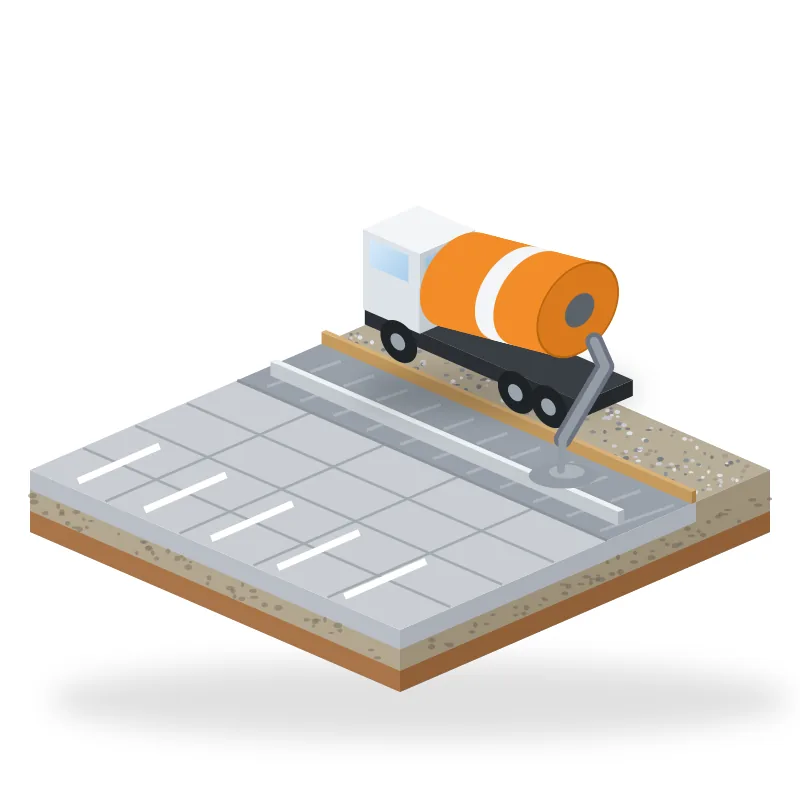
A concrete parking lot is priced by the slab, not by the square foot alone. The thickness sets the volume of ready-mix, the traffic sets the thickness, and the joints decide how the slab cracks. The EstiCube concrete parking lot calculator turns those choices into separate lines: demolition, fine grading, subbase, ready-mix concrete, placing and finishing, reinforcement, sawcut joints and mobilization.
Enter the lot area, choose a slab thickness for the traffic, then pick the reinforcement, subbase depth, joints and any old surface to remove. Results are national-average estimates for a private lot, and every unit price can be replaced with the figure from a supplier or contractor quote.
Repaving an existing lot instead? Estimate the parking lot resurfacing cost. Want a hot-mix price to compare? Use the asphalt paving cost calculator.
Concrete parking lot cost: unit prices used
Concrete is priced per cubic yard with 5 percent added for waste, and most other work per square foot of lot. The examples are for 20,000 sq ft with a 5 in slab. The total is never less than the minimum job charge.
| Line item | Unit price | Notes |
|---|---|---|
| Ready-mix concrete, 4,000 psi | $160 per cu yd | 324.1 cu yd for 20,000 sq ft at 5 in, $51,852 |
| Place, finish & cure | $2.25 per sq ft | $45,000 for 20,000 sq ft |
| Welded wire mesh | $0.35 per sq ft | Optional; $7,000 for 20,000 sq ft |
| Rebar, #4 at 18 in each way | $0.95 per sq ft | Optional instead of mesh; $19,000 for 20,000 sq ft |
| Aggregate subbase | $32 per ton | 450.0 tons for 4 in over 20,000 sq ft, $14,400 |
| Fine grading & compaction | $0.35 per sq ft | $7,000 for 20,000 sq ft |
| Sawcut control joints | $1.10 per LF | 3,200 LF at 12.5 ft spacing, $3,520 |
| Demolition of old asphalt | $1.50 per sq ft | Optional; $30,000 for 20,000 sq ft, with haul-off |
| Demolition of old concrete | $2.50 per sq ft | Optional; $50,000 for 20,000 sq ft, with haul-off |
| Mobilization | $2,500 | Flat charge to bring crew and equipment |
| Minimum job charge | $6,000 | Floor if mobilization is lowered or the area is zero |
A default job (20,000 sq ft, 5 in slab, wire mesh, 4 in subbase, sawcut joints, no demolition) comes to $131,272, or $6.56 per sq ft.
How much does a concrete parking lot cost?
With the defaults, a 20,000 sq ft lot with a 5 in slab, wire mesh, 4 in of aggregate subbase and sawcut joints comes to $131,272, or $6.56 per sq ft. The ready-mix is the largest line at $51,852 for 324.1 cu yd, followed by $45,000 to place, finish and cure it, $14,400 for 450.0 tons of subbase, $7,000 each for fine grading and mesh, $3,520 for 3,200 LF of sawcut joints and $2,500 of mobilization.
Thickness moves the price through the volume of concrete. With everything else at the default, a 4 in slab is $121,781 ($6.09 per sq ft), 5 in is $131,272, 6 in is $141,056 ($7.05), 7 in is $151,427 ($7.57) and 8 in is $161,797 ($8.09). Reinforcement matters less: leaving it out takes the default to $124,272, and swapping the mesh for #4 rebar at 18 in each way takes it to $143,272. Skipping the subbase saves $14,400, which gives $116,872.
Tearing out an old surface can cost as much as a thick slab. Removing asphalt adds $30,000 and removing concrete adds $50,000 on 20,000 sq ft, taking the default to $161,272 or $181,272. Size changes the price per square foot because mobilization is a flat charge: the same 5 in lot at 5,000 sq ft is $34,693 ($6.94 per sq ft), and at 100,000 sq ft it is $646,359 ($6.46).
State DOT prices give a rough check, but they come from large lettings and a different kind of pavement. South Dakota DOT's 2024 bid item report shows an average of about $77 per sq yd, or roughly $8.59 per sq ft, for nonreinforced concrete pavement 8 to 12.5 in thick on projects over 20,000 sq yd. Highway pavement has its own requirements, so use it as a rough outside check, not a quote. Small private jobs cost more per unit than large lettings, and the mobilization and minimum job lines carry that difference.
Concrete vs asphalt parking lot
For a new lot the closest asphalt equivalent in EstiCube is the parking lot resurfacing calculator with the full-depth method, which removes the old surface, builds a new base and lays 3 in of asphalt. With 20,000 sq ft and no striping or castings, that comes to $96,163, or $4.81 per sq ft. That price always includes removing the old pavement, so the like-for-like concrete figure is the one with the remove-old-asphalt option on: $161,272, or $8.06 per sq ft, which is $65,109 more up front. A lighter 4 in slab with removal is $151,781. On bare ground the concrete default is $131,272, but the asphalt calculator has no bare-ground option to set against it.
The up-front difference is not the whole story. Asphalt lots need sealcoating, crack filling and eventually an overlay, while a concrete lot is jointed and left to age. The American Society of Concrete Contractors' parking lot brochure says concrete has a much longer life than asphalt and that many concrete lots last 30 years or more without major maintenance, and it claims initial costs have become about the same. Those are industry claims, and the calculator does not show an equal first cost, so ask for both bids on your own site before you rely on either.
Several things tilt the choice. The ASCC brochure puts heavy-duty truck facilities at 7 in, and the calculator's 7 and 8 in options are for spots such as dumpster aprons and loading areas. Asphalt costs less at the start in these calculators. Subgrade, drainage, climate and the owner's plans for the property matter more than any rule of thumb. Run both calculators with your area and compare the totals and the maintenance each one needs.
Slab thickness by traffic
Thickness follows the heaviest traffic that uses the pavement. The ASCC parking lot brochure, which draws on ACI 330R-08, shows light-duty commercial, retail and office parking at 4 to 5 in, medium-duty mixed-use pavement at 6 in and heavy-duty truck facilities and industrial pavement at 7 in. Its worked example for a bank or office lot with cars only and about one truck a day comes to 4.5 in, using 4,000 psi concrete because of freeze-thaw exposure.
The calculator offers 4 to 8 in. Use 4 in only for cars, 5 in for a typical retail or office lot, 6 in where an occasional delivery or garbage truck crosses the pavement, and 7 in where delivery trucks use it every day. The 8 in option is for the heaviest loads, such as a dumpster apron where a refuse truck stands. It is not a figure taken from the brochure, so use the city standard detail or an engineer to set the real thickness.
Thickness is a design decision that depends on the soil, the traffic count and the concrete strength. The NRMCA offers a free design assistance program that gives thickness and jointing recommendations for parking lots. Use the calculator for budgeting, and let the designer of record set the final section.
Joints, reinforcement, subbase and curing
Joints do more for crack control than mesh. NRMCA's CIP 6 sheet says wire mesh will not prevent cracking, and the NRMCA and ASCC guidance quoting ACI 330R-08 says that a pavement jointed into short panels does not need distributed steel and that adding steel to stretch panel length has largely been discredited. That is why reinforcement is set to none, mesh or rebar in the calculator and why the joint line stays on by default.
CIP 6 recommends contraction joints no farther apart than 24 to 36 times the slab thickness and no more than 15 ft, with panels that are square or nearly so and grooves at least a quarter of the slab thickness deep. The calculator spaces joints at 2.5 ft per inch of thickness, which is 30 times, up to 15 ft: 10 ft for a 4 in slab, 12.5 ft for 5 in, and 15 ft for 6 in and thicker. It assumes a square grid, so the sawcut length is twice the area divided by the spacing, which is 3,200 LF for the default lot.
Subbase is optional. The NRMCA's FAQ quotes ACI 330R-08 as saying granular subbases are not normally used under concrete parking lots, and that pavements with fewer than about 200 heavily loaded trucks a day do not need one to prevent pumping. A subbase can still help on a wet or poorly draining site. The calculator defaults to 4 in; set it to 0 when the soil report and the designer say it is not needed.
Drainage and curing finish the job. Slope the surface so water leaves the slab, and keep the subgrade from holding water. After the pour, the concrete needs curing and time to gain strength before vehicles use it. There is no single day count that fits every mix and season, so ask the ready-mix supplier and the designer when it can open to traffic.
How to use the concrete parking lot calculator
- Enter the paved area in square feet, including drive aisles and stalls. Measure the lot from a site plan or a satellite map.
- Choose the slab thickness for the heaviest traffic: 4 or 5 in for cars, 6 or 7 in with delivery trucks, 8 in for the heaviest loads.
- Pick the reinforcement: none for plain jointed concrete, welded wire mesh, or #4 rebar at 18 in each way.
- Enter the aggregate subbase depth in inches, or 0 if the soil report says none is needed. Keep sawcut control joints on unless the designer says otherwise.
- Choose whether an old asphalt or concrete surface has to be removed and hauled away first.
- Open the pricing section and replace any unit price with a supplier or contractor quote, such as the ready-mix price per cubic yard or the mobilization charge.
- Review the line items, the total and the cost per square foot, compare with the asphalt calculator, then copy the share link or switch to contractor bid mode to add overhead, profit and a proposal.
Concrete parking lot cost FAQ
How much does a concrete parking lot cost per square foot?
With the defaults (20,000 sq ft, 5 in slab, wire mesh, 4 in subbase and sawcut joints) the calculator gives $131,272, or $6.56 per sq ft. A 4 in slab is $6.09 per sq ft and an 8 in slab is $8.09. Small lots cost more per square foot because mobilization is a flat charge: 5,000 sq ft comes to $6.94 per sq ft. Local prices and site conditions change the real figure.
How thick should a concrete parking lot be?
It depends on the heaviest traffic. The ASCC brochure, based on ACI 330R-08, shows 4 to 5 in for light-duty commercial parking, 6 in for medium-duty mixed use and 7 in for heavy-duty truck facilities. The calculator also offers 8 in for the heaviest loads, such as dumpster aprons. A designer or the city standard sets the final thickness.
Is a concrete or asphalt parking lot cheaper?
Asphalt is cheaper up front in the calculators. For replacing an old 20,000 sq ft asphalt lot, concrete with the old pavement removed comes to $161,272 ($8.06 per sq ft), while full-depth asphalt with 3 in of asphalt, removal included, comes to $96,163 ($4.81 per sq ft). Concrete groups say it lasts longer with less maintenance, so compare both bids and the upkeep over the life of the lot.
Do I need rebar or wire mesh in a concrete parking lot?
Often not. NRMCA says wire mesh will not prevent cracking, and the ACI 330R-08 guidance it quotes says a pavement jointed into short panels does not need distributed steel. Leaving the reinforcement out takes the default from $131,272 to $124,272, while rebar takes it to $143,272. Follow the designer's drawings if they call for it.
How far apart should control joints be in a parking lot?
NRMCA recommends no more than 24 to 36 times the slab thickness and never more than 15 ft, with square panels. The calculator uses 2.5 ft per inch of thickness up to 15 ft, so a 5 in slab has joints every 12.5 ft, which is 3,200 LF of sawcut on 20,000 sq ft and costs $3,520.
Do I need a gravel subbase under a concrete parking lot?
Not always. The NRMCA FAQ quotes ACI 330R-08 saying granular subbases are not normally used under concrete lots and that lots with fewer than about 200 heavy trucks a day do not need one to prevent pumping. A wet site may still call for one. The default 4 in subbase costs $14,400 on 20,000 sq ft, and setting it to 0 gives $116,872.
Why is the ready-mix price $160 per cubic yard?
The calculator assumes an exterior 4,000 psi air-entrained mix delivered to a commercial site, which is a higher specification than the $145 residential default in the concrete calculator. Delivered prices vary by plant, haul distance and load size, and small loads often carry extra fees. Enter your supplier's price in the pricing section.
When can cars drive on a new concrete parking lot?
It depends on the mix, the weather and the curing, so there is no single number of days. Concrete is opened to traffic when it has reached the strength the designer or specification requires, and the ready-mix supplier can advise on the mix. Plan for barricades, and allow for the time in the schedule and the bid.
Guides
Sources
- Concrete Parking Lots: A Quick Reference Guide (thickness by traffic, 4,000 psi concrete, equivalent designs) — American Society of Concrete Contractors (ASCC)
- FAQ About Concrete Parking Lot Design & Construction Specifications (reinforcement, jointing, subbase) — National Ready Mixed Concrete Association (NRMCA), hosted by ASCC
- CIP 6: Joints in Concrete Slabs on Grade (joint spacing, groove depth, wire mesh) — National Ready Mixed Concrete Association (NRMCA)
- 2024 Bid Item Price Report (nonreinforced PCC pavement, base course and asphalt removal prices) — South Dakota Department of Transportation
Related calculators
Projects often planned together — jump to a related estimator for the next line item.
Asphalt
Calculate tons of hot-mix asphalt for driveways and overlays. Includes gravel base, sealcoating, and paving cost estimates.
New parking lot
Estimate the cost to build a new parking lot per space and per sq ft: clearing, excavation, base, asphalt or gravel, curb, drainage and striping.
Resurfacing
Estimate parking lot resurfacing cost from lot size, overlay, mill-and-overlay, or full-depth method, asphalt thickness, base patching, and restriping.
Concrete
Calculate cubic yards of concrete for slabs, driveways, and sidewalks. Includes bags, rebar, delivery, and pour cost estimates.
Curbing
Estimate linear feet of mountable, barrier, and valley curb with concrete volume and install cost. Includes demo and mobilization for parking lots.
Striping
Estimate pavement marking linear feet, traffic paint gallons, and striping cost. Includes stalls, ADA symbols, fire lanes, arrows, and mobilization.
More pavement & parking calculators
Striping, paving, ADA, sealcoating, signs, sweeping & curbing
Explore all 6 categories
Browse every free EstiCube tool by project type — pavement & parking, commercial property, outdoor projects, home & structure, landscape & lawn, home services.
View full calculator directory