Ice and Water Shield Calculator
Find out how many rolls of ice and water shield a roof needs. Enter the eave length, overhang, pitch, valleys, rakes and penetrations, and the calculator works out how many courses run up the slope at the eave, the square feet covered and the rolls to buy, then adds material and labor cost. Switch to contractor bid mode to turn it into a proposal.
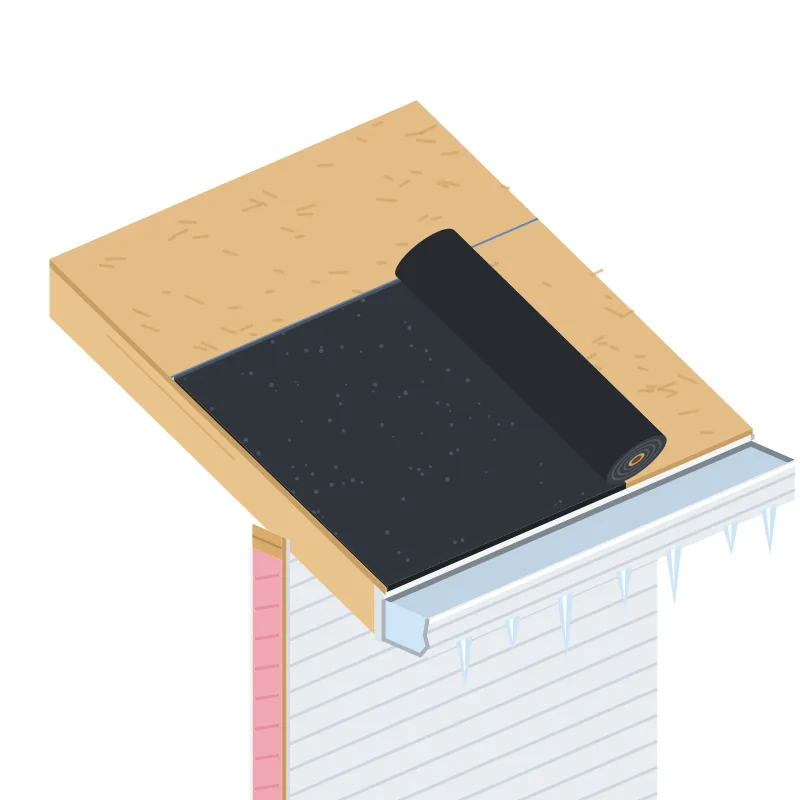
Ice and water shield is a self-adhering membrane that goes under the shingles at the eaves, and often in valleys and around penetrations, to keep water from leaking in when ice backs it up. The number of rolls depends less on the size of the house than on how far up the slope the membrane has to reach, and that depends on the overhang, the thickness of the wall and the pitch of the roof. The EstiCube ice and water shield calculator does that geometry for you.
Enter the length of the eaves, the overhang, how far past the inside of the wall the membrane must reach, and the roof pitch. Add the valleys, the rakes and the number of chimneys, skylights and vents. The results show the rolls first, with the courses at the eave and the square feet covered, and the cost comes second. Every unit price can be replaced with a figure from your supplier or installer.
Planning the whole roof? Size the shingles, underlayment and flashing with the roofing calculator. Ice dams start with heat escaping from the house, so check the attic with the attic insulation calculator.
Ice and water shield cost and coverage: values used
The calculator prices the rolls you need and, if you choose, installation labor per roll. The coverage rules below set how many rolls that is. There is no minimum charge in this estimate.
| Item | Value used | Notes |
|---|---|---|
| 200 sq ft roll | $95 each | Default; 5 rolls cost $475 |
| 225 sq ft roll | $115 each | 5 rolls cost $575 |
| Installation labor | $45 per roll | Optional; 5 rolls cost $225 |
| Roll width | 36 in | Each eave course is one roll width wide |
| Headlap between courses | 3 in | Each course after the first adds 33 in up the slope |
| Wall thickness assumed | 6 in | Added to the overhang and the distance past the wall |
| Valley and rake strips | 3 ft wide | A 30 ft valley is 90 sq ft |
| Penetrations | 25 sq ft each | Chimney, skylight, vent or pipe; 2 is 50 sq ft |
| Waste allowance | 10% | Added to the area before rounding up to whole rolls |
A default job (120 ft of eave, 12 in overhang, 24 in past the wall, 6/12 pitch, 30 ft of valley, 2 penetrations) needs 2 courses at the eave and covers 860 sq ft, which is 5 rolls of 200 sq ft. That costs $475 for the rolls and $225 for installation, or $700 in total.
How many rolls of ice and water shield do you need?
The calculator works in four steps. First it finds the slope distance the membrane must cover at the eave: the overhang plus 6 in of wall plus the distance past the inside of the wall, multiplied by a pitch factor. With the defaults that is 12 + 6 + 24 = 42 in of horizontal distance, which is 47.0 in along a 6/12 roof. Second, it counts the courses. One 36 in roll covers 33 in of slope once the 3 in headlap is allowed for, so 47.0 in needs 2 courses along the eave.
Third, it adds up the area. Two courses along 120 ft of eave is 2 x 3 ft x 120 ft = 720 sq ft. A 30 ft valley with a 3 ft strip is 90 sq ft, and 2 penetrations at 25 sq ft each is 50 sq ft, for 860 sq ft in total. Fourth, it adds a 10% waste allowance and divides by the roll size: 860 x 1.1 = 946 sq ft, and 946 / 200 = 4.73, which rounds up to 5 rolls. At $95 a roll that is $475, and installation at $45 a roll adds $225, for $700.
Rolls come in whole units, so small changes can add a whole roll or none at all. The same house without the valley and the penetrations covers 720 sq ft and needs 4 rolls, or $560. A 225 sq ft roll also comes to 5 rolls here, but at $115 a roll the total is $800, so a bigger roll is not automatically the cheaper buy. Compare the price per sq ft of the roll you can actually get.
What the IRC says about ice barriers and how far up they go
The model code is section R905.1.2 of the International Residential Code, which covers ice barriers. In both the 2021 and 2024 editions it applies in areas where there has been a history of ice forming along the eaves and causing a backup of water, as designated in Table R301.2. Where it applies, an ice barrier goes under asphalt shingles, metal roof shingles, mineral-surfaced roll roofing, slate and slate-type shingles, wood shingles and wood shakes. It can be at least two layers of underlayment cemented together, or a self-adhering polymer-modified bitumen sheet used in place of normal underlayment.
The barrier runs from the lowest edges of all roof surfaces to a point at least 24 in inside the exterior wall line of the building. On roofs with a slope of 8 units vertical in 12 or steeper, it must also reach at least 36 in measured along the roof slope from the eave edge. Detached accessory structures that do not contain conditioned floor area are excepted. The calculator never falls short of the 36 in rule: with the smallest overhang and distance past the wall it allows, the slope distance on an 8/12 roof is already about 36.1 in.
Whether the requirement applies to your house is a local question. States and towns adopt different editions of the code and may amend this section, so the local building department decides whether you need an ice barrier and where it must stop. Ask them before you order, and enter the distance past the wall that they require. The calculator measures that distance from the inside face of the wall and adds a 6 in wall thickness, which errs on the side of covering a little more than the bare 24 in.
Why pitch and overhang change the number of courses
The code distance is measured across the house in plan, but the membrane lies on the slope, and a steeper slope is longer for the same horizontal distance. At the default 42 in of horizontal distance, a 6/12 roof needs 47.0 in of membrane, a 12/12 roof needs 59.4 in and an 18/12 roof needs 75.7 in. The first two still fit in 2 courses, but 75.7 in needs 3, which takes the default job from 5 rolls ($700) to 7 rolls ($980). With the default overhang, 16/12 is the first whole pitch that gives 3 courses.
Overhang works the same way, and it is the one most often forgotten. A roof with no overhang at 6/12 needs only 33.5 in, a single course of 1 roll width, and with the other defaults it comes to 500 sq ft, 3 rolls and $420. Going the other way, a 24 in overhang makes the slope 60.4 in and stays at 2 courses, while a 36 in overhang makes it 73.8 in and needs 3 courses, 1,220 sq ft, 7 rolls and $980.
The extremes add up quickly. A 12/12 roof with a 36 in overhang and the membrane carried 36 in past the wall comes to a slope of 110.3 in, which needs 4 courses. For 120 ft of eave with the default valley and penetrations that is 1,580 sq ft, 9 rolls and $1,260. If you are close to a course boundary, measure the roof rather than trusting the plan dimensions, because the code distance is a minimum.
Valleys, penetrations and what the membrane does not do
Eaves are where ice dams form, but they are not the only place a roof leaks. Many installers also line valleys and seal around chimneys, skylights, vents and pipes with the same membrane, which is why the calculator includes a 3 ft strip for valleys and rakes and 25 sq ft for each penetration. Treat these as optional scope: set valleys, rakes or penetrations to 0 if your roofer is using another product there. Adding a 100 ft valley to the default job takes it from 860 sq ft to 1,070 sq ft and from 5 rolls to 6.
The membrane protects the roof deck from water that backs up behind ice. It does not stop ice dams from forming. The University of Minnesota Extension explains that ice dams come from heat loss from the house, snow cover and outside temperatures acting together, and it says that ice dams can be prevented by controlling the heat loss from the home. The U.S. Department of Energy's Building Science Education resource recommends sealing the eaves with a peel-and-stick bituminous membrane in Climate Zone 5 and higher, alongside air sealing, attic insulation and ventilation that reduce heat transfer to the roof deck.
In practice that means ice and water shield is cheap insurance and not a cure. If the attic leaks warm air, the ice will come back every winter, and the membrane is only the last line of defense when it does. Pair the membrane with air sealing and enough insulation, and have a roofer or weatherization contractor look at the attic.
How to use the ice and water shield calculator
- Enter the total length of eave edge in feet, adding every low roof edge that needs the membrane.
- Enter the roof overhang in inches, measured from the face of the exterior wall to the end of the roof edge. Use 0 if the roof has no overhang.
- Enter the distance the membrane must reach past the inside of the exterior wall. The default of 24 in matches the model code figure; the calculator measures it from the inside face of the wall and adds 6 in for the wall itself, so use a larger number only if your local building department asks for it.
- Choose the roof pitch as the rise per 12 in of run, for example 6 for a 6/12 roof, and check the slope distance and courses in the results.
- Add valley length, rake length and the number of penetrations such as chimneys, skylights and vents, or set them to 0 if they will not get membrane.
- Choose the roll size, then turn installation labor on or off, and open the pricing section to replace the roll price and labor rate with your supplier's figures.
- Review the rolls, the courses at the eave and the square feet covered, then copy the share link or switch to contractor bid mode to add overhead and profit.
Ice and water shield FAQ
How many rolls of ice and water shield do I need?
With the defaults (120 ft of eave, 12 in overhang, 24 in past the wall, 6/12 pitch, 30 ft of valley, 2 penetrations) the calculator gives 5 rolls of 200 sq ft. That is 2 courses along the eave, 860 sq ft covered, and 946 sq ft with the 10% waste allowance. Longer eaves, steeper roofs and bigger overhangs add rolls.
How far up the roof does ice and water shield need to go?
The model code (IRC R905.1.2) requires an ice barrier from the lowest edges of the roof to a point at least 24 in inside the exterior wall line, measured horizontally, and at least 36 in along the slope on roofs of 8/12 or steeper. The calculator adds the overhang, a 6 in allowance for the wall thickness (an estimating assumption, not a code figure) and the 24 in past the inside face of the wall, so for the default roof it covers 42 in measured horizontally, or 47.0 in along a 6/12 slope, a little more than the bare minimum. Your local building department decides what applies, so check with them.
Does my house need ice and water shield?
The IRC requires an ice barrier where there is a history of ice forming along the eaves and causing a backup of water, as designated in Table R301.2. Whether your area is designated is set by the local code, so ask the building department. Even where it is not required, many roofers add it at the eaves as insurance.
Why does roof pitch change how much I need?
The code distance is measured in plan but the membrane lies along the slope, and a steeper roof is longer for the same horizontal distance. With the defaults (12 in overhang, 6 in wall allowance and 24 in past the wall), 42 in of horizontal distance is 47.0 in at 6/12, 59.4 in at 12/12 and 75.7 in at 18/12. The last one needs 3 courses instead of 2, which raises the default job from 5 rolls to 7.
How much does ice and water shield cost?
At the calculator prices, a 200 sq ft roll is $95, so the default 5 rolls cost $475 in material. Installation at $45 a roll adds $225, for $700 in total. A 225 sq ft roll at $115 brings the same job to $800. These are placeholders, so replace them with the prices from your supplier or installer.
Do valleys and penetrations need ice and water shield?
R905.1.2 itself is about the eaves. Valleys, chimneys, skylights and vents are a different part of the roof assembly, and many installers line them with the membrane as extra leak protection. The calculator includes them as a 3 ft strip along valleys and rakes and 25 sq ft per penetration, and you can set each to 0.
Should I buy 200 sq ft or 225 sq ft rolls?
Buy whichever roll gives the lower cost for the area you need. The default job is 946 sq ft with waste and needs 5 rolls either way, so the 200 sq ft roll at $95 costs $475 and the 225 sq ft roll at $115 costs $575. On a different job the bigger roll can save a whole roll, so check the rolls line after switching.
Does ice and water shield prevent ice dams?
No. It protects the roof deck when ice does back up water. The University of Minnesota Extension says that ice dams can be prevented by controlling the heat loss from the home, and the U.S. Department of Energy also points to air sealing, attic insulation and ventilation. Think of the membrane as a backup to fixing the attic.
Sources
- 2024 International Residential Code, Chapter 9: Roof Assemblies (R905.1.2 Ice barriers) — International Code Council
- Dealing with and preventing ice dams — University of Minnesota Extension
- Eaves Sealed in Cold Climates — Building Science Education (U.S. Department of Energy)
Related calculators
Projects often planned together — jump to a related estimator for the next line item.
Roofing
Calculate roofing squares, shingle bundles, underlayment, and installed roof cost. Includes pitch, tear-off, ice shield, and flashing.
Siding
Estimate vinyl, fiber cement, wood, and aluminum siding cost per square foot. Includes trim, waste allowance, and installation labor.
Insulation
Calculate blown insulation bags or batts for attic, walls, and floors. R-value depth estimates with material and install cost.
More home & structure calculators
Whole-home builds, drywall, siding, insulation & finishes
Explore all 6 categories
Browse every free EstiCube tool by project type — pavement & parking, commercial property, outdoor projects, home & structure, landscape & lawn, home services.
View full calculator directory