Speed Bump Installation Cost Calculator
Price speed bumps for a parking lot, driveway or private road from the number of bumps, the length of each and the type: rubber, plastic, asphalt or concrete. Add anchoring into concrete, paint and reflective markings and warning signs, then switch to contractor bid mode to build a proposal.
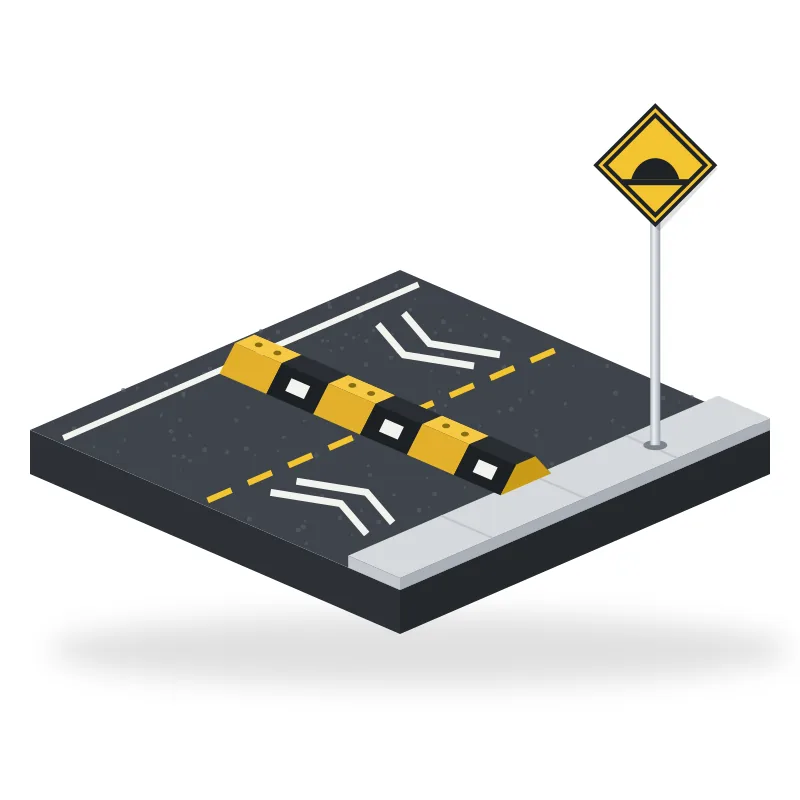
Speed bump cost depends mostly on what the bump is made of. Rubber and plastic bumps are manufactured sections that bolt down to the pavement, so they are the cheapest and the quickest to install. Asphalt and concrete bumps are built in place by a paving or concrete crew, which costs more per foot and is harder to undo. The EstiCube speed bump calculator prices the bump material, the installation labor, anchoring, markings, signs and mobilization as separate lines.
Enter the number of bumps, the length of each across the lane and the type, then choose whether the pavement underneath is asphalt or concrete. Results are national-average estimates, and every unit price can be replaced with the figure from an installer quote.
Also protecting the stalls? Estimate the wheel stop installation cost. Need more than the warning signs? Price the parking sign installation cost.
Speed bump installation cost: unit prices used
Bump material and installation labor are priced per linear foot of bump, and the rates depend on the type. Markings are priced per bump and signs per sign. The total is never less than the minimum job charge.
| Line item | Unit price | Notes |
|---|---|---|
| Rubber bump: material | $28 per ft | $1,344 for 48 ft (four bumps of 12 ft) |
| Rubber bump: labor | $9 per ft | $432 for 48 ft |
| Plastic bump: material and labor | $22 + $8 per ft | $1,056 + $384 for 48 ft |
| Asphalt bump: material and labor | $40 + $30 per ft | $1,920 + $1,440 for 48 ft; built in place |
| Concrete bump: material and labor | $55 + $45 per ft | $2,640 + $2,160 for 48 ft; poured in place |
| Anchoring into concrete | $4 per ft | Rubber and plastic bumps on a concrete surface only; $192 for 48 ft |
| Paint & reflective markings | $45 per bump | Optional; $180 for four bumps |
| Warning signs | $225 each | $450 for two signs |
| Mobilization | $350 | Flat charge to bring crew and equipment |
| Minimum job charge | $600 | Floor for a single short bump |
A default job (four 12 ft rubber bumps on asphalt, with markings and two warning signs) comes to $2,756, or $689 per bump.
How much does a speed bump cost to install?
With the defaults, four 12 ft rubber speed bumps on an asphalt lot come to $2,756, or $689 per bump. That is $1,344 for 48 ft of bump, $432 of installation labor, $180 to paint and add reflective markings on four bumps, $450 for two warning signs and $350 of mobilization.
The type changes the price the most. With the same four 12 ft bumps, plastic comes to $2,420, asphalt to $4,340 and concrete to $5,780. Bolting a rubber or plastic bump into a concrete surface adds anchoring at $4 per ft, which takes the rubber default to $2,948 and plastic to $2,612. Asphalt and concrete bumps are built in place, so the surface under them does not add a line.
The extras are small but easy to forget. Turning markings off takes the default to $2,576 and dropping both signs takes it to $2,306. Mobilization is a flat charge, so the cost per bump falls as the job grows: one 12 ft bump with one sign is $1,064, while ten 12 ft bumps with two signs come to $5,690, or $569 per bump. A single 4 ft bump with no markings or signs adds up to $498, which the calculator raises to the $600 minimum job charge.
Speed bump, speed hump or speed table?
The terms are not interchangeable in engineering, even though the public uses them that way. The federal Manual on Uniform Traffic Control Devices says that speed humps generally provide more gradual vertical deflection than speed bumps, and that speed bumps limit the speed of traffic more severely. The manual lists speed tables and raised crosswalks or intersections as other forms of speed humps, and it treats the names as interchangeable for signing purposes.
In a parking lot, a short, abrupt bump is often the choice, because drivers are already moving slowly and the goal is usually to hold speeds near walking pace in front of entrances, crosswalks and drive aisles with a lot of foot traffic. A longer, gentler hump is used where vehicles should still be able to cross at a slow but steady speed. The calculator prices a bump by its length across the lane, so treat the type you choose as the product you want quoted: bolt-down rubber or plastic sections, or an asphalt or concrete bump built in place.
Rubber is often picked for a lot because it is relatively cheap and can be removed or reset. Plastic is lighter and cheaper still and is typically sold for lighter traffic, so check the manufacturer's load rating. Asphalt and concrete cost more per foot and are permanent, so they tend to fit a drive aisle that sees truck traffic.
Permits and rules on private lots
On a public street, a speed hump is a decision for the agency that owns the road, and it follows that agency's traffic calming process. A private lot is different: the owner decides, and many owners can install bolt-down bumps without a traffic permit. The federal MUTCD says it does not apply to parking areas, including the driving aisles within them, whether they are publicly or privately owned, so its sign and marking rules are not a requirement for a lot aisle. State and local rules can still apply to devices on private property used by the public, so check before you buy.
Ask the city or county whether a building, zoning or right-of-way permit is needed, and ask the fire department whether the bumps affect an emergency access route. Look at accessible routes too, because a bump should not cross a path that wheelchair users depend on, and read your lease or HOA rules. An owner or manager should also keep the signs and markings in place, since a bump that drivers cannot see is a liability.
Anchoring a bump or building one in place means drilling or cutting into pavement. 811 says utilities can be buried just inches below the surface, so call 811 a few business days before the work. The call is free.
Placement, markings and plowing
Place a bump square across the lane, so drivers meet it at a right angle, and leave short gaps at the curb where water drains. Put bumps ahead of crosswalks and entrances rather than inside turns, where drivers are steering over the bump. The calculator adds a markings line at $45 per bump for paint and reflectors so the bump can be seen day and night. The federal manual shows white markings on a speed hump for public roads, while manufactured rubber bumps usually come with their own high-visibility color, so follow the product and local rules.
The federal manual says a SPEED HUMP warning sign should be used in advance of a vertical deflection that is designed to limit speed, and it allows the legend SPEED BUMP on that sign. The calculator adds a warning sign at $225 each, so two signs cover both approaches of a single aisle.
In snow country, plowing is a common reason to choose rubber. Bolt-down rubber and plastic bumps can be unbolted and stored for winter, which keeps the plow blade from catching them. Asphalt and concrete bumps stay in place, so mark them well and ask the plow contractor to work around them.
How to use the speed bump calculator
- Decide how many speed bumps you need and enter the count. Mark each position across the drive aisle.
- Enter the length of each bump across the lane in feet. A bump normally spans the full lane width, less any gap left at the curb.
- Choose the type: rubber, plastic, asphalt or concrete.
- Choose the pavement surface. Anchoring is only added when a rubber or plastic bump goes on concrete.
- Switch paint and reflective markings on or off, and enter the number of warning signs.
- Open the pricing section and replace any unit price with the figure from a quote, such as the material rate per foot, the labor rate or the mobilization charge.
- Review the line items, the total and the cost per bump, then copy the share link or switch to contractor bid mode to add overhead, profit and a proposal.
Speed bump installation FAQ
How much does it cost to install a speed bump?
With the defaults (four 12 ft rubber bumps on asphalt, with markings and two warning signs) the calculator gives $2,756, or $689 per bump. A single 12 ft bump with one sign comes to $1,064, and ten bumps come to $5,690, or $569 each. Local prices and site conditions change the real figure.
Are rubber, plastic, asphalt or concrete speed bumps cheapest?
Plastic is the cheapest at $22 per ft of material plus $8 of labor, which makes the default job $2,420. Rubber follows at $2,756, then asphalt at $4,340 and concrete at $5,780. Asphalt and concrete cost more because they are built in place, but they are the most permanent.
What is the difference between a speed bump and a speed hump?
The federal MUTCD says speed humps generally give a more gradual vertical deflection than speed bumps, and that speed bumps limit speeds more severely. For signing, the manual treats the two names as interchangeable. In a parking lot, an abrupt bump is often used, and a longer, gentler hump is typical where traffic needs to keep moving.
Why does anchoring cost extra on concrete?
Rubber and plastic bumps are bolted to the pavement, and drilling anchors into concrete takes longer than fastening into asphalt. The calculator adds $4 per ft when a rubber or plastic bump goes on a concrete surface, which is $192 for four 12 ft bumps and brings the rubber default to $2,948. Asphalt and concrete bumps are built in place and have no anchoring line.
Do I need a permit to install speed bumps in a parking lot?
Often not for a traffic permit, because a private owner makes the decision, but local rules vary. Ask the city or county about building or zoning permits and the fire department about emergency access, and check lease or HOA rules. The federal MUTCD says it does not apply to parking areas or their drive aisles, but state and local rules can still apply.
Do speed bumps need signs and markings?
They should have them, since a bump that drivers cannot see is a hazard. The MUTCD says a SPEED HUMP sign should be used in advance of a vertical deflection built to limit speed, and it shows white markings on speed humps on public roads. The calculator adds $45 per bump for markings and $225 per sign. Without markings the default job is $2,576.
Can speed bumps be removed for winter plowing?
Rubber and plastic bumps are bolted down, so they can be unbolted and stored for winter and put back in spring. Asphalt and concrete bumps cannot be removed that way and can catch a plow blade, so mark them well. Being removable is one reason rubber is often chosen in cold climates.
Why is the minimum job charge $600?
Crews charge for travel and setup however small the job is, so one short bump costs far more per foot than a larger order. A single 4 ft rubber bump with no markings or signs adds up to $498 (material $112, labor $36 and mobilization $350), which the calculator raises to the $600 minimum. Ask the installer what their minimum is and enter it in the pricing section.
Sources
- MUTCD 11th Edition, Part 2C: Warning Signs and Object Markers (Section 2C.27, SPEED HUMP sign) — Federal Highway Administration
- MUTCD 11th Edition, Part 3: Markings (Sections 3B.29 and 3B.30, speed hump markings) — Federal Highway Administration
- MUTCD 11th Edition, Part 1: General (Section 1B.01, facilities the MUTCD does not apply to) — Federal Highway Administration
- Call 811 Before You Dig — Common Ground Alliance
Related calculators
Projects often planned together — jump to a related estimator for the next line item.
Wheel Stop
Calculate rubber and concrete parking wheel stop supply and installation cost. Includes rebar pins, reflective stripes, and mobilization.
Signs
Estimate regulatory, ADA, stop, and wayfinding sign counts with posts, footings, and installation cost for commercial parking lots.
Striping
Estimate pavement marking linear feet, traffic paint gallons, and striping cost. Includes stalls, ADA symbols, fire lanes, arrows, and mobilization.
Bollard
Estimate steel, concrete, and removable bollard supply and installation cost. Core drill, surface mount, paint, and mobilization for storefront protection.
More pavement & parking calculators
Striping, paving, ADA, sealcoating, signs, sweeping & curbing
Explore all 6 categories
Browse every free EstiCube tool by project type — pavement & parking, commercial property, outdoor projects, home & structure, landscape & lawn, home services.
View full calculator directory