Commercial Snow Removal Cost Calculator
Compare per-push, seasonal, and per-inch snow contracts side by side. Enter your lot size and climate zone to see which billing model costs less over a full winter.
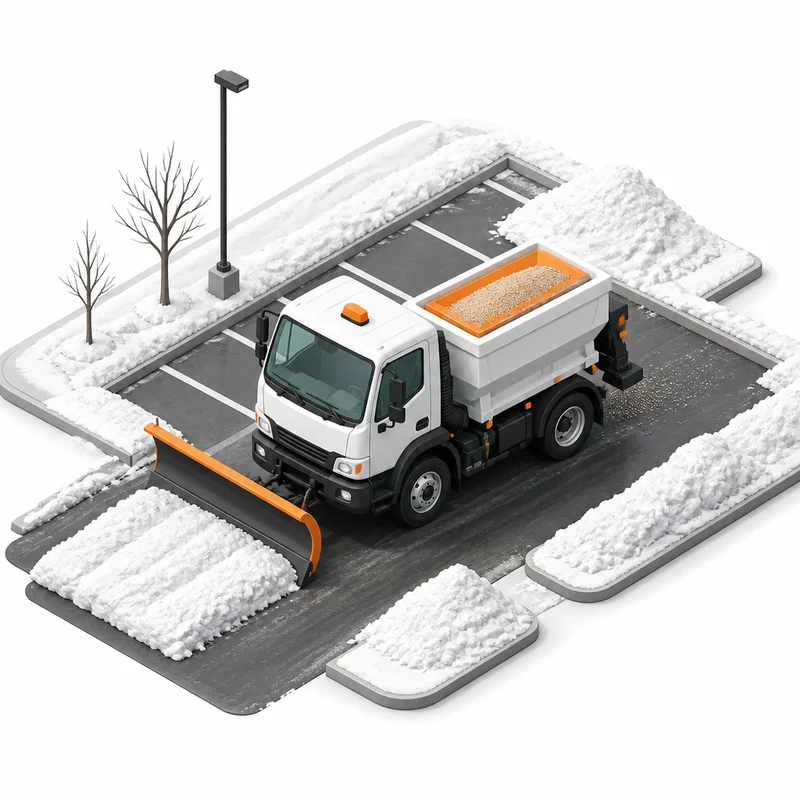
Snow contractors quote the same lot three different ways, and the cheapest model depends entirely on how much it snows. This calculator prices all three from one set of inputs — per push, flat seasonal contract, and per inch of accumulation — so you can see which structure actually favors your property before you sign.
Enter your lot square footage, climate zone, and trigger depth to get a cost per push, a full-season total under each billing model, and a separate salting budget. Built for US property managers, retail operators, and facility teams putting winter services out to bid.
Budgeting the whole year? Use the parking lot maintenance cost calculator. Spring cleanup after the season: parking lot sweeping prices.
Commercial snow removal cost per square foot and per push
These are the 2026 US unit rates behind the calculator. Plowing is quoted per square foot of lot with a minimum charge per rollout, which is why small lots cost far more per square foot than large ones.
| Line item | Unit rate | Notes |
|---|---|---|
| Plowing | $0.0055 / sq ft per push | About $550 per push on a 100,000 sq ft lot |
| Minimum per push | $185 | Applies to small lots regardless of size |
| Sidewalk clearing | $0.55 / linear ft per push | Shoveling and walk-behind work, billed with each push |
| Salting / de-icing | $0.004 / sq ft per application | Billed separately from plowing, minimum $145 |
| Seasonal contract | ~92% of expected per-push total | Contractor absorbs the weather risk |
| 3 to 6 in. event | 1.45x a base push | Per-inch billing only |
| 6 to 12 in. event | 2.1x a base push | Per-inch billing only |
| Over 12 in. event | 3x a base push | Per-inch billing only |
Rates are 2026 US national averages for commercial lots. Regional pricing varies widely: a Buffalo or Minneapolis contractor prices a routine season very differently from an Atlanta one, where a single storm may need equipment brought in from out of state.
How much does commercial snow removal cost?
Commercial snow plowing in the United States runs roughly $0.004 to $0.008 per square foot per push, which puts a typical 100,000 sq ft retail lot at $400 to $800 each time the plow rolls out. Most contractors apply a minimum charge of $150 to $250 per visit, so a small office lot pays the minimum rather than the square-foot rate.
Over a full winter the number that matters is the season total, and that depends on how often it snows. A moderate Midwest season of about 16 plowable events at a 2-inch trigger puts the same 100,000 sq ft lot near $8,800 for plowing alone. In a severe Upper Midwest winter with 42 events, the same lot can pass $23,000.
Salting is quoted separately at roughly $0.003 to $0.005 per square foot per application, or $300 to $500 per application on that same lot. Property managers routinely underbudget here, because de-icing runs on freeze-thaw cycles and black ice, not just on snowfall — a mild, wet winter can need more salt than a cold, dry one.
Per push, seasonal, or per inch — which contract is cheaper?
Per-push billing charges a flat rate every time the contractor clears the lot. You pay only for work performed, which wins in a mild winter and hurts in a heavy one. It is the most common structure for small and mid-size properties, and the easiest to audit against service tickets.
A seasonal contract is a single flat fee for the whole winter, usually priced near 90 to 95 percent of the expected per-push total. It is not cheaper on average — it is insurance. The contractor takes the weather risk, you get a predictable line item, and in a blizzard year you come out well ahead. In a mild year you overpay.
Per-inch billing tiers the price by accumulation: a 1 to 3 inch event costs a base push, 3 to 6 inches about 1.45x, 6 to 12 inches about 2.1x, and anything over a foot roughly 3x. It tracks actual workload most closely, which makes it the fairest structure for both sides, but it also produces the least predictable invoice. Run all three above before you choose.
What to check before signing a snow contract
Trigger depth drives cost more than almost any other term. A 1-inch trigger sends the plow out roughly 28 percent more often than a 2-inch trigger; a 3-inch trigger cuts rollouts by about a quarter. Retail and medical properties usually need a 1-inch or 2-inch trigger for liability reasons, while an industrial yard can often live with 3 inches.
Confirm what counts as a separate push during a long storm. Some contracts re-bill every 4 to 6 hours of continuous snowfall, which can turn a single 14-inch event into three or four billable pushes. Get the re-push interval in writing, and ask whether the plow returns to open the lot after the municipal plow berms your entrance.
Finally, verify insurance and slip-and-fall indemnification before price. Snow and ice liability is the single largest exposure in winter facility management, and a contractor who underprices the work is usually the one carrying the thinnest coverage. Ask for a certificate of insurance naming your entity as additional insured, and keep the service tickets — they are your evidence if a claim is filed.
How to use the snow removal calculator
- Enter your lot area in square feet. If you only know acreage, multiply by 43,560 — a 2.5-acre lot is about 109,000 sq ft.
- Pick the climate zone that matches your region. It sets the expected number of plowable events per season and how those events distribute across depth bands.
- Choose your trigger depth. Use 1 or 2 inches for retail, medical, and anywhere the public walks; 3 inches is common for industrial and warehouse yards.
- Set the scope. If sidewalks are included, enter their total linear footage — walk clearing is billed alongside each push and is often a third of the total.
- Add your expected salt applications for the season. Twelve is a reasonable starting point for a moderate climate; heavy freeze-thaw regions run higher.
- Compare the three season totals. The lowest is flagged, but read the note below it: the cheapest model on paper is not always the right one once you price in weather risk.
Commercial snow removal FAQ
How much does commercial snow removal cost per push?
Most US commercial lots run $0.004 to $0.008 per square foot per push, with a minimum charge of $150 to $250. A 50,000 sq ft lot typically costs $250 to $400 per push, and a 100,000 sq ft lot $400 to $800. Sidewalk clearing adds roughly $0.55 per linear foot each time.
How much does a seasonal snow contract cost?
Seasonal contracts usually price at about 90 to 95 percent of the expected per-push total for your climate zone. On a 100,000 sq ft lot in a moderate Midwest winter that lands near $8,000 to $9,000 for plowing. You pay the same amount whether it snows twice or thirty times, which is the point: you are buying budget certainty, not a discount.
Is a seasonal contract cheaper than per push?
On average, no — it is priced to be roughly break-even against an expected season, slightly discounted for guaranteed revenue. It is cheaper in a heavier-than-normal winter and more expensive in a mild one. Choose seasonal when a predictable line item matters more than the lowest possible spend, and per push when you can absorb a bad year.
How much does salting a parking lot cost?
De-icing runs about $0.003 to $0.005 per square foot per application, or $300 to $500 on a 100,000 sq ft lot. Budget 10 to 20 applications in a moderate climate and more where freeze-thaw cycles are frequent. Salting is billed separately from plowing on nearly every commercial contract.
What is a trigger depth in a snow contract?
The trigger depth is the accumulation that obligates the contractor to clear the lot without you calling. A 2-inch trigger is the market standard. Dropping to 1 inch increases rollouts by roughly 28 percent and cost with it, but is common for retail, medical, and any property with heavy foot traffic and slip-and-fall exposure.
How much does snow plowing cost per acre?
One acre is 43,560 sq ft, so at typical commercial rates a single push runs about $175 to $350 per acre. Large lots price toward the low end because the equipment moves efficiently across open pavement; small, obstructed lots with islands and drive-thrus price much higher per acre.
When should I put snow services out to bid?
Late summer through early fall. Contractors set routes and equipment commitments before the first freeze, and by November the good ones are full. Bidding in August or September gives you leverage and choice; bidding in December gets you whoever is left.
Does the contractor re-bill during a long storm?
Many contracts allow a new billable push every 4 to 6 hours of continuous snowfall, so one large event can generate several charges. This is legitimate — the lot genuinely needs repeated clearing — but the interval must be in the contract. Ask for it explicitly and reconcile invoices against service tickets.
Sources
- Snow and Ice Control: Guidelines for Materials and Methods — Transportation Research Board (National Academies)
- Winter Weather — Plan, Equip, and Train — U.S. Occupational Safety and Health Administration
- Road Salt Application and Water Quality — U.S. Environmental Protection Agency
Related calculators
Projects often planned together — jump to a related estimator for the next line item.
Lot maintenance planner
Annual parking lot maintenance budget — sweeping, sealcoating, restriping, crack sealing, potholes, snow and lighting on a 1, 3 or 5-year schedule.
Sweeping
Calculate power sweeping cost per visit and annual contract pricing by lot size. Includes curb blow-off, debris level, and mobilization.
Striping
Estimate pavement marking linear feet, traffic paint gallons, and striping cost. Includes stalls, ADA symbols, fire lanes, arrows, and mobilization.
Pothole
Estimate pothole patch count, cold mix bags, saw-cut prep, and repair cost for parking lots and commercial pavement. Includes mobilization minimums.
Lot lighting
Price LED retrofits and new pole installs, then see annual energy savings and simple payback period for a commercial parking lot.
Crack Seal
Estimate linear feet of crack sealant, hot-pour blocks, and routing cost for parking lot pavement maintenance. Includes mobilization and minimum trip charges.
More commercial calculators
Striping, sealcoating, potholes, signs, sweeping & curbing
Explore all 5 categories
Browse every free EstiCube tool by project type — home & structure, outdoor projects, landscape & lawn, commercial, home services.
View full calculator directory