Radon Mitigation Cost Calculator
Price a radon mitigation system from the foundation type, the footprint of the house and your test result. Choose how the vent pipe is routed, add sealing, a dedicated circuit and a post-mitigation test, then switch to contractor bid mode to build a proposal.
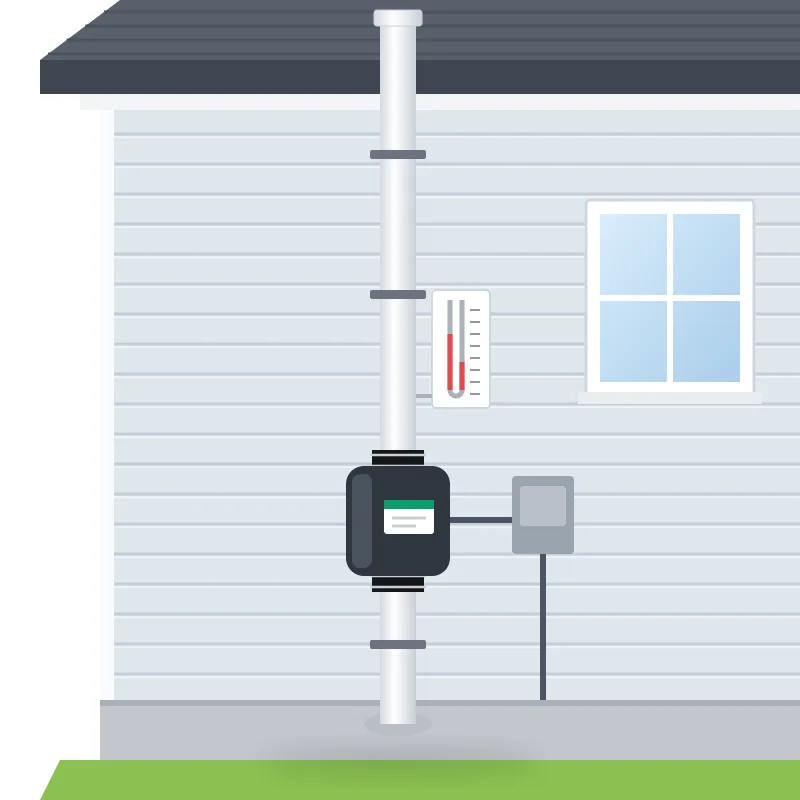
Radon is a radioactive gas that can seep into a house from the soil beneath it. When a test comes back high, the usual fix is a mitigation system: a vent pipe draws the gas from under the foundation and a fan sends it above the roof line. The cost depends mostly on the foundation, how many suction points the house needs and how the pipe is routed. The EstiCube radon mitigation calculator lays those pieces out line by line.
Enter the foundation type, the footprint of the house and the radon level from your test, then pick the pipe routing and the optional extras. Results are national-average estimates for a typical installation, and every unit price can be changed to match a quote from a radon contractor.
Radon system going into a crawl space? Compare the crawl space encapsulation cost. Budgeting for the other systems around the house? Check the septic tank pumping cost.
Radon mitigation cost: unit prices used
The base system covers the fan, piping and the first suction point. Extra suction points, routing, a crawl space membrane and the optional lines are added on top, and the total is never less than the minimum job charge.
| Line item | Unit price | Notes |
|---|---|---|
| Mitigation system | $1,050 | Fan, piping and the first suction point |
| Additional suction point | $375 each | One point per 2,000 sq ft of footprint; $375 for a 3,000 sq ft basement |
| Interior pipe routing | $350 | Pipe run through the house instead of up the outside wall |
| Garage / attic routing | $225 | Pipe run through the garage or attic |
| Crawl space membrane | $1.60 per sq ft | Crawl space and mixed foundations only; $1,600 for 1,000 sq ft |
| Crack & sump sealing | $250 | Optional; sealing slab cracks and the sump pit lid |
| Dedicated electrical circuit | $225 | Optional, if no outlet is near the fan |
| Post-mitigation radon test | $175 | Optional; confirms the result |
| Minimum job charge | $1,100 | Floor for a bare system |
A default job (basement, 2,000 sq ft footprint, 8 pCi/L, exterior pipe run, sealing and a post-mitigation test) comes to $1,475.
How much does radon mitigation cost?
With the defaults, a basement home with a 2,000 sq ft footprint, a test result of 8 pCi/L, an exterior pipe run, sealing and a post-mitigation test comes to $1,475. The system itself is $1,050, sealing adds $250 and the retest adds $175.
The biggest swings come from the foundation and the routing. A garage or attic run adds $225 and an interior run adds $350, so the default job becomes $1,700 or $1,825. A dedicated electrical circuit for the fan adds $225 more. A bare system with sealing and the retest switched off lands under the minimum, so the calculator raises it to the $1,100 minimum job charge.
Real quotes also depend on access, the condition of the slab, local labor rates and the equipment used, so use the pricing section to enter the figures from a contractor and compare bids on the same footing.
How sub-slab depressurization works
Most systems use sub-slab depressurization. A suction point is cut through the slab or the floor membrane, a vent pipe is connected to it and a fan keeps the soil gas moving out and away from the house, releasing it above the roof. Pulling the gas from under the foundation helps keep it out of the living space.
How many suction points a house needs depends on how well air moves through the material under the slab. The calculator uses a simple rule of thumb: one point per 2,000 sq ft for a basement or slab, which means a 3,000 sq ft basement is priced with two points and adds $375, for $1,850. A very high reading adds one more point in the estimate. A diagnostic test by the installer decides the real number.
A crawl space is treated differently. A heavy plastic membrane covers the ground and the suction point draws from under it. The calculator prices that membrane at $1.60 per sq ft. A crawl space foundation with 1,000 sq ft of crawl space comes to $3,075 with the other defaults. A mixed foundation, with a basement or slab plus a crawl space, needs a point for each, so 2,000 sq ft of slab and 1,000 sq ft of crawl space comes to $3,450.
When to fix a house: what the test result means
The EPA recommends fixing the home when the radon level is 4 pCi/L or higher, and says to consider fixing it when the level is between 2 and 4 pCi/L. The level field in the calculator is in pCi/L, and a decimal such as 12.5 is accepted.
The level does not change the price of the system directly, apart from one thing: when it is above 20 pCi/L, the calculator adds one extra suction point. That takes the default job from $1,475 to $1,850.
Ask your installer to explain the reading, whether it came from a short-term or a long-term test and whether a second test is worth doing before you commit to a system.
Post-mitigation testing and the cost of running the fan
Installing the system is not the end of the job. A post-mitigation test confirms the result in your own house, and the calculator includes it at $175. The result is not guaranteed, which is why testing afterwards and again from time to time matters. No estimate here promises a specific reduction in the radon level.
The fan runs all day, every day. At a typical 70 watts and $0.15 per kWh that is about $92 a year in electricity, which is a running cost this one-time estimate does not include. The calculator shows it as a separate figure.
When choosing a contractor, ask about radon certification, such as a National Radon Proficiency Program (NRPP) listing, and about local licensing rules, which vary. Ask what the quote covers: the number of suction points, the pipe routing, sealing, electrical work and the post-mitigation test.
How to use the radon mitigation calculator
- Choose the foundation type: basement, slab on grade, crawl space, or a mixed foundation that has a crawl space as well as a basement or slab.
- Enter the footprint of the house in square feet. This sets the number of suction points for basement, slab and mixed foundations.
- Enter the radon level from your test in pCi/L. A result above 20 adds one suction point to the estimate.
- If the foundation includes a crawl space, enter its area in square feet for the membrane line.
- Pick the pipe routing: exterior, interior or through the garage or attic. Then tick sealing, a dedicated electrical circuit and the post-mitigation test as needed.
- Open the pricing section and replace any unit price with the figure from a contractor quote, such as the base system or the price per extra suction point.
- Review the line items and total, then copy the share link or switch to contractor bid mode to add overhead, profit and a proposal.
Radon mitigation FAQ
How much does radon mitigation cost?
With the defaults (basement, 2,000 sq ft footprint, 8 pCi/L, exterior pipe run, sealing and a post-mitigation test) the calculator gives $1,475. A garage or attic run makes it $1,700 and an interior run $1,825. Access, the slab and local labor rates will change the real figure.
At what radon level should I fix my home?
The EPA recommends fixing the home when the level is 4 pCi/L or higher, and says to consider fixing it between 2 and 4 pCi/L. Enter the result of your test in the level field. Above 20 pCi/L the calculator adds one extra suction point.
How does a radon mitigation system work?
Most systems use sub-slab depressurization. A pipe is connected to a suction point under the slab or crawl space membrane, and a fan draws the soil gas out and vents it above the roof. That keeps the gas from entering the house.
How many suction points do I need?
The calculator uses one point per 2,000 sq ft for a basement or slab, one for a crawl space, and one for each part of a mixed foundation, plus one when the level is above 20 pCi/L. A 3,000 sq ft basement has two points, so the default job rises from $1,475 to $1,850. The installer's diagnostic test sets the real number.
Does a crawl space cost more to treat?
Usually, because a membrane covers the ground under the suction point. The calculator prices it at $1.60 per sq ft, so 1,000 sq ft of crawl space adds $1,600 and makes the job $3,075. A mixed foundation with 2,000 sq ft of slab and 1,000 sq ft of crawl space is $3,450.
Do I need a test after the system is installed?
Yes. A post-mitigation test confirms the result in your own house, and the calculator includes it at $175. No estimate can promise a specific reduction, so the test is how you find out what the system achieved. It is worth retesting from time to time.
How much does it cost to run a radon fan?
A typical fan draws about 70 watts and runs all year. At $0.15 per kWh that is about $92 a year in electricity, which the calculator shows as a separate running cost and does not add to the one-time total.
What certification should a radon contractor have?
Ask about radon certification, such as a National Radon Proficiency Program (NRPP) listing, and check your local licensing rules, which differ from place to place. Also ask what the quote covers, such as suction points, routing, sealing, electrical work and the retest.
Guides
Sources
- Radon — U.S. Environmental Protection Agency
- What is EPA's Action Level for Radon and What Does it Mean? — U.S. Environmental Protection Agency
- National Radon Proficiency Program — NRPP
Related calculators
Projects often planned together — jump to a related estimator for the next line item.
Crawl space
Estimate crawl space encapsulation cost from square footage, vapor barrier, dehumidifier, drainage, and insulation choices.
Insulation
Calculate blown insulation bags or batts for attic, walls, and floors. R-value depth estimates with material and install cost.
Septic
Estimate septic tank pumping, inspection, and new system installation cost from tank size, system type, and soil conditions.
Well pump
Estimate well pump replacement or new well drilling cost from well depth, pump type, casing, and pressure tank options.
Explore all 5 categories
Browse every free EstiCube tool by project type — home & structure, outdoor projects, landscape & lawn, commercial, home services.
View full calculator directory