Crawl Space Encapsulation Cost Calculator
Price a crawl space encapsulation from its length, width and wall height, the vapor barrier thickness and how wet the space is. Add vent sealing, a dehumidifier, wall insulation, interior drainage and a sump pump, then switch to contractor bid mode to build a proposal.
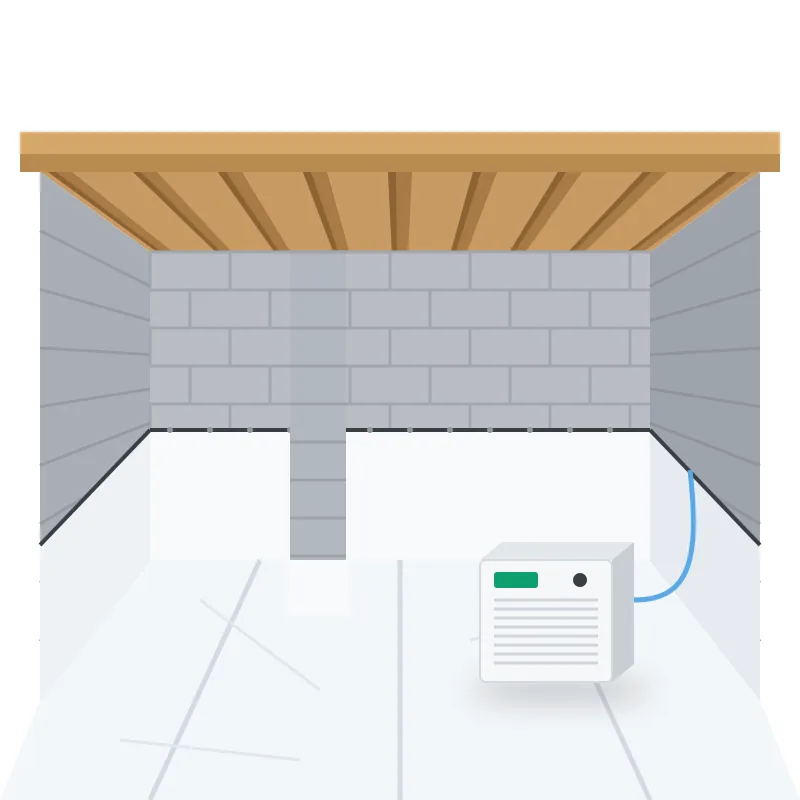
Encapsulating a crawl space means closing it off from the outdoors: a heavy vapor barrier runs across the floor and up the foundation walls, the vents are sealed, and a dehumidifier keeps the air dry. It costs far more than laying a sheet of plastic on the dirt, and the bill moves a lot with the size of the space, the thickness of the liner and how much water you are dealing with. The EstiCube crawl space encapsulation calculator breaks the job into its lines so you can see where the money goes.
Enter the length, width and wall height, choose a liner thickness and the condition of the space, then set the number of vents and the optional extras. Results are line-by-line national-average estimates for a typical installation, and every unit price can be changed to match a quote from a local contractor.
Planning work on the air under your house? Compare radon mitigation cost. Insulating the floor above or the walls around the space? Use the insulation calculator.
Crawl space encapsulation cost: unit prices used
The vapor barrier is priced on floor plus wall area. Cleanup and prep is priced on floor area and scaled up for damp or flooded spaces. The rest are fixed or per-unit allowances.
| Line item | Unit price | Notes |
|---|---|---|
| Vapor barrier, 10 mil | $1.60 per sq ft | Floor plus wall area; $3,168 for the default 1,980 sq ft |
| Vapor barrier, 12 mil | $2.00 per sq ft | Default liner; $3,960 for 1,980 sq ft |
| Vapor barrier, 20 mil | $2.80 per sq ft | Heavy-duty reinforced liner; $5,544 for 1,980 sq ft |
| Cleanup & surface prep, dry | $0.75 per sq ft floor | Clearing debris and smoothing the ground; $1,125 for 1,500 sq ft |
| Cleanup & surface prep, damp | $0.975 per sq ft floor | Prep rate times 1.3; $1,463 for 1,500 sq ft |
| Cleanup & surface prep, standing water | $1.35 per sq ft floor | Prep rate times 1.8; $2,025 for 1,500 sq ft |
| Vent sealing | $65 per vent | $390 for the default six vents |
| Crawl space dehumidifier | $2,200 | Flat allowance for the unit and installation |
| Rigid foam wall insulation | $3.50 per sq ft of wall | Optional; $1,680 for 480 sq ft of wall |
| Interior drain tile | $28 per linear foot | Optional, around the perimeter; $4,480 for 160 LF |
| Sump pump | $1,800 | Optional flat allowance |
| Minimum job charge | $2,500 | Floor for very small crawl spaces |
A default crawl space (50 by 30 ft, 3 ft walls, 12 mil liner, damp, six vents sealed, dehumidifier) comes to $8,013, or $5.34 per sq ft of floor.
How much does it cost to encapsulate a crawl space?
With the defaults, a 50 by 30 ft crawl space with 3 ft walls, a 12 mil liner, damp conditions, six sealed vents and a dehumidifier comes to $8,013, or $5.34 per sq ft of floor. The liner is the biggest line at $3,960, followed by the $2,200 dehumidifier, $1,463 for cleanup and prep and $390 for vent sealing.
Size matters, but not in a straight line, because the dehumidifier is a flat cost. A 25 by 20 ft space (500 sq ft) with four vents comes to $4,488, which is $8.98 per sq ft. A 40 by 30 ft space with six vents comes to $7,000, or $5.83 per sq ft, and a 60 by 40 ft space with eight vents comes to $11,060, or $4.61 per sq ft. The smallest spaces hit the $2,500 minimum job charge when the extras are left out.
The calculator prices a typical installation. Access, the amount of debris to remove, local labor rates and the brand of equipment all move a real quote, so use the pricing section to enter the numbers from a contractor and compare bids on the same footing.
Encapsulation vs a plain vapor barrier
A plain vapor barrier is a sheet of plastic laid over the dirt floor to slow moisture coming up from the ground. Encapsulation goes further. The liner is a thicker, durable material that covers the floor and climbs the foundation walls, the seams are overlapped and sealed, the vents are closed off and the space is conditioned, usually with a dehumidifier. The aim is to treat the crawl space as part of the building envelope instead of an open, vented cavity.
That is why this calculator measures liner area as floor plus wall area. At the default size that is 1,980 sq ft rather than 1,500 sq ft. The liner thickness you pick changes the price: a 10 mil liner brings the default job to $7,221, 12 mil is $8,013 and a 20 mil reinforced liner is $9,597. Thicker liners resist tears from foot traffic when someone has to get under the house to service equipment.
Raising the wall height also adds liner. At 4 ft walls instead of 3 ft the default job rises from $8,013 to $8,333, because the liner area grows from 1,980 to 2,140 sq ft.
Vent sealing, dehumidifier and keeping the space dry
Controlling moisture is the core of the job. The EPA says moisture control is the key to controlling mold, so the point of sealing the vents and adding a dehumidifier is to keep humid outdoor air from wetting the space and to dry the air that is already there. Sealing costs $65 per vent in the calculator, so six vents add $390.
The dehumidifier is a $2,200 flat allowance. Leaving it out drops the default job from $8,013 to $5,813, but a sealed space with no way to remove moisture may not stay dry, so check with your installer before taking it off the list. A dehumidifier also runs on electricity, so it adds an ongoing running cost that this one-time estimate does not include.
Wall insulation is optional, and how much is worthwhile depends on your climate and how the space is used, so ask your contractor. In the calculator, rigid foam on the foundation walls is $3.50 per sq ft of wall, which is $1,680 on the default 480 sq ft of wall and brings the total to $9,693.
Standing water: drainage and a sump pump
A damp crawl space and one that holds standing water are different problems. The condition setting multiplies the cleanup and prep line: 1.0 for dry, 1.3 for damp and 1.8 for standing water. On the default 1,500 sq ft floor that is $1,125, $1,463 or $2,025, which makes the whole job $7,675, $8,013 or $8,575.
A liner and a dehumidifier will not cope with liquid water coming in. Interior drain tile along the perimeter collects it and a sump pump moves it out. The calculator charges $28 per linear foot of drain tile, so 160 LF of perimeter is $4,480, and a sump pump is an $1,800 allowance. A standing-water crawl space with both comes to $14,855 at the default size.
Fixing where the water comes from, such as gutters, downspouts and grading around the house, is usually the first step and is not part of this estimate. Encapsulation manages moisture in the space but does not replace sound drainage outside.
How to use the crawl space encapsulation calculator
- Measure the length and width of the crawl space in feet. If the footprint is irregular, use the overall length and width as a close approximation.
- Enter the wall height, which is the distance from the dirt floor to the underside of the floor framing where the liner will end.
- Choose the vapor barrier thickness: 10 mil for light duty, 12 mil as the standard or 20 mil for heavy-duty reinforced material.
- Select the condition of the crawl space: dry, damp or musty, or standing water after rain. This scales the cleanup and prep line.
- Enter the number of vents to seal and tick the dehumidifier, wall insulation, interior drainage and sump pump options that apply.
- Open the pricing section and replace any unit price with the figure from a contractor quote, such as the liner rate per square foot or the dehumidifier price.
- Review the line items and total, then copy the share link or switch to contractor bid mode to add overhead, profit and a proposal.
Crawl space encapsulation FAQ
How much does it cost to encapsulate a crawl space?
With the defaults (50 by 30 ft, 3 ft walls, 12 mil liner, damp, six vents sealed, a dehumidifier) the calculator gives $8,013, or $5.34 per sq ft of floor. A 500 sq ft space with four vents is $4,488, and a 2,400 sq ft space with eight vents is $11,060. Your access, debris and local labor rates will change the real figure.
What is the difference between encapsulation and a vapor barrier?
A vapor barrier is a plastic sheet over the ground. Encapsulation uses a thicker liner that also covers the foundation walls, seals the seams and the vents, and adds a dehumidifier so the space is conditioned instead of open to outdoor air. That is why the calculator prices the liner on floor plus wall area and adds vent sealing and a dehumidifier.
How much does a crawl space dehumidifier cost?
The calculator uses a $2,200 flat allowance for the unit and its installation. Removing it takes the default job from $8,013 to $5,813. A dehumidifier also uses electricity to run, which is not part of this estimate.
Which vapor barrier thickness should I choose?
The calculator offers 10, 12 and 20 mil at $1.60, $2.00 and $2.80 per sq ft. On the default 1,980 sq ft of liner that is $3,168, $3,960 and $5,544, making the whole job $7,221, $8,013 or $9,597. Thicker and reinforced liners resist tears from foot traffic. Ask your installer what suits your space.
Why do I have to seal the vents?
Open vents let outdoor air into the space. The EPA says moisture control is the key to controlling mold, so an encapsulated crawl space closes the vents and dries the air with a dehumidifier instead. Sealing costs $65 per vent in this calculator, or $390 for six.
Do I need drainage or a sump pump?
Only if water collects in the space. A damp crawl space is often handled with the liner and a dehumidifier, but standing water usually needs interior drain tile and a sump pump. In the calculator that adds $4,480 for 160 LF of drain tile and $1,800 for the pump, taking a standing-water job to $14,855.
How does the condition of the crawl space change the price?
It scales the cleanup and surface prep line, which is $0.75 per sq ft of floor. Dry spaces use 1.0, damp or musty spaces use 1.3 and standing water uses 1.8. At the default size those prep lines are $1,125, $1,463 and $2,025.
Should I insulate the crawl space walls?
It is optional, and how much is worthwhile depends on your climate and how the space is used, so ask your contractor. In this calculator, rigid foam on the foundation walls is $3.50 per sq ft of wall, which is $1,680 for the default 480 sq ft and a total of $9,693.
Guides
Sources
- Mold — U.S. Environmental Protection Agency
Related calculators
Projects often planned together — jump to a related estimator for the next line item.
Radon
Estimate radon mitigation system cost from foundation type, home size, and pipe routing, including the fan, sealing, and post-install test.
Insulation
Calculate blown insulation bags or batts for attic, walls, and floors. R-value depth estimates with material and install cost.
Concrete
Calculate cubic yards of concrete for slabs, driveways, and sidewalks. Includes bags, rebar, delivery, and pour cost estimates.
Septic
Estimate septic tank pumping, inspection, and new system installation cost from tank size, system type, and soil conditions.
More home services calculators
Septic, radon, crawl space & well systems
Explore all 5 categories
Browse every free EstiCube tool by project type — home & structure, outdoor projects, landscape & lawn, commercial, home services.
View full calculator directory