Resurfacing quotes for the same parking lot can differ by a factor of two, and most of that gap is the method, not the contractor. An overlay paves over what is there, a mill and overlay grinds off the worn top first, and full-depth reconstruction digs out the asphalt and the base and builds both again. This guide prices all three on one lot using the EstiCube parking lot resurfacing calculator, then shows what moves the number and when a lot does not need resurfacing at all.
All figures are national planning numbers from the calculator, not a quote. Asphalt prices, haul distance, drainage work and site access vary widely, so use the examples to see how a resurfacing price is built and then enter your own unit prices.
The same lot priced three ways
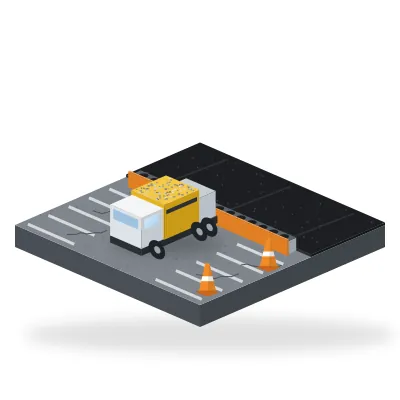
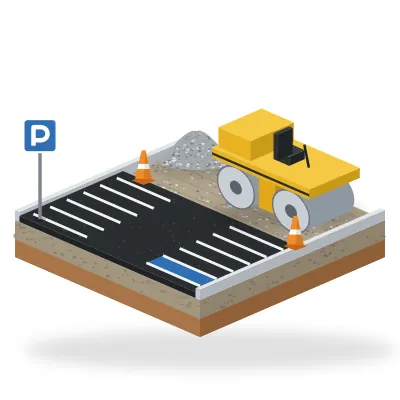
The calculator's default lot is 20,000 sq ft with 2 inches of new asphalt, base repair on 5% of the area, two manholes or catch basins to raise and 60 stalls to restripe. The table runs that lot through each method. The tack coat, asphalt, castings, striping and mobilization lines are identical in all three; what changes is the work done before paving.
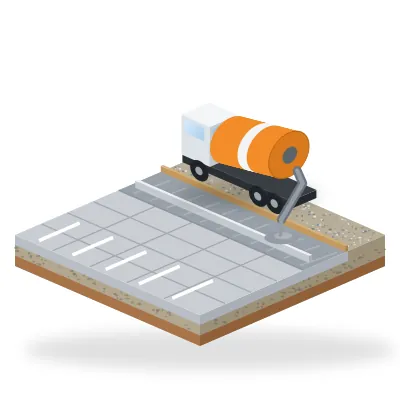
An overlay has no removal line, so it is the cheapest. A mill and overlay adds milling at $0.45 per sq ft, $9,000 on this lot. Full-depth reconstruction replaces the milling and the patching with a single removal and new base line at $2.75 per sq ft, $55,000 here. It has no separate patching line because the whole base is replaced.
| Line (20,000 sq ft, 2 in) | Overlay | Mill and overlay | Full-depth |
|---|---|---|---|
| Milling | - | $9,000 | - |
| Full-depth removal and new base | - | - | $55,000 |
| Base repair patching, 1,000 sq ft | $6,000 | $6,000 | - |
| Tack coat | $1,600 | $1,600 | $1,600 |
| Hot-mix asphalt, 241.7 tons | $25,375 | $25,375 | $25,375 |
| Adjust 2 castings | $900 | $900 | $900 |
| Restripe 60 stalls | $720 | $720 | $720 |
| Mobilization | $1,500 | $1,500 | $1,500 |
| Total | $36,095 | $45,095 | $85,095 |
| Per sq ft | $1.80 | $2.25 | $4.25 |
Cost per square foot by asphalt thickness
The calculator works out the asphalt from the area and the thickness at 145 pounds per cubic foot of compacted hot mix, a common planning figure. On 20,000 sq ft that is 181.3 tons at 1.5 inches, 241.7 tons at 2 inches and 362.5 tons at 3 inches. At $105 a ton, each extra half inch on this lot adds $6,344.
The table keeps everything else at the default and changes only the method and the thickness. Thickness shifts every method by the same dollar amount, so it matters most, in percentage terms, on an overlay. Which thickness a lot needs depends on its traffic and the condition of the base, which is a question for the paving contractor or an engineer rather than a budget decision.
FHWA's guide to asphalt pavement preservation describes thin overlays as a dense-graded mix laid in a layer of less than 2 inches after cold milling removes surface defects. That is the same idea as the 1.5-inch mill and overlay row. Thicker layers are typically used where trucks, buses or delivery vans cross the lot every day.
| Method | 1.5 in | 2 in | 3 in |
|---|---|---|---|
| Overlay | $29,751 ($1.49/sq ft) | $36,095 ($1.80/sq ft) | $48,783 ($2.44/sq ft) |
| Mill and overlay | $38,751 ($1.94/sq ft) | $45,095 ($2.25/sq ft) | $57,783 ($2.89/sq ft) |
| Full-depth | $78,751 ($3.94/sq ft) | $85,095 ($4.25/sq ft) | $97,783 ($4.89/sq ft) |
What drives the price besides the method
Base repair is the line that most often surprises an owner. An overlay or mill and overlay only lasts if the failed spots underneath are cut out and rebuilt first, and the calculator prices that at $6.00 per sq ft of repair. On the default mill and overlay, no patching gives $39,095, 5% gives $45,095, 10% gives $51,095 and 20% gives $63,095. On an overlay the same steps run from $30,095 to $54,095. Two quotes that disagree on how much of the lot needs patching will disagree on the total, so ask each contractor for the square footage they priced.
Lot size matters less per square foot than you might expect, because only the $1,500 mobilization is fixed. With stalls and castings scaled to the lot, a mill and overlay works out as shown below. Below a certain size the minimum takes over: a 3,000 sq ft overlay at 1.5 inches with no patching, castings or striping adds up to $4,595, and the calculator raises it to its $5,000 minimum job.
Castings are $450 each to raise manholes, valve boxes and catch basins to the new surface. Restriping is $12 per stall in this calculator, since new asphalt covers the old lines; turn it off if the striping is bid separately.
| Mill and overlay, 2 in | Total | Per sq ft |
|---|---|---|
| 5,000 sq ft, 15 stalls, 1 casting | $12,624 | $2.52 |
| 10,000 sq ft, 30 stalls, 1 casting | $23,298 | $2.33 |
| 20,000 sq ft, 60 stalls, 2 castings | $45,095 | $2.25 |
| 50,000 sq ft, 150 stalls, 5 castings | $110,488 | $2.21 |
| 100,000 sq ft, 300 stalls, 8 castings | $218,575 | $2.19 |
When sealcoating is enough instead
Resurfacing fixes a surface that has worn out. If the surface has not worn out yet, it is the wrong purchase. FHWA's pavement preservation guide says treatments such as crack sealing work well when done in a timely manner before the structure is damaged, and that crack and fog seals are most appropriate for pavement in excellent to good condition. It places thin overlays later, once condition has become fair or poor, and describes poor pavement as having frequent alligator cracking, rutting and potholes.
For a parking lot, that usually translates into a simple test. If the asphalt is faded and has scattered cracks but holds its shape, crack sealing and sealcoating are typically the right spend. In the EstiCube sealcoating calculator, two coats of asphalt emulsion with crack prep, mobilization and traffic control on the same 20,000 sq ft lot come to $6,700, about $0.34 per sq ft, against $36,095 for the default overlay. If the lot shows alligator cracking, ruts, potholes or patches that keep failing, sealcoat will not hold it together and the comparison is between the three resurfacing methods.
FHWA sums up its pavement preservation program as keeping good roads good, and frames it as a budget tool: its guide says preventive maintenance can reduce the frequency of costly and disruptive rehabilitation and reconstruction. Pricing both options per sq ft over the years you expect each to last is the fair way to compare them.
From cost to a contractor bid
The calculator's total is a direct cost. Switch it to Contractor bid mode and it adds markup on top: 10% overhead, then 20% profit on cost plus overhead, with contingency and material tax at zero by default. On the default mill and overlay that is $4,509.50 of overhead and $9,920.90 of profit, a $59,525.40 customer price or about $2.98 per sq ft. The default overlay becomes $47,645.40 and full-depth becomes $112,325.40.
Material tax, if you set one, applies only to the tack coat and the asphalt, $26,975 on the default lot, and not to milling, patching, castings, striping or mobilization. Up to five extra line items, such as traffic control, drainage work or after-hours paving, can be added before the markup. The proposal prints with your company name, logo and license number, the client and site address, the line items, the total and a valid-until date, and can be saved as a PDF or shared as a link.
Whoever is buying or selling the job, a resurfacing bid is easier to check when it lists these items:
- The method and the compacted thickness of the new asphalt, and the tons it assumes.
- The area to be milled or removed, and the square footage of base repair.
- The number of manholes, valve boxes and catch basins to adjust.
- Restriping by stall count, or a note that striping is bid separately.
- Mobilization, traffic control, and how the lot will be phased if it has to stay open.
- Who requests utility locates for full-depth work. The 811 site says every digging project, regardless of depth, calls for contacting 811 a few business days before digging.
Run your numbers with the Parking Lot Resurfacing Cost Calculator
Change any unit price to match your quote and see every line item add up. It is free, needs no sign-up and works on your phone.
Open the Resurfacing calculatorFrequently asked questions
How much does it cost to resurface a parking lot per square foot?
In the EstiCube parking lot resurfacing calculator, a 20,000 sq ft lot with 2 inches of new asphalt, 5% base repair, two castings and 60 stalls restriped costs $1.80 per sq ft as an overlay, $2.25 as a mill and overlay and $4.25 as full-depth reconstruction. These are national planning numbers, not a quote.
Is mill and overlay worth the extra cost over a straight overlay?
Milling adds $0.45 per sq ft in the calculator, $9,000 on a 20,000 sq ft lot. It removes the cracked top layer and lets the new asphalt go back at about the same grade, which typically matters where curbs, doors or drains would not tolerate a raised surface. On a sound lot with room to build up, an overlay is the cheaper choice.
How much does a 2-inch asphalt overlay cost?
On a 20,000 sq ft lot the calculator gives $36,095 with the default 5% base repair, two castings and 60 stalls restriped, or $28,475 for the bare overlay with no patching, castings or striping. The asphalt alone is 241.7 tons, or $25,375 at $105 a ton.
When does a parking lot need full-depth reconstruction?
When the base has failed: widespread alligator cracking, ruts and soft spots that come back after patching. The calculator prices removal and a new base at $2.75 per sq ft, so the default 20,000 sq ft lot is $85,095 with 2 inches of asphalt. An engineer or paving contractor should confirm it from a site visit.
Can I sealcoat instead of resurfacing?
Only if the lot is still in good shape. Sealcoating protects a sound surface but adds no structure. FHWA describes crack and fog seals as most appropriate for pavement in excellent to good condition. In the EstiCube sealcoating calculator, two coats on 20,000 sq ft cost $6,700, against $36,095 for the default overlay of the same lot, or $28,475 for a bare overlay with no patching, castings or striping.
Sources
- Asphalt Pavement Preservation: companion guide to the Federal-aid Essentials video — Federal Highway Administration
- Pavement Preservation — Federal Highway Administration
- 811 Before You Dig — Common Ground Alliance
More guides