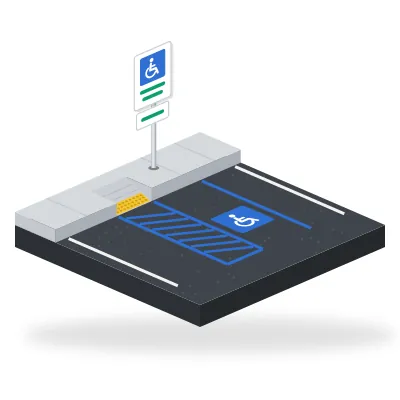
Making a parking lot ADA compliant is rarely one big job. It is a checklist of small ones: the right number of accessible and van spaces, marked aisles, level surfaces, signs, curb ramps where the route changes level, and sometimes warning panels or a short ramp to the entrance. This guide walks through that checklist, prices each item with the EstiCube ADA parking and curb ramp calculator, and then prices three typical upgrades from a quick fix to a full one.
The prices are national planning numbers from the calculator, not a quote, and the requirements are summarized from ADA.gov and the U.S. Access Board pages listed in the sources. This is general information, not legal advice. Check your lot with an ADA specialist or your local code office before you build.
The checklist, item by item
The table lists what to check on an existing lot and what each fix costs in the calculator. Ramps, panels and signs are priced each, markings per stall and a route ramp per foot. Every job also carries $500 of mobilization, and the calculator's $750 minimum job is a floor: it sets the price only when the lines add up to less.
| Item | What to check | Calculator price |
|---|---|---|
| Space count | Enough accessible spaces for the size of each parking facility; a 60-stall lot needs 3 | $75 marking per car space |
| Van spaces | At least one of every six accessible spaces, or fraction of six, is van accessible | $95 marking per van space |
| Access aisles | An aisle beside each accessible space, marked to discourage parking in it, with the accessible route connecting directly to it | Included in the stall marking |
| Slope | Spaces and aisles no steeper than 1:48 in any direction | Not priced; regrading is paving work |
| Signs | A sign with the symbol of accessibility for each space, at least 60 in to the bottom edge; van spaces also say van accessible | $290 per sign on a post, $35 per VAN ACCESSIBLE plaque |
| Curb ramps | A ramp wherever the accessible route changes level by more than 1/2 in; running slope 1:12 or less, cross slope 1:48 or less | $2,500 new, $1,200 retrofit |
| Detectable warnings | Required at transit facilities covered by DOT's standards; check local codes and project specs | $350 per panel |
| Accessible route | Spaces on the shortest accessible route to an accessible entrance; route at least 3 ft wide and firm, stable and slip-resistant | $450 per ft of route ramp |
Spaces, aisles, signs and slope
The EstiCube guide to ADA parking lot striping requirements already covers the space-count table for every lot size, the van ratio, the car and van space and aisle widths and the 98 in van clearance, so this guide does not repeat them. In short: the count is set for each parking facility, at least one of every six accessible spaces is a van space, every accessible space gets a marked access aisle, and the striping guide is the place to check the widths and the full count table.
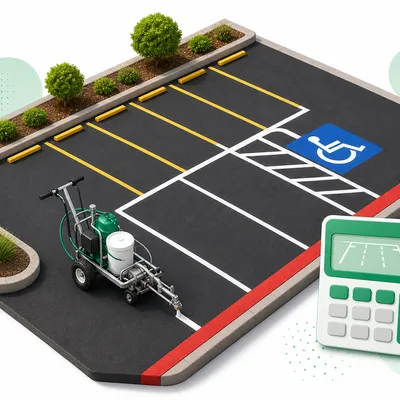
In the calculator, a car space costs $75 to mark and $290 for its sign on a post, $365 in all. A van space costs $95 to mark, $290 for the sign and $35 for the VAN ACCESSIBLE plaque, $420 in all. The Access Board's guide says accessible spaces must be identified by signs with the International Symbol of Accessibility, that signs must be at least 60 in high measured to the bottom edge, that van space signs include the term van accessible, and that a site with 4 or fewer spaces in total does not need a sign on its accessible space.
Slope is the item a paint crew cannot fix. Both ADA.gov and the Access Board say accessible spaces and aisles can be no steeper than 1:48 in any direction. If a space sits on a slope, it can be cheaper to move it to a level spot that is still on the shortest accessible route to the entrance than to regrade. No EstiCube calculator prices regrading, so get a paving quote for that work.
Curb ramps, detectable warnings and the accessible route
ADA.gov says accessible spaces must be on the shortest accessible route of travel to an accessible entrance, and that the route is at least 3 ft wide with a firm, stable, slip-resistant surface. Where that route crosses a curb, the Access Board's guide says ramps and curb ramps are required to span changes in level greater than 1/2 in, with a running slope of 1:12 at most and a cross slope of 1:48 at most. A built-up curb ramp needs a top landing at least 36 in deep and cannot project into parking spaces, access aisles or vehicle traffic lanes, and curb ramps cannot protrude into access aisles.
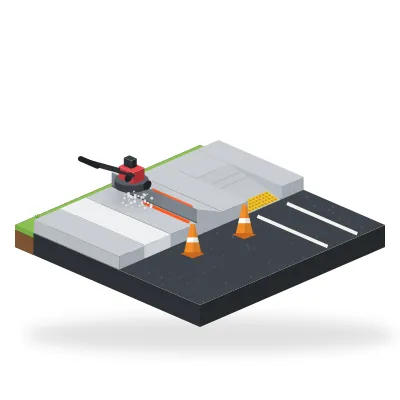
In the calculator a new curb ramp cut into the curb and sidewalk is $2,500 and a retrofit of an existing ramp is $1,200. One new ramp on its own, with mobilization, comes to $3,000. If the entrance sits above the lot, a route ramp is a bigger job: the Access Board's guide says ramp runs need a clear width of at least 36 in, a rise of no more than 30 in per run, level landings at the top and bottom of each run and handrails on both sides when the rise is greater than 6 in. The calculator prices a concrete route ramp with handrails at $450 per foot, so 12 ft is $5,400 and 20 ft is $9,000. Get a site-specific design before relying on that allowance.
Detectable warnings need care. According to the Access Board's guide, the 2010 Standards require them on curb ramps at transit facilities covered by DOT's standards, and they are not required at non-transit facilities subject to DOJ's standards. The same guide says DOT requires them on curb ramps in projects funded by the Federal Highway Administration, and that the Board's guidelines for public streets and sidewalks address them there. Local codes and project specifications may also ask for them. The calculator prices a panel at $350, so set the panel count from what your project actually requires.
Three upgrade scenarios on a 60-stall lot
A 60-stall lot needs 3 accessible spaces, one of them van accessible. The restripe-only fix marks those spaces and puts up their signs. Adding two ramps fixes the curb between the spaces and the walk, with a warning panel at each. The full upgrade adds a 12 ft route ramp to reach a raised entrance.
Each scenario can be trimmed. Rebuilding two existing ramps instead of cutting new ones takes the middle scenario to $4,750, and leaving out the panels where they are not required takes it to $6,650. Marking the three spaces without signs adds up to $745, so the $750 minimum job sets that price; pair it with other work rather than calling a crew out for it alone.
| Line | Restripe-only fix | Add two ramps | Full upgrade with route ramp |
|---|---|---|---|
| Curb ramps, new, 2 | - | $5,000 | $5,000 |
| Detectable warning panels, 2 | - | $700 | $700 |
| Car space markings, 2 | $150 | $150 | $150 |
| Van space marking, 1 | $95 | $95 | $95 |
| Signs on posts, 3 | $870 | $870 | $870 |
| VAN ACCESSIBLE plaque, 1 | $35 | $35 | $35 |
| Route ramp, 12 ft | - | - | $5,400 |
| Mobilization | $500 | $500 | $500 |
| Total | $1,650 | $7,350 | $12,750 |
How the cost changes with lot size
A bigger lot needs more accessible spaces, but the ramps and the route ramp do not change with it. So the restripe-only fix grows with the lot while the ramp-heavy scenarios grow only by the cost of the extra spaces and signs. The table keeps the same two ramps, two panels and 12 ft route ramp at every size.
| Lot size | Accessible spaces (van) | Restripe-only fix | Add two ramps | Full upgrade |
|---|---|---|---|---|
| 20 stalls | 1 (1) | $920 | $6,620 | $12,020 |
| 60 stalls | 3 (1) | $1,650 | $7,350 | $12,750 |
| 100 stalls | 4 (1) | $2,015 | $7,715 | $13,115 |
| 200 stalls | 6 (1) | $2,745 | $8,445 | $13,845 |
| 300 stalls | 7 (2) | $3,165 | $8,865 | $14,265 |
When the work is required
ADA.gov states that when a business or a state or local government restripes a parking lot, it must provide accessible parking spaces as required by the 2010 ADA Standards, and that businesses have a continuing obligation to remove barriers to access in existing parking facilities. It adds that because restriping is relatively inexpensive, it is readily achievable in most cases.
The Access Board's guide says accessible spaces are required where parking facilities are altered or added, and that resurfacing or resealing and projects that add new parking spaces are alterations. It treats normal maintenance, such as repainting the existing striping for a few spaces, as generally not an alteration unless it affects the facility's usability. Either way, a resurfacing, sealcoat or restripe project is the cheapest time to fix the lot, because the crew and the traffic control are already there.
This is general information, not legal advice. Your state or city may add requirements beyond the federal standards, and ADA.gov notes that state or local laws may address the color and manner of marking spaces and aisles. Confirm what applies to your lot with an ADA specialist, your local code office or an attorney.
Run your numbers with the ADA Parking & Curb Ramp Cost Calculator
Change any unit price to match your quote and see every line item add up. It is free, needs no sign-up and works on your phone.
Open the ADA upgrades calculatorFrequently asked questions
How much does it cost to make a parking lot ADA compliant?
On a 60-stall lot, the EstiCube calculator gives $1,650 to mark and sign the 3 accessible spaces, $7,350 with two new curb ramps and two warning panels, and $12,750 with a 12 ft route ramp as well. The real figure depends on what your lot is missing, so walk the checklist first.
How much does an ADA curb ramp cost?
The calculator uses $2,500 for a new ramp cut into the curb and sidewalk and $1,200 for a retrofit of an existing ramp. One new ramp on its own, with $500 of mobilization, comes to $3,000, and a warning panel adds $350 where one is required.
Are detectable warnings required on curb ramps in a private parking lot?
The Access Board's guide says the 2010 ADA Standards require detectable warnings on curb ramps at transit facilities covered by DOT's standards, and that they are not required at non-transit facilities subject to DOJ's standards. DOT requires them in projects funded by the Federal Highway Administration, and local codes or project specifications may ask for them, so check before you leave them out.
Does resurfacing or restriping a lot trigger ADA upgrades?
ADA.gov states that when a business or a state or local government restripes a lot, it must provide accessible spaces under the 2010 Standards. The Access Board's guide treats resurfacing or resealing as an alteration, while normal maintenance, such as repainting existing striping for a few spaces, generally is not. This is general information, not legal advice.
What slope is allowed in an accessible parking space?
ADA.gov and the Access Board both say accessible spaces and their access aisles can be no steeper than 1:48 in any direction. A curb ramp can have a running slope of up to 1:12 and a cross slope of up to 1:48.
Sources
- ADA Compliance Brief: Restriping Parking Spaces (restriping duty, route, slope, signs) — ADA.gov (U.S. Department of Justice)
- Chapter 5: Parking Spaces (signs, aisles, slope, alterations) — U.S. Access Board
- Chapter 4: Ramps and Curb Ramps (slopes, landings, handrails, detectable warnings) — U.S. Access Board
More guides