Warehouse floor marking requirements: what OSHA says, aisle colors and cost
Updated
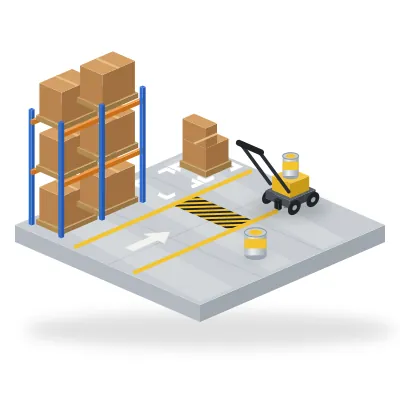
Warehouse floor lines mark aisles, forklift lanes, work cells and pallet positions. Before you price them, it helps to know which parts are required and which are a choice. OSHA requires permanent aisles to be marked where mechanical handling equipment is used, but it does not say what color or how wide the lines must be. This guide quotes the rule, sets out what it leaves open, shows one vendor's color scheme, and then prices the lines by material with the EstiCube warehouse floor striping calculator.
This is general information, not legal advice. Check the current text of the rules and talk to a safety professional about your own site. The prices are national planning estimates from the calculator, not a quote.
What OSHA requires
The marking requirement is in 29 CFR 1910.176, Handling materials - general. Paragraph (a), headed “Use of mechanical equipment,” reads in full: “Where mechanical handling equipment is used, sufficient safe clearances shall be allowed for aisles, at loading docks, through doorways and wherever turns or passage must be made. Aisles and passageways shall be kept clear and in good repair, with no obstruction across or in aisles that could create a hazard. Permanent aisles and passageways shall be appropriately marked.”
Three things follow from the text. The paragraph opens with a condition, “Where mechanical handling equipment is used,” so it is written for workplaces that use that equipment. The marking sentence covers permanent aisles and passageways. And it says “appropriately marked” without defining it, so the rule itself sets no color, width, material or line pattern.
Marking is one of three duties in the paragraph. The other two are sufficient safe clearances and aisles kept clear and in good repair, with no obstruction that could create a hazard, and lines alone do not cover either.
What OSHA does not set: colors and widths
On color and width, the most specific OSHA text is an old letter of interpretation dated May 15, 1972, which cites 1910.22(b). It says the lines “may be any color so long as they clearly define the area considered as aisle space,” that they may be made of dots, squares, strips or continuous lines, and that recommended widths vary from 2 to 6 inches, so “any width 2 inches or more is considered acceptable.” It also gives a recommended aisle width of at least 3 feet wider than the largest equipment to be used, or a minimum of 4 feet. OSHA now keeps the letter in its archive with a notice that it “may no longer represent OSHA Policy,” so read it as history, not current guidance.
Two other OSHA rules are often cited next to floor marking, and neither is a floor marking rule:
- 29 CFR 1910.144, the safety color code for marking physical hazards, says in (a)(3) that yellow “shall be the basic color for designating caution and for marking physical hazards” such as striking against, stumbling, falling, tripping and caught in between. The section does not mention floors or aisles.
- 29 CFR 1910.36, on the design and construction of exit routes, says in (g)(2) that “An exit access must be at least 28 inches (71.1 cm) wide at all points.” That is a minimum width for the exit access, the part of an exit route that leads to an exit, not for a painted line, and 1910.36 does not mention floor lines.
A common color convention
Because the rule names no colors, facilities pick their own scheme. The table below is one vendor's recommendation: Brady, a maker of floor marking tape, publishes it in its floor marking guide. Brady itself says there are “no current government-mandated or even widely accepted industry standards” for which colors to use, and it notes that the 1910.144 color code is not designed to guide floor marking colors. Our reading is that the scheme is common practice, not law.
Brady also advises using as few colors as possible, so staff can remember what each one means. The calculator has no color input, because its prices do not depend on color.
| Color | What Brady recommends it marks |
|---|---|
| Yellow | Aisle ways, traffic lanes and work cells |
| White | Equipment and fixtures not otherwise color coded, such as workstations, carts and racks |
| Blue, green or black | Materials and components: raw materials, work in progress and finished goods |
| Orange | Materials or products held for inspection |
| Red | Defects, scrap, rework and red tag areas |
| Red and white stripes | Areas kept clear for safety or compliance, such as in front of electrical panels and firefighting equipment |
| Black and white stripes | Areas kept clear for operational reasons |
| Yellow and black stripes | Areas that may expose employees to physical or health hazards |
| Photoluminescent | Steps and perimeter lines that show egress routes in a lights-out emergency |
Floor marking cost by material
The table prices two jobs at the calculator's default prices: 2,000 LF and 10,000 LF of 4 in line, each with a new layout, a cleaned line path and 10 symbols. Grinding a 6 in strip under each line is offered for epoxy and polyurea only; it adds $1,250 to the 2,000 LF job and $6,250 to the 10,000 LF job. The cost per linear foot is the whole job divided by the feet of line.
At the default prices, for these two jobs, floor paint is the lowest, then tape, then epoxy, then polyurea. Tape has the highest material price of the four ($1.10 per LF of 4 in line) and the lowest labor price ($0.40 per LF), while paint is $0.15 of material and $1.00 of labor, so on the 2,000 LF job tape's material is $2,200 against $300 for paint, and its labor $800 against $2,000. The cost per foot falls as the job grows because the $450 mobilization and the 10 symbols are spread over more line.
A restripe over existing lines has no layout line, and turning cleaning off removes that line too. With both, the 2,000 LF epoxy job comes to $5,000 and the 10,000 LF epoxy job to $21,000. Small jobs work the other way: 200 LF of 4 in epoxy line with no symbols adds up to $920 and is billed at the $1,000 minimum. The $1,000 minimum is a floor that sets the price only when the job adds up to less.
Every unit price in the calculator is a planning estimate except the epoxy material price, which comes from a retail listing. Replace them with contractor quotes in the calculator's pricing section.
| Material (4 in line) | 2,000 LF | 2,000 LF, ground | 10,000 LF | 10,000 LF, ground |
|---|---|---|---|---|
| Industrial floor paint | $3,800 ($1.90 per LF) | Not offered | $15,800 ($1.58 per LF) | Not offered |
| Floor marking tape | $4,450 ($2.23 per LF) | Not offered | $19,250 ($1.93 per LF) | Not offered |
| Epoxy line paint | $5,700 ($2.85 per LF) | $6,950 ($3.48 per LF) | $24,500 ($2.45 per LF) | $30,750 ($3.08 per LF) |
| Polyurea / polyaspartic | $6,800 ($3.40 per LF) | $8,050 ($4.03 per LF) | $29,600 ($2.96 per LF) | $35,850 ($3.59 per LF) |
How to measure a floor for a quote
The calculator asks for the linear feet of 2, 3, 4 and 6 in line, the number of symbols and the number of corner marks. Measure from a floor plan or with a measuring wheel, and keep each width separate. Material is priced per foot of 4 in line and scales with width, so a 6 in line uses 1.5 times the material of a 4 in line, while labor is the same per foot whatever the width.
Here is an example warehouse, worked through with those inputs. Ten aisles of 200 ft with a line on each side are 4,000 LF. Two cross aisles of 120 ft, also with two lines each, add 480 LF, for 4,480 LF of 4 in line. Arrows and stop symbols at the crossings come to 20 symbols. Sixty pallet positions marked with an L at each of their four corners are 240 corner marks, and fewer where neighboring positions share a mark. In epoxy, with a new layout and a cleaned line path, that job comes to $14,238, or $3.18 per LF, at the default prices: $896 of layout, $672 of cleaning, $2,240 of line material, $6,720 of application labor, $1,100 for the symbols, $2,160 for the corner marks and $450 of mobilization.
The same floor costs $9,310 in floor paint, $10,538 in tape and $17,158 in polyurea. Without the corner marks the epoxy job is $12,078, so decide early whether pallet positions get full outlines, corner marks or nothing.
- Count a line shared by two neighboring aisles once, not once per aisle.
- Measure each width on its own and enter it in its own field.
- Count every symbol and stencil you want placed, such as arrows, footprints, stop and forklift shapes.
- Choose a restripe instead of a new layout when you are going over existing lines.
Run your numbers with the Warehouse Floor Striping Cost Calculator
Change any unit price to match your quote and see every line item add up. It is free, needs no sign-up and works on your phone.
Open the Floor striping calculatorFrequently asked questions
Does OSHA require floor marking in a warehouse?
29 CFR 1910.176(a) says “Permanent aisles and passageways shall be appropriately marked.” The paragraph is headed “Use of mechanical equipment” and opens with “Where mechanical handling equipment is used.” It sets no color, width or material. This is general information, not legal advice.
What color should warehouse aisle lines be?
OSHA's aisle-marking rule names no color. An archived 1972 OSHA letter said aisle lines may be any color that clearly defines the aisle space. Yellow for aisle ways and traffic lanes is a common convention, recommended for example by Brady, which says no government-mandated or widely accepted color standard exists.
How wide do aisle marking lines have to be?
The current rule sets no width. An OSHA letter of interpretation from May 15, 1972 said any width of 2 inches or more is acceptable, but OSHA has archived it and says it may no longer represent OSHA policy. The calculator prices 2, 3, 4 and 6 in lines; material cost scales with width and labor does not.
Does OSHA require yellow floor lines?
Not for aisles. 29 CFR 1910.144(a)(3) makes yellow the basic color for designating caution and marking physical hazards such as tripping, but the section does not mention floors or aisles, and the aisle-marking rule in 1910.176(a) names no color.
How much does warehouse floor marking cost per linear foot?
At the calculator's default prices, 2,000 LF of 4 in line with a new layout, cleaning and 10 symbols is $1.90 per LF in floor paint, $2.23 in tape, $2.85 in epoxy and $3.40 in polyurea. At 10,000 LF the same job is $1.58, $1.93, $2.45 and $2.96 per LF. These are planning estimates, so replace them with quotes.
Is floor tape cheaper than paint?
Not on the two jobs priced here. At the default prices, 2,000 LF of 4 in line with a new layout, cleaning and 10 symbols is $3,800 in floor paint and $4,450 in tape, and 10,000 LF is $15,800 against $19,250. Tape's material costs more and its labor less, so enter your own quotes to compare.
Sources
- 29 CFR 1910.176, Handling materials - general (paragraph (a), use of mechanical equipment) — Occupational Safety and Health Administration
- Compliance with Aisle Markings (Part 1910.22(b)), letter of interpretation, May 15, 1972 (archived) — Occupational Safety and Health Administration
- 29 CFR 1910.144, Safety color code for marking physical hazards — Occupational Safety and Health Administration
- 29 CFR 1910.36, Design and construction requirements for exit routes (paragraph (g)(2), exit access width) — Occupational Safety and Health Administration
- Floor Marking Guide (color convention and the absence of a mandated color standard) — Brady (bradyid.com)
More guides