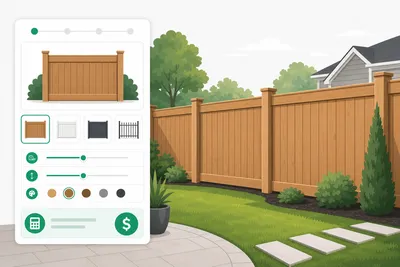
Fence contractors usually quote by the linear foot, because most of the work and material follows the length of the run. The per-foot number on a quote, though, is a blend: a material rate, a labor rate, the posts and concrete, and any gates, divided by the length. This guide takes that number apart using the rates in the EstiCube fence calculator, then shows what typical yard sizes cost in each material.
All figures are national planning numbers, not a quote. Prices vary with your area, your soil and the fence style, so use the examples to understand how an estimate is built, then enter your own rates in the calculator.
How a fence quote is built
The calculator prices a fence with four lines. Material is a rate per linear foot for the chosen material, which covers the posts, rails and pickets or panels. Labor is a second rate per linear foot. Each gate is $150. Post concrete is 1.5 bags of 80-pound mix per post at $6 a bag. The material and labor rates are set for a 6-foot fence and scale with height.
The default job is 150 feet of 6-foot wood privacy fence with one gate and posts every 8 feet. That is 19 sections, so 20 posts along the run plus two for the gate, or 22 posts and 33 bags of concrete. The calculator also lists 57 rails and 328 pickets as a takeoff, but those are inside the per-foot material rate rather than priced one by one.
| Line | Cost |
|---|---|
| Material: 150 ft x $18 | $2,700 |
| Gate: 1 x $150 | $150 |
| Concrete: 33 bags x $6 | $198 |
| Labor: 150 ft x $12 | $1,800 |
| Total ($32 per foot) | $4,848 |
Fence cost per foot by material
The table runs the same job, 150 feet at 6 feet tall with one gate and 8-foot post spacing, in each of the five materials in the calculator. The gate and concrete are the same $348 in every row, so the difference between rows comes from the material and labor rates.
Chain link and aluminum are often built lower than 6 feet. At 4 feet with one gate, 150 feet of chain link is $2,348 (about $16 per foot) and aluminum is $5,148 (about $34 per foot). A 4-foot wood picket fence of the same length is $2,748, about $18 per foot.
| Material (6 ft) | Material rate | Labor rate | Total, 150 ft | Per foot |
|---|---|---|---|---|
| Chain link | $12/ft | $8/ft | $3,348 | $22 |
| Wood picket | $14/ft | $10/ft | $3,948 | $26 |
| Wood privacy | $18/ft | $12/ft | $4,848 | $32 |
| Vinyl | $28/ft | $14/ft | $6,648 | $44 |
| Aluminum | $32/ft | $16/ft | $7,548 | $50 |
Worked examples for 100, 150 and 200 feet
These are common backyard lengths, each with one gate and 8-foot post spacing except chain link, which uses 10-foot spacing as many chain link fences do. A 100-foot wood privacy run needs 16 posts and 24 bags of concrete; a 200-foot run needs 28 posts and 42 bags.
The cost per foot falls slightly on longer runs because the gate is spread over more feet, but the total is driven by length. If the run grows to 200 feet with two gates, wood privacy is $6,570 and vinyl is $8,970.
| Fence | 100 ft | 150 ft | 200 ft |
|---|---|---|---|
| Wood privacy, 6 ft | $3,294 ($33/ft) | $4,848 ($32/ft) | $6,402 ($32/ft) |
| Vinyl, 6 ft | $4,494 ($45/ft) | $6,648 ($44/ft) | $8,802 ($44/ft) |
| Wood picket, 4 ft | $1,894 ($19/ft) | $2,748 ($18/ft) | $3,602 ($18/ft) |
| Chain link, 4 ft, 10 ft spacing | $1,600 ($16/ft) | $2,312 ($15/ft) | $3,024 ($15/ft) |
What changes the price
Height has the biggest effect after length and material. The calculator multiplies the material and labor rates by the height divided by 6, so a 4-foot fence is two thirds of the 6-foot rate and an 8-foot fence is a third more. The gate and concrete lines do not change with height. On 150 feet of wood privacy with one gate, that gives the totals below.
Gates add $168 each: the $150 gate plus three bags of concrete for its two posts. The default run is $4,680 with no gate and $5,184 with three. Post spacing matters less than you might expect, because the posts themselves are part of the per-foot material rate and only the concrete changes. At 6-foot spacing the default job needs 28 posts and is $4,902; at 10 feet it needs 18 posts and is $4,812.
Several things that often appear on real quotes are not modeled in the calculator, so they can explain why a quote comes in higher:
- Tearing out and hauling away an old fence.
- Permits, HOA review and a property survey.
- Sloped ground, where panels are stepped or racked to follow the grade.
- Rocky or hard soil that slows post digging.
- Extra corner and end posts on a layout with many short sides.
- Wide drive gates or upgraded hardware. The $150 gate is a basic walk gate, and you can change it in the calculator's pricing section.
| Height (wood privacy, 150 ft) | Total | Per foot |
|---|---|---|
| 4 ft | $3,348 | $22 |
| 5 ft | $4,098 | $27 |
| 6 ft | $4,848 | $32 |
| 8 ft | $6,348 | $42 |
Materials versus labor
The calculator shows materials and labor as separate lines. On the default job, materials (including the gate and concrete) are $3,048 and labor is $1,800, so labor is a little over a third of the total. For vinyl the split is $4,548 and $2,100, and for chain link at 6 feet it is $2,148 and $1,200.
That split is useful in two ways. If you plan to build the fence yourself, the materials line is a rough starting budget, before tools, delivery and waste. If you are comparing contractors, a quote whose labor share is far from these proportions is worth a question about what the crew is including.
Reading a contractor quote
A fence quote you can check shows the length it assumed, the height and material, the number of gates and posts, and what site work is included. With those numbers you can enter the same job in the calculator and see where a quote is above or below it. If a quote is a single total, ask for the breakdown.
The FTC's guidance on home improvement work says a written estimate should describe the work, the materials, the completion date and the price, and advises against automatically choosing the lowest bid. It also suggests getting a written contract with the contractor's license number and start and completion dates, not paying the full amount up front, and holding the final payment until the work is done. Posts go in the ground, and the 811 site lists installing fences among the projects that call for contacting 811 a few business days before digging, whatever the depth. Ask who will request the locate.
- Linear feet, height and material, with the style named.
- Number of gates, their width and hardware.
- Post count, spacing and how posts are set.
- Whether removal of an old fence, haul-away and permits are included.
- Start and completion dates, payment schedule and warranty.
Run your numbers with the Fence Calculator
Change any unit price to match your quote and see every line item add up. It is free, needs no sign-up and works on your phone.
Open the Fence calculatorFrequently asked questions
How much does a fence cost per foot?
In the EstiCube fence calculator, a 6-foot fence is $30 per foot for wood privacy, $24 for wood picket, $42 for vinyl, $20 for chain link and $48 for aluminum, material and labor combined, before gates and concrete. With one gate on a 150-foot run, that becomes about $32, $26, $44, $22 and $50 per foot. These are national planning numbers; local quotes may differ.
How much does a 150-foot fence cost?
With one gate and 6-foot height, the calculator gives $4,848 for wood privacy, $6,648 for vinyl and $3,348 for chain link. A 4-foot wood picket fence of the same length is $2,748.
How many posts does a 150-foot fence need?
At 8-foot spacing the calculator counts 19 sections, 20 posts along the run and two more for one gate, so 22 posts and 33 bags of concrete. A layout with many corners or short sides can need a few more.
Does the estimate include removing my old fence?
No. The calculator prices new material, labor, gates and post concrete only. Tear-out, haul-away, permits and surveys are separate, so ask whether each quote includes them before you compare totals.
Do I need to call 811 before installing a fence?
The 811 site lists installing fences among the projects that call for contacting 811 a few business days before you dig, regardless of depth. Ask your contractor whether the locate has been requested before the posts go in.
Sources
- How To Avoid a Home Improvement Scam — Federal Trade Commission
- 811 Before You Dig — Common Ground Alliance
More guides