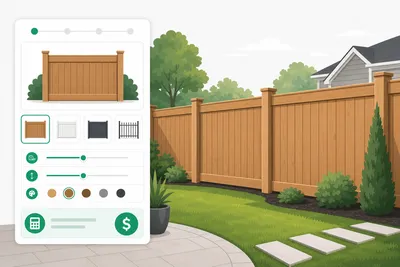
Wood and vinyl are the two usual choices for a backyard privacy fence, and the first question is usually how much more vinyl costs. The answer depends on the length and height of the run, and the upfront price is only part of the comparison, because a wood fence needs upkeep that vinyl does not. This guide compares the two on the same job using the EstiCube fence calculator, then looks at the costs the calculator leaves out.
All figures are national planning numbers, not a quote. Use them to see how the gap between materials is built, then enter your own length, height and local rates in the calculator.
The same fence in wood and vinyl
The table prices 150 feet of 6-foot privacy fence with one gate and posts every 8 feet. Both versions need the same 22 posts and 33 bags of concrete, and the calculator charges the same $150 gate in each, so the $348 for the gate and concrete is identical. Everything else comes from the per-foot rates.
Vinyl's material rate is $28 per foot against $18 for wood privacy, and its labor rate is $14 against $12. That $12 per foot over 150 feet is the whole $1,800 difference. In cost per foot, the wood fence is about $32 and the vinyl fence about $44.
| Line | Wood privacy | Vinyl |
|---|---|---|
| Material rate | $18/ft | $28/ft |
| Labor rate | $12/ft | $14/ft |
| Materials, gate and concrete | $3,048 | $4,548 |
| Labor | $1,800 | $2,100 |
| Total, 150 ft | $4,848 | $6,648 |
| Per foot | $32 | $44 |
How the gap changes with length and height
Because the difference is a per-foot amount, it scales with the run. At 6 feet tall it is $1,200 on a 100-foot fence and $2,400 on a 200-foot fence. The calculator scales both rates with height, so at 4 feet the gap is two thirds as large, or $8 per foot.
For a privacy fence, 6 feet is the common backyard height, so the first three rows are the relevant ones for most privacy fence comparisons. A 4-foot fence is more typical of a front yard or a pet enclosure.
| Run (one gate) | Wood privacy | Vinyl | Difference |
|---|---|---|---|
| 100 ft, 6 ft tall | $3,294 | $4,494 | $1,200 |
| 150 ft, 6 ft tall | $4,848 | $6,648 | $1,800 |
| 200 ft, 6 ft tall | $6,402 | $8,802 | $2,400 |
| 100 ft, 4 ft tall | $2,294 | $3,094 | $800 |
| 150 ft, 4 ft tall | $3,348 | $4,548 | $1,200 |
| 200 ft, 4 ft tall | $4,402 | $6,002 | $1,600 |
Upkeep and post life for wood
The main argument for vinyl is upkeep. A wood fence is usually stained, sealed or painted after it is built and refinished from time to time, while vinyl is not stained. How often wood needs refinishing depends on the product, the sun and the climate, so ask the contractor or the finish manufacturer for a recoat interval rather than relying on a rule of thumb. The calculator does not price any finishing.
The posts are the part of a wood fence that sits in the ground, where rot starts. A University of Kentucky extension publication on fence posts says untreated posts or posts that have only been dip-treated are unsuitable for long-term use, and that properly treated and installed pine posts can last 20 to 35 years against 3 to 7 years for untreated pine. It also says the installation method affects how long a post lasts.
The same publication points to two installation details: if the top of a treated post is cut, the cut end should be re-treated with a wood preservative, and freshly treated posts should be allowed to air-dry for a few months before painting so water is not trapped under the paint. Its examples are farm fences, but the same questions apply to a backyard fence.
- Are the posts pressure-treated for ground contact, and is that on the tag?
- Will cut post tops be re-treated?
- Is a first coat of stain or sealer included, and when should it go on?
- For vinyl, what does the manufacturer warranty cover, and for how long?
Where chain link and aluminum fit
If privacy is not the goal, two other materials are in the calculator. Chain link is the lowest-cost option: on the same 150-foot run with one gate it is $3,348 at 6 feet and $2,348 at 4 feet. Aluminum is the highest: $7,548 at 6 feet and $5,148 at 4 feet. A 4-foot wood picket fence sits between them at $2,748.
Chain link and aluminum are open designs, so they mark a boundary or contain pets without blocking the view. In the calculator, aluminum costs more than vinyl at the same height and length, so it is usually chosen for appearance rather than price.
| Material, 150 ft, one gate | 4 ft tall | 6 ft tall |
|---|---|---|
| Chain link | $2,348 | $3,348 |
| Wood picket | $2,748 | $3,948 |
| Wood privacy | $3,348 | $4,848 |
| Vinyl | $4,548 | $6,648 |
| Aluminum | $5,148 | $7,548 |
When each makes sense
These are general planning considerations, not rules. The right answer depends on how long you will keep the fence and how much upkeep you are willing to do or pay for.
Whichever material you choose, get the comparison in writing. The FTC's home improvement guidance says a written estimate should describe the work, the materials, the completion date and the price, and advises against automatically choosing the lowest bid. Asking two contractors to quote the same run in both wood and vinyl gives you a like-for-like gap to compare with the calculator. Both materials go on posts set in the ground, and the 811 site lists installing fences among the projects that call for contacting 811 a few business days before digging.
- Wood privacy: the lower upfront cost for a solid fence, and boards can be replaced one at a time, but plan for finishing and post quality.
- Vinyl: a higher upfront cost for a fence that is not stained, which can pay off if you would otherwise pay for regular refinishing.
- Chain link: the lowest cost for a boundary or pet fence when privacy does not matter.
- Aluminum: an open, decorative fence at the highest cost in the calculator.
Run your numbers with the Fence Calculator
Change any unit price to match your quote and see every line item add up. It is free, needs no sign-up and works on your phone.
Open the Fence calculatorFrequently asked questions
How much more does a vinyl fence cost than wood?
In the EstiCube fence calculator, vinyl is $12 per linear foot more than wood privacy at 6 feet tall. On 150 feet with one gate that is $6,648 against $4,848, a difference of $1,800. These are national planning numbers; your quotes may differ.
How much does a 6-foot vinyl privacy fence cost?
With one gate and 8-foot post spacing, the calculator gives $4,494 for 100 feet, $6,648 for 150 feet and $8,802 for 200 feet, or about $44 to $45 per foot.
How much does a 6-foot wood privacy fence cost?
With one gate, the calculator gives $3,294 for 100 feet, $4,848 for 150 feet and $6,402 for 200 feet, or about $32 to $33 per foot. Staining or sealing is not included.
Is vinyl cheaper than wood in the long run?
It depends on what wood upkeep costs you. The vinyl premium on 150 feet of 6-foot fence is $1,800 in the calculator. Compare that with real quotes for staining and likely repairs over the years you expect to keep the fence.
How long do wood fence posts last?
A University of Kentucky extension publication says properly treated and installed pine fence posts can last 20 to 35 years, while untreated pine posts might last only 3 to 7 years, and that the installation method affects post life.
Sources
- Installing Wood Posts for Greatest Longevity in Farm or Paddock Fencing (FORFS 03-05) — University of Kentucky Cooperative Extension Service
- How To Avoid a Home Improvement Scam — Federal Trade Commission
- 811 Before You Dig — Common Ground Alliance
More guides