Well drillers quote a rate per foot, but that rate is only part of what a new well costs. Casing, the pump system, a permit, a water test and mobilization all come on top, and they are mostly fixed amounts rather than per-foot charges. This guide separates the drilling rate from the all-in cost per foot and shows how each moves, using the unit prices in the EstiCube well pump calculator.
All figures are national planning numbers, not a quote. Depth, rock and local requirements vary, so use the examples to understand a quote, then enter your own prices in the calculator.
The drilling rate versus the all-in cost per foot
The calculator has two per-foot figures. The drilling rate is what the driller charges for each foot bored. The all-in cost per foot is the total job divided by the depth, so it includes everything else. The default new well is 250 feet in mixed soil and rock with 80 feet of steel casing, and it totals $16,520. Divided by 250 feet, that is about $66 per foot, against a drilling rate of $45.
| Line | Cost |
|---|---|
| Drilling: 250 ft x $45 | $11,250 |
| Steel casing: 80 ft x $14 | $1,120 |
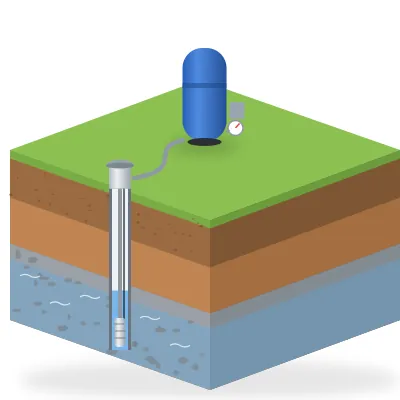
| Pump, pressure tank and wiring | $2,800 |
| Well permit | $450 |
| Water quality test | $250 |
| Mobilization | $650 |
| Total | $16,520 |
How geology changes the rate
The calculator sets the drilling rate by ground type: $30 per foot in sand and gravel, $45 in mixed soil and rock, and $60 in hard bedrock. On the default 250-foot, 80-foot-casing well, that makes the total $12,770, $16,520 or $20,270. The all-in cost per foot is about $51, $66 and $81.
Your driller knows the ground in your area better than a calculator does. If you do not know your geology, ask what nearby wells have encountered, and ask how the quote changes if the driller hits harder rock than expected.
| Ground type | Drilling rate | Total (250 ft) | All-in per foot |
|---|---|---|---|
| Sand and gravel | $30 per ft | $12,770 | $51 |
| Mixed soil and rock | $45 per ft | $16,520 | $66 |
| Hard bedrock | $60 per ft | $20,270 | $81 |
Why deeper wells cost less per foot
Casing aside, the pump system, permit, water test and mobilization do not change with depth. That is about $4,150 on the default setup. Spread over a shallow well it is a large share of each foot, and spread over a deep one it is a small share. The table uses mixed ground and 80 feet of casing.
A deeper well still costs more in total. Going from 250 to 400 feet adds $6,750 of drilling. Do not read a falling per-foot figure as a cheaper well. It means the fixed costs are being shared over more feet.
| Drilled depth | Total | All-in per foot |
|---|---|---|
| 100 ft | $9,770 | $98 |
| 150 ft | $12,020 | $80 |
| 250 ft (default) | $16,520 | $66 |
| 400 ft | $23,270 | $58 |
| 500 ft | $27,770 | $56 |
Casing and hydrofracturing
Steel casing is $14 per foot in the calculator, and the amount you need depends on how far down loose or unstable ground runs. On the default 250-foot well, 40 feet of casing gives a total of $15,960 and 120 feet gives $17,080, against $16,520 at 80 feet. Casing cannot exceed the drilled depth, and the calculator caps it there.
Hydrofracturing is an optional $2,500 in the calculator. It takes the default well to $19,020, or about $76 per foot. Ask your driller whether it is likely to be needed on your site and what it is expected to do, rather than adding it by default.
A worked example you can reproduce
Take a 400-foot well in hard bedrock with 100 feet of casing and hydrofracturing. Drilling is 400 x $60 = $24,000, casing is $1,400, the pump system is $2,800, the permit is $450, the water test is $250, hydrofracturing is $2,500 and mobilization is $650. The total is $32,050, or about $80 per foot.
To reproduce it, choose new well drilling, set the depth to 400 feet and the casing to 100 feet, pick hard bedrock and tick hydrofracturing. A smaller well in easy ground sits at the other end: 150 feet in sand and gravel with 60 feet of casing is $9,490, about $63 per foot.
Permits, water testing and finding a contractor
The calculator includes a $450 permit and a $250 water quality test. Permit requirements and fees vary by location, so ask your driller what applies where you live. The EPA says private well owners are responsible for delivering safe drinking water to their households, and that this water is not regulated by the federal government under the Safe Drinking Water Act, so a test of a new well is worth planning for.
The National Ground Water Association's site links to WellOwner.org, which includes a way to find a contractor, and lists contractor certification and state licensing resources. Compare quotes line by line:
- The drilling rate per foot and the estimated depth.
- How much casing is included and at what rate.
- Whether the pump, tank and wiring are in the price.
- Permit, water test and mobilization, and what happens if the depth changes.
Run your numbers with the Well Pump Replacement & Well Drilling Cost Calculator
Change any unit price to match your quote and see every line item add up. It is free, needs no sign-up and works on your phone.
Open the Well pump calculatorFrequently asked questions
How much does well drilling cost per foot?
In this calculator the drilling rate is $30, $45 or $60 per foot depending on the ground. The default 250-foot well in mixed ground is $16,520 all in, about $66 per foot. Your local quote may differ.
Why is the all-in cost per foot higher than the drilling rate?
The total includes casing, the pump system, a permit, a water test and mobilization. On the default well that is $4,150 of fixed costs plus $1,120 of casing on top of the $11,250 of drilling.
Why does a deeper well cost less per foot?
The fixed costs are spread over more feet. A 100-foot well is about $98 per foot all in and a 500-foot well is about $56, although the 500-foot well costs $27,770 against $9,770.
What does hydrofracturing add?
It is an optional $2,500 in the calculator, which takes the default well from $16,520 to $19,020. Ask your driller whether it is likely to be needed for your site.
Do I need to test the water from a new well?
The EPA says private well owners are responsible for delivering safe drinking water to their households. The calculator includes a $250 water quality test, and a lab or your local health department can tell you which tests suit your area.
Sources
- Private Drinking Water Wells — U.S. Environmental Protection Agency
- National Ground Water Association — NGWA
More guides