A well pump replacement is a short list of parts and a block of labor: the pump, the work of pulling the old one and setting the new one, a pressure switch, a trip charge, and sometimes a pressure tank, wire and drop pipe. The price moves mostly with the pump type, its horsepower and how deep the well is. This guide walks through each driver using the unit prices in the EstiCube well pump calculator.
All figures are national planning numbers, not a quote. A well contractor will diagnose the problem and size the pump to your well and household, so use these to understand a quote, then enter your own prices in the calculator.
The default replacement and its parts
The calculator starts from a 1 HP submersible pump in a 200-foot well, with a new pressure switch and no tank, wire or pipe. The total is $2,170. Pulling and setting a submersible pump is $500 plus $2.50 per foot of well depth, so 200 feet is $1,000, which makes labor the biggest line.
| Line | Cost |
|---|---|
| 1 HP submersible pump | $900 |
| Pull and set labor: $500 + 200 ft x $2.50 | $1,000 |
| Pressure switch | $120 |
| Trip charge | $150 |
| Total | $2,170 |
Pump size and pump type
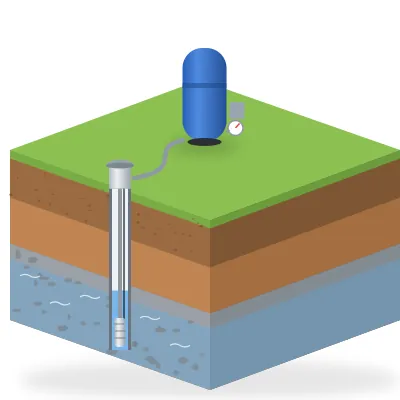
A submersible pump sits down in the well, and the calculator prices the pump itself from $650 at 1/2 HP to $1,500 at 2 HP. Because the labor and switch do not change, the total ranges from $1,920 to $2,770 across that range on the default 200-foot well.
A jet pump sits above ground, so there is no pulling and setting. The calculator replaces that labor with a flat $350 jet installation. A 1 HP jet pump is $550 and the default jet job is $1,170. A 2 HP jet pump comes to $1,520. Sizing depends on your well and household, so let your contractor choose the horsepower rather than picking the cheapest one.
| Horsepower | Submersible total | Jet total |
|---|---|---|
| 1/2 HP | $1,920 | $1,020 |
| 3/4 HP | $2,020 | $1,070 |
| 1 HP (default) | $2,170 | $1,170 |
| 1.5 HP | $2,520 | $1,370 |
| 2 HP | $2,770 | $1,520 |
How well depth changes the price
For a submersible pump, depth sets the pull-and-set labor and the cost of any wire and drop pipe you replace. On the default 1 HP pump, a 100-foot well is $1,920, a 200-foot well is $2,170 and a 400-foot well is $2,670. If you also replace the pump wire at $1.20 per foot and the drop pipe at $1.80 per foot, those totals become $2,220, $2,770 and $3,870.
That is why the wire and pipe are worth asking about. On a deep well they are a larger share of the job, and they are easier to replace while the pump is already out of the hole.
| Well depth | Pump only | With new wire and pipe |
|---|---|---|
| 100 ft | $1,920 | $2,220 |
| 200 ft | $2,170 | $2,770 |
| 400 ft | $2,670 | $3,870 |
Pressure tank and other add-ons
A pressure tank is an optional $650 in the calculator. Added to the default job it brings the total to $2,820. With the tank, new wire and new pipe on a 200-foot well, it is $3,420. A service call outside normal hours is an extra $250, which makes that job $3,670.
Not every replacement needs a tank, and the calculator leaves it off by default. Ask your contractor whether the existing tank is sound or is part of the problem, and which parts are being replaced and why.
A worked example you can reproduce
Take a 400-foot well with a 1.5 HP submersible pump, new wire and pipe, and a new pressure tank. The calculator lines are the $1,250 pump, $1,500 pull-and-set ($500 plus 400 feet at $2.50), $480 of wire, $720 of pipe, $650 for the tank, $120 for the switch and $150 trip charge, for $4,870.
To reproduce it, choose pump replacement, a submersible pump and 1.5 HP, set the depth to 400 feet and tick the tank, wire and pipe options. The pressure switch is on by default.
Quotes, contractors and water safety
The EPA says private well owners are responsible for delivering safe drinking water to their households, and that private well water is not regulated by the federal government under the Safe Drinking Water Act. A pump failure is a good moment to ask your contractor about the well itself, and to ask a lab or your local health department about testing your water.
The National Ground Water Association's site links to WellOwner.org, a resource for well owners that includes a way to find a contractor. Get more than one quote and ask each to show what is replaced:
- Pump type and horsepower, and why that size.
- Whether wire, drop pipe, switch and tank are included.
- Whether the price depends on well depth and what depth it assumes.
- Trip charge and any after-hours charge.
Run your numbers with the Well Pump Replacement & Well Drilling Cost Calculator
Change any unit price to match your quote and see every line item add up. It is free, needs no sign-up and works on your phone.
Open the Well pump calculatorFrequently asked questions
How much does it cost to replace a well pump?
In this calculator the default job, a 1 HP submersible pump in a 200-foot well with a new pressure switch, is $2,170. A jet pump above ground is $1,170. A pressure tank, new wire and pipe, and deeper wells raise the total. Your local quote may differ.
Why does well depth change the cost?
A submersible pump has to be pulled and set at depth, so the calculator charges $500 plus $2.50 per foot, and wire and pipe are priced per foot. A 400-foot well costs $500 more than a 200-foot well on the same pump.
Do I need a new pressure tank with a new pump?
Not always. The calculator leaves the $650 tank off by default. Ask your contractor to check the existing tank and the pressure switch and to say what they recommend and why.
Is a jet pump cheaper than a submersible?
In this calculator, yes: a 1 HP jet job is $1,170 against $2,170 for a 1 HP submersible. A jet pump sits above ground, so there is no pulling and setting. Whether it suits your well is for your contractor to say.
Who is responsible for the safety of my well water?
The EPA says private well owners are responsible for delivering safe drinking water to their households. Ask a lab or your local health department about testing, especially if the pump is being replaced or the water has changed.
Sources
- Private Drinking Water Wells — U.S. Environmental Protection Agency
- National Ground Water Association — NGWA
More guides