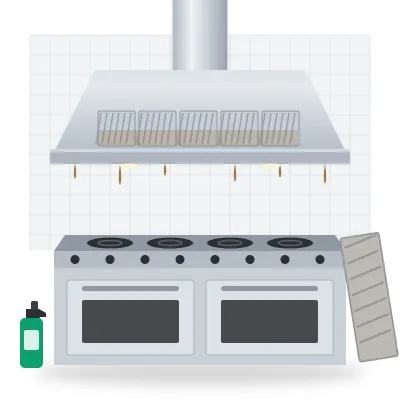
Most restaurant owners know their exhaust system needs regular cleaning. Fewer know where the schedule comes from. NFPA 96, the national standard for ventilation control and fire protection of commercial cooking operations, links the cleaning frequency to the kind of cooking you do. This guide explains the four frequency tiers, who decides which one applies to you and what the schedule means for your budget.
This is a planning guide, not code advice. The standard is adopted and enforced locally, so confirm the schedule for your kitchen with the people who inspect it.
What NFPA 96 covers
NFPA 96 is published by the National Fire Protection Association and addresses the exhaust system over commercial cooking equipment: the hood, the ducts, the exhaust fan and the fire protection around them. Grease builds up in these parts as you cook, and the standard sets how often that build-up has to be inspected and removed.
The standard does not apply itself. Local fire and building codes adopt it, sometimes with changes, so the authority having jurisdiction decides what rule applies in your kitchen. For the exact wording, see the standard itself on the NFPA page listed in the sources below.
The four-tier inspection and cleaning schedule
The baseline inspection and cleaning schedule depends on the cooking. In the EstiCube calculator each tier becomes a number of visits a year, and the calculator labels high-volume cooking as fryers, griddles and charbroilers. The annual cost column uses the default kitchen: one 12 ft hood, 20 ft of duct and one floor at $491 per visit.
| Type of cooking | Cleaning schedule | Visits per year | Annual cost at $491 per visit |
|---|---|---|---|
| Solid-fuel cooking (wood or charcoal) | Monthly | 12 | $5,892 |
| High-volume cooking (24-hour operations, charbroiling, wok cooking; the calculator lists fryers, griddles and charbroilers) | Quarterly | 4 | $1,964 |
| Moderate-volume cooking | Semiannual | 2 | $982 |
| Low-volume cooking (seasonal businesses, churches, day camps, senior centers) | Annual | 1 | $491 |
Working out which tier applies to you
The tiers are descriptions of how a kitchen is used, not labels you choose. A pizzeria with a wood-fired oven and a senior center that cooks a few meals a week sit at opposite ends. Questions that help you place your kitchen:
- Do you cook with wood or charcoal? That is the most frequent tier.
- Does the kitchen run around the clock, or use charbroilers or woks? Those point to quarterly cleaning.
- Is the cooking steady but not heavy, or is it limited to a season or a few days a week? Those point to the lower tiers.
Who can require a stricter schedule
The tiers are a baseline, not a ceiling. The authority having jurisdiction, such as your fire marshal or building department, can require more frequent cleaning than the baseline for your cooking type. So can your insurer, whose policy conditions may set a schedule of their own.
Grease build-up found at an inspection is a separate trigger. If an inspector finds more build-up than the schedule assumed, you may be asked to clean sooner. A kitchen that mixes several cooking types is a question for your authority having jurisdiction and your contractor to settle; the calculator does not decide it.
Records inspectors and insurers may ask for
Staying on schedule is one thing and being able to show it is another. Ask each cleaning to leave you with documentation, and keep it where you can find it:
- The date of each cleaning and the name of the company.
- A report describing what was cleaned and anything the crew could not reach.
- A service sticker on the hood, if your contractor provides one.
- Notes on any repairs or access problems the crew flagged, such as a fan that cannot be opened for cleaning.
Planning the cleaning calendar
A schedule only works if the visits actually happen. A kitchen that cleans quarterly needs four dates a year, and those dates have to fit around service hours, deliveries and any seasonal closures. Agree the dates with your contractor in advance rather than waiting for the build-up to remind you.
Seasonal operations are a good example of why the tiers exist. A camp kitchen or a church hall that is used for only part of the year sits in the low-volume tier because it cooks so little, but the exhaust system still needs a cleaning on the schedule that applies to it. Ask your authority having jurisdiction how a seasonal kitchen should time its cleaning.
- Put every cleaning date in a shared calendar with a reminder ahead of it.
- Ask your contractor whether they schedule repeat visits for you.
- Tell your insurer if your cooking changes, for example by adding a charbroiler or a fryer line, because that may change the tier.
What the schedule means for your budget
Because every visit costs the same, the tier drives the annual budget. The default kitchen costs $491 once a year, $982 twice, $1,964 quarterly and $5,892 monthly. If you are told your kitchen needs quarterly rather than semiannual cleaning, the annual cost doubles from $982 to $1,964. This guide only touches on cost; see the cost guide for what goes into a single visit.
To test a different schedule, use the Cleaning frequency selector in the calculator. Choose Semiannual for moderate-volume cooking, then switch it to Quarterly to see the doubled figure. Use the cooking type setting to see what the automatic schedule gives for each tier.
Adding a filter exchange to the default kitchen takes the visit from $491 to $603. At the four tiers the annual cost then becomes $7,236 for solid-fuel cooking, $2,412 for high volume, $1,206 for moderate volume and $603 for low volume. To reproduce this, switch on the filter exchange and change the cooking type with the frequency left on automatic.
Run your numbers with the Commercial Kitchen Hood Cleaning Cost Calculator
Change any unit price to match your quote and see every line item add up. It is free, needs no sign-up and works on your phone.
Open the Hood cleaning calculatorFrequently asked questions
How often does a commercial kitchen hood need to be cleaned?
NFPA 96 ties the schedule to the type of cooking: monthly for solid-fuel cooking, quarterly for high-volume cooking, semiannual for moderate volume and annual for low volume. Confirm your schedule with your authority having jurisdiction, because it can require more.
What counts as high-volume cooking?
High volume covers cooking such as 24-hour operations, charbroiling and wok cooking. The calculator uses quarterly cleaning, 4 visits a year, for this tier. Ask your fire marshal or contractor which tier applies to you.
Who decides which cleaning schedule I follow?
The authority having jurisdiction, usually the fire marshal or building department, decides how NFPA 96 applies to your kitchen. Your insurer can also require a stricter schedule than the baseline for your cooking type.
Can I clean less often than the standard says?
Not on the strength of a calculator. The automatic frequency is a planning starting point. Ask the authority having jurisdiction and your insurer before changing a schedule.
How do I see what a different schedule costs?
Set Cleaning frequency in the hood cleaning calculator to Monthly, Quarterly, Semiannual or Annual instead of Automatic. The annual cost updates because it is the per-visit price times the number of visits.
Sources
- NFPA 96: Standard for Ventilation Control and Fire Protection of Commercial Cooking Operations — National Fire Protection Association
- International Kitchen Exhaust Cleaning Association — IKECA
More guides