Fire lane striping requirements: what the fire code asks for and what it costs
Updated
Fire lanes are the part of a parking lot that the fire department, not the owner, gets to define. The model fire code says a fire lane has to be marked when the fire code official requires it and has to stay legible, and then leaves the details to the local jurisdiction. That is why fire lane striping looks different from one city to the next.
This guide quotes the International Fire Code text, compares the published fire lane standards of three fire departments, and shows how to price fire lane curb and stripe work in the EstiCube striping calculator. It is general information, not a code interpretation. Before you mark or repaint a fire lane, get the current standard from your local fire code official.
What the International Fire Code says
The International Fire Code (IFC) is a model code. Whether it applies, which edition and with what amendments depends on what your state or city has adopted, so check the local fire code. Section 503.3 of the 2024 IFC reads, in part, that where required by the fire code official, approved signs or other approved notices or markings that include the words NO PARKING—FIRE LANE shall be provided for fire apparatus access roads to identify such roads or prohibit their obstruction.
The same section adds a maintenance duty: the means by which fire lanes are designated must be kept in a clean and legible condition at all times, and replaced or repaired when necessary to provide adequate visibility. Faded fire lane paint is a code issue, not only a cosmetic one.
Two neighboring sections explain why the markings matter. Section 503.4 says fire apparatus access roads shall not be obstructed in any manner, including the parking of vehicles. Section 503.2.1 sets a minimum unobstructed width of 20 feet and a vertical clearance of 13 feet 6 inches, and the fire code official can require or permit changes to those widths.
The local fire code official sets the details
The IFC names the words but not the paint. Color, stripe width, letter height, the exact wording and how often it repeats are set by the local fire code official, usually in a fire department standard or a city code section. Some jurisdictions also tie fire lanes to state law. Santa Clara County Fire in California, for example, has fire lanes marked under section 22500.1 of the California Vehicle Code as well as its own standard.
Designation comes first. Santa Clara County Fire's standard says fire apparatus access roads, driveways and access ways shall not be marked as fire lanes without first obtaining fire department approval, and the Camas-Washougal Fire Department asks for a plan showing all fire lanes and sign locations before any new fire lane is marked. Stafford, Texas, has the fire marshal verify and approve fire lanes before a certificate of occupancy is issued.
Three local standards compared
These three published standards show how much the details vary. They are examples, not a national rule, and each department can change its standard.
Santa Clara County Fire (California) accepts any one of three methods, or what the fire code official specifies. Red curbs carry the words FIRE LANE in white on the top and side, at intervals of no more than 30 feet, in 3-inch letters. A painted roadway outlines or paints the fire lane in red with FIRE LANE in white at least every 50 feet, in letters at least 24 inches high. Signs are 12 by 18 inch reflective metal, no more than 50 feet apart.
The Stafford Fire Marshal's Office (Texas) wants a red stripe from the roadway to the back of the curb, with 4-inch white letters reading FIRE LANE NO PARKING TOW-AWAY ZONE about every 20 feet along the whole fire lane. Where there is no curb, the stripe is 6 inches wide and red with the same 4-inch lettering. Signs are added if the markings do not control parking.
The Camas-Washougal Fire Department (Washington) calls for red curbs with white lettering at least 4 inches high reading NO PARKING FIRE LANE every 50 feet. Without a curb, the stenciling goes on the pavement in white block letters at least 10 inches high, and a fire lane outlined on the roadway may be yellow, red or white with contrasting FIRE LANE lettering every 50 feet. Signs are reflective, at least 12 by 18 inches, with red letters on white, no more than 75 feet apart.
| Department | Curb marking | Lettering | Repeat interval |
|---|---|---|---|
| Santa Clara County Fire, CA | Red curb, top and side | FIRE LANE, white, 3 in | 30 ft max on curbs |
| Stafford Fire Marshal, TX | Red stripe, roadway to back of curb | FIRE LANE NO PARKING TOW-AWAY ZONE, white, 4 in | About 20 ft |
| Camas-Washougal Fire, WA | Red curb | NO PARKING FIRE LANE, white, 4 in min | 50 ft |
Pricing fire lane striping in the calculator
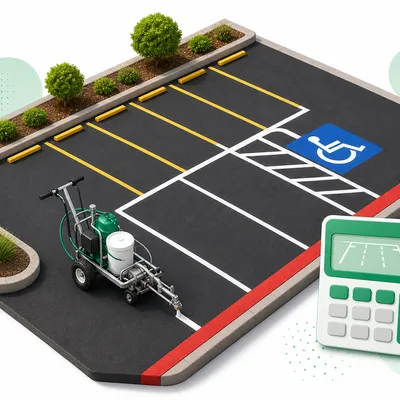
Enter the length of the fire lane in feet. The calculator counts each foot as 1.5 feet of standard 4-inch line, to allow for a stripe about 6 inches wide, and prices it with the red and blue paint rate, which is 35% higher in material than white or yellow. If your local standard has you paint the curb itself, face and top, use the separate Painted curb field instead. It counts each foot of curb as 3 feet of stripe, about 6 inches of face plus about 6 inches of top, and uses the same red and blue paint rate, always at the water-based price even if the job is oil-based or thermoplastic. The tables below assume no painted curb.
Lettering is not a separate line in the striping calculator. Count the stencils from the local repeat interval, one per interval along the length: a 300-foot fire lane takes 6 stencils at 50-foot intervals (300 divided by 50) or 15 at 20-foot intervals (300 divided by 20), plus one more if the standard wants lettering at both ends. Add them in Contractor bid mode as an extra line item at your own per-stencil price. Fire lane signs are not in the striping calculator either.
As an example, take the default 50-stall restripe with its 120-foot fire lane and add 200 feet of painted curb. That is 600 feet of extra stripe in red, yellow or blue paint, and the calculator total goes from $1,455 to $1,661, an increase of $206. Without the fire lane stripe, the same 200 feet of curb takes the total from $1,394 to $1,600. Curb lettering stencils are not included.
On the calculator's default 50-stall restripe in water-based paint, the fire lane changes the total like this:
| Fire lane on a 50-stall restripe | Stripe footage | Calculator total |
|---|---|---|
| None | 0 LF | $1,394 |
| 120 feet (calculator default) | 180 LF | $1,455 |
| 220 feet | 330 LF | $1,507 |
| 400 feet | 600 LF | $1,600 |
Fire lane repaints on their own
Fire departments can call for a faded fire lane to be repainted between restripes, and Stafford's standard says the owner must repair or repaint it on notice. A fire-lane-only job still carries the $325 mobilization and the $475 restripe minimum, so short runs cost far more per foot. The table prices fire lane only, with no stalls, in water-based paint.
A 100-foot touch-up adds up to $435 and the calculator raises it to the $475 minimum. With the default Contractor bid markup of 10% overhead and 20% profit, the 300-foot job becomes a $710.16 bid before any lettering is added. Folding the fire lane into a restripe is much cheaper: in the calculator, 100 feet added to a 50-stall restripe costs $51, against $475 on its own.
| Fire lane only, water-based | Calculator total | Per foot of fire lane |
|---|---|---|
| 100 feet | $475 (minimum) | $4.75 |
| 200 feet | $487 | $2.44 |
| 300 feet | $538 | $1.79 |
| 500 feet | $641 | $1.28 |
Run your numbers with the Parking Lot Line Striping Calculator
Change any unit price to match your quote and see every line item add up. It is free, needs no sign-up and works on your phone.
Open the Striping calculatorFrequently asked questions
What color does a fire lane have to be?
The International Fire Code does not set a color; the local fire code official does. Red with white lettering is common in the three standards in this guide, but Camas-Washougal also allows a roadway outline in yellow, red or white. Ask your fire department for its current standard.
What words must a fire lane marking include?
IFC section 503.3 calls for signs, notices or markings that include the words NO PARKING—FIRE LANE where the fire code official requires them. Local standards add their own wording, such as FIRE LANE NO PARKING TOW-AWAY ZONE in Stafford, Texas.
How far apart do fire lane stencils go?
It depends on the jurisdiction. In the standards compared here, the lettering repeats about every 20 feet in Stafford, Texas, at most every 30 feet on curbs in Santa Clara County, California, and every 50 feet in Camas-Washougal, Washington.
Can a property owner mark a fire lane without approval?
Not safely. Fire lanes are designated by the fire department, and Santa Clara County Fire's standard says access roads must not be marked as fire lanes without first obtaining fire department approval. Get the designation and the marking standard before painting.
How much does fire lane striping cost?
In the EstiCube striping calculator, adding 100 feet of fire lane to a 50-stall restripe adds $51 in water-based paint. On its own, a 300-foot fire lane repaint is $538 and a 100-foot touch-up hits the $475 minimum. Lettering stencils and signs are extra.
Sources
- 2024 International Fire Code, Chapter 5: Fire Service Features — International Code Council
- Standard Details and Specifications A-6: Fire Lane Marking — Santa Clara County Fire Department
- Fire Lane Markings Requirements Packet — City of Stafford, Texas, Fire Marshal's Office
- Informational Bulletin: Fire Lanes — Camas-Washougal Fire Department
More guides